
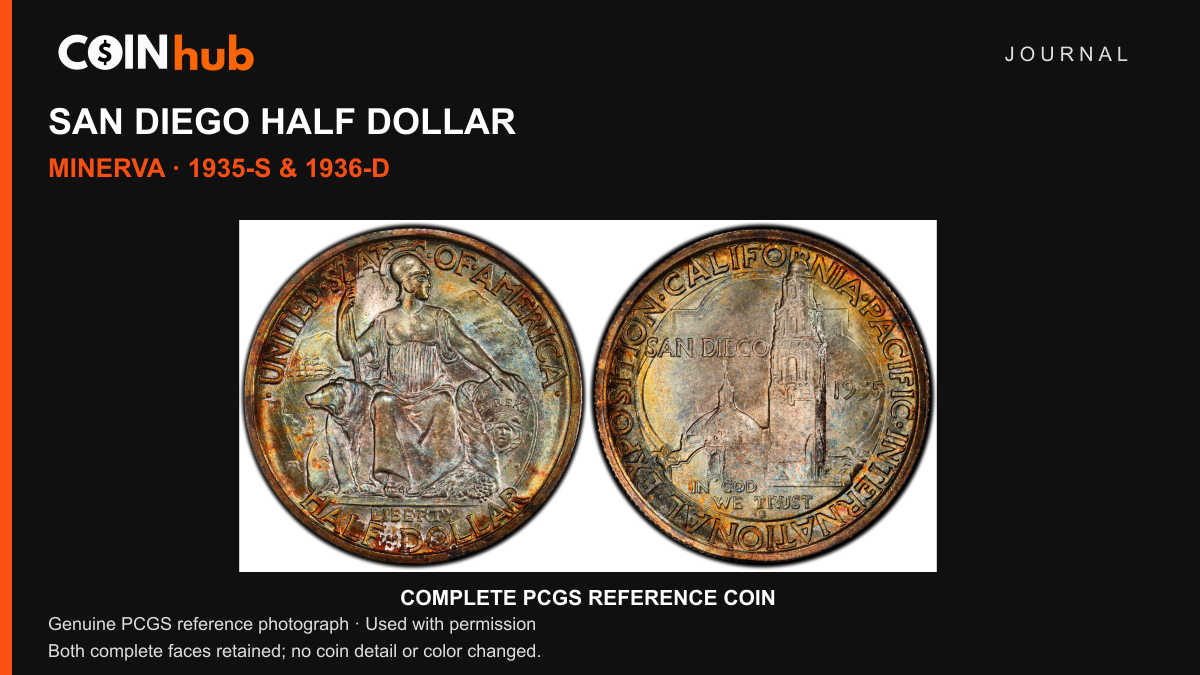
The San Diego half dollar shows Minerva with a bear and shield on one face, and a tower and chapel on the other. The classic issue has two date-and-mint pairs: 1935-S and 1936-D. The photograph here is a genuine 1935-S reference coin, not a picture of both years.
Read the scene, then the date and small mint letter. That order helps separate this exposition coin from a modern replica, a cropped listing image or another half dollar with a seated figure.
The helmet identifies Minerva
The obverse, or front, has a helmeted woman seated toward the viewer's left. A bear sits near her feet, and her shield carries EUREKA. Smaller background details include a ship and a miner. HALF DOLLAR names the denomination along the lower edge.
The American Numismatic Association identifies the woman as Minerva and connects the scene to California's state seal. Its guide is 1935-1936 California-Pacific Exposition (San Diego) Half Dollar (https://www.money.org/
Use the complete face rather than the helmet alone. A small crop can hide the denomination and the supporting design. The photo preserves the coin's full rim, so you can follow the words around the scene.
The tower side supplies the date
The reverse, or back, shows the tall California Tower beside the lower Chapel of St. Francis. SAN DIEGO appears above the chapel, with 1935 to the right of the tower on this specimen. The exposition's name curves around the edge.
The official design record is San Diego California-Pacific Exposition Half Dollar (https://www.usmint.gov/
Now look below IN GOD WE TRUST for the small mint mark. It is easy to miss at listing size. On the pictured coin, the date and letter combine as 1935-S...keep those two clues together in your notes.
Two years, two mint letters
| Issue | Mint | Photo check |
|---|---|---|
| 1935-S | San Francisco | The reference coin pictured in this guide. |
| 1936-D | Denver | A separate dated issue; check its own date and D. |
PCGS catalogs the first as 1935-S 50C San Diego (Regular Strike) (https://www.pcgs.com/
Both belong to the same commemorative design. Commemorative means made to mark an event; it does not mean every coin offered under that name is genuine. A seller's title should agree with the actual date, letter and design shown.
Save the whole comparison
Keep photographs of both complete faces and a close-up of the date and mint mark. If a holder is present, save its label too. The grade attached to the PCGS reference belongs to that specimen, not to another coin that shares its design.
Identify the issue before comparing prices. An old issue price, a current asking price and a completed sale are different evidence. Condition and surface problems still matter, so avoid polishing a coin to make it resemble a bright reference image.
Photograph notes
The genuine PCGS reference pair is used with permission. Both complete faces retain their original detail and color; CoinHub added the surrounding labels and layout. This is a guide to reading the design and date pair, not an authentication or grade finding for your coin.