
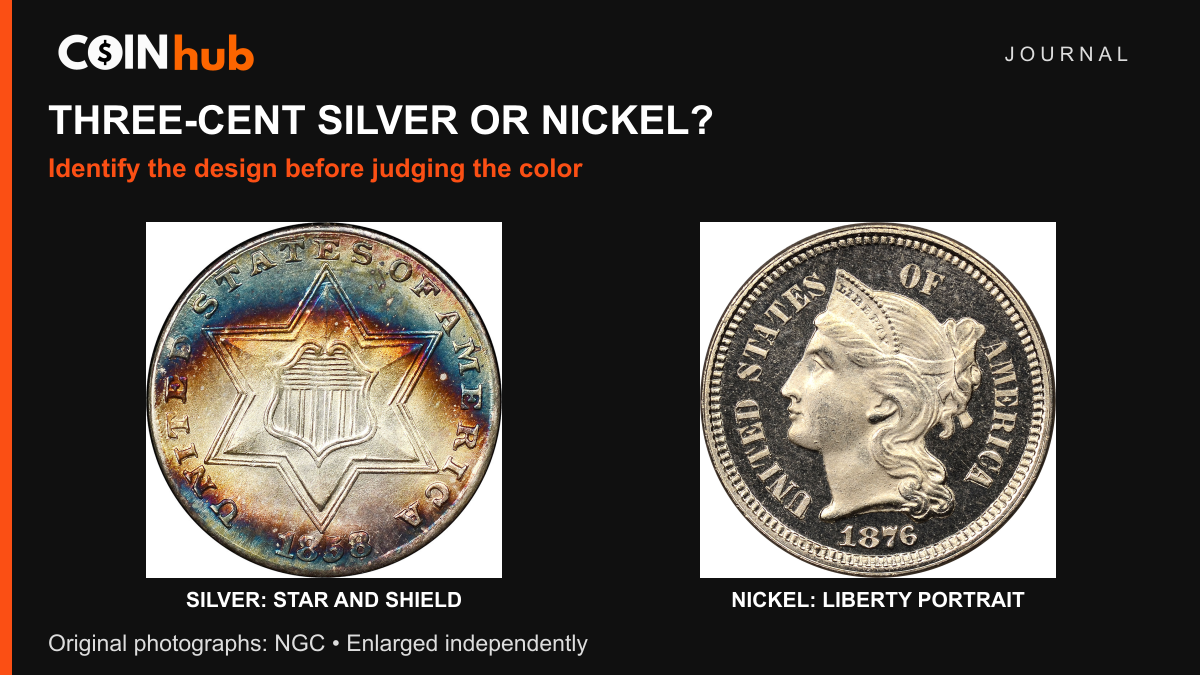
Start with the picture on the coin
These are two different coin designs with the same face value. “Nickel” in the second name describes an alloy, not a five-cent denomination. A three-cent nickel is still a three-cent coin. Both series can look silver-colored, and their production dates overlap, making a design check more useful than a quick guess from color or age.
Read the two faces together
In the photographs above, the 1858 silver example has a shield centered on a star. The 1876 nickel example shows a portrait wearing a coronet. The photographs are independently enlarged for detail; they do not represent the coins’ relative physical sizes.
Turn a silver three-cent piece over and look for III inside an ornate C-shaped border, with stars around the outside. On the nickel version, a wreath surrounds III. NGC’s nickel-series reference documents this portrait-and-wreath design. Compare both sides of the same coin before attaching a label to it.
| Check | Three-cent silver | Three-cent nickel |
|---|---|---|
| Front design | Star with central shield | Liberty’s head facing left |
| Back design | III within ornate C-shaped device | III within wreath |
| Series dates | 1851–1873 | 1865–1889 |
| General size relationship | Smaller and much lighter | Larger and heavier |
The silver alloy changes at 1854
The first silver three-cent issues, dated 1851–1853, used 75% silver and 25% copper and had a nominal weight of 0.80 gram. Beginning with the 1854-dated coins, the alloy became 90% silver and 10% copper while nominal weight fell to 0.75 gram. The change therefore increased fineness while reducing total coin weight. NGC’s silver-series history explains the transition and the associated design revisions.
Do not apply a single silver percentage to every trime, the familiar nickname for the silver three-cent piece. Also keep a law’s date separate from the dates on coins: the revised pieces appeared with 1854 dates. For a simple collection record, identify the series first, then use the readable date to select the appropriate specification.
What “nickel” means here
The three-cent nickel is 75% copper and 25% nickel. PCGS’s type-coin discussion lists a diameter of 17.9 millimeters; its CoinFacts specification record lists a nominal weight of 1.94 grams. Despite the large copper share, the normal alloy does not resemble an ordinary brown copper cent.
This is why a photograph’s apparent color is a weak sorting tool. Lighting, white balance, toning and the surrounding background can all change what a viewer sees. A written label saying “silver” is also just a claim until the coin’s identity supports it.
Why the date can leave two possibilities
The nickel series began in 1865 while the silver series continued through 1873. A date within that overlap does not settle which series is in front of you. Nor does it mean that both versions were made in the same quantities or by the same manufacturing method in every year. Read the design and then research the particular issue.
That order also prevents a common cataloging mistake: entering a three-cent nickel into a silver-coin inventory because of its appearance. Keep denomination, series, date and composition in separate fields rather than squeezing them into a vague description such as “old silver nickel.”
A useful record for a worn or uncertain coin
- Photograph the entire front and back without cleaning the coin.
- Write the visible design: star and shield, Liberty portrait, or unresolved.
- Transcribe only readable date digits. Mark missing digits as uncertain.
- If practical, record dimensions and weight, including the measuring equipment used.
- Compare the combined evidence with the correct series reference.
Measurements can support an identification, but a matching weight is not an authenticity certificate. Wear, damage, deposits, measurement error and counterfeits complicate the result. Avoid destructive tests or removing a coin from a certified holder merely to weigh it. If an expensive purchase depends on the answer, obtain a qualified examination.
Weakly struck details can also resemble wear, as NGC’s silver three-cent grading discussion notes. If the photograph does not show enough information, an unresolved record is more accurate than a confident guess. Our beginner’s collecting guide provides broader context for organizing the next steps.
Identify first; value the specific coin afterward
Separating these designs answers what kind of coin you have, not what someone will pay for it. Date, manufacture, condition and authenticity still matter. Save both-face images with your identification so that a later specialist can review the same evidence. A clear, limited conclusion is a stronger starting point than a metal guess attached to an auction price for a different specimen.
Sources and search results reviewed September 20, 2026. Specifications are nominal issue standards. No current price, grade or authenticity determination is assigned to a reader’s coin.