
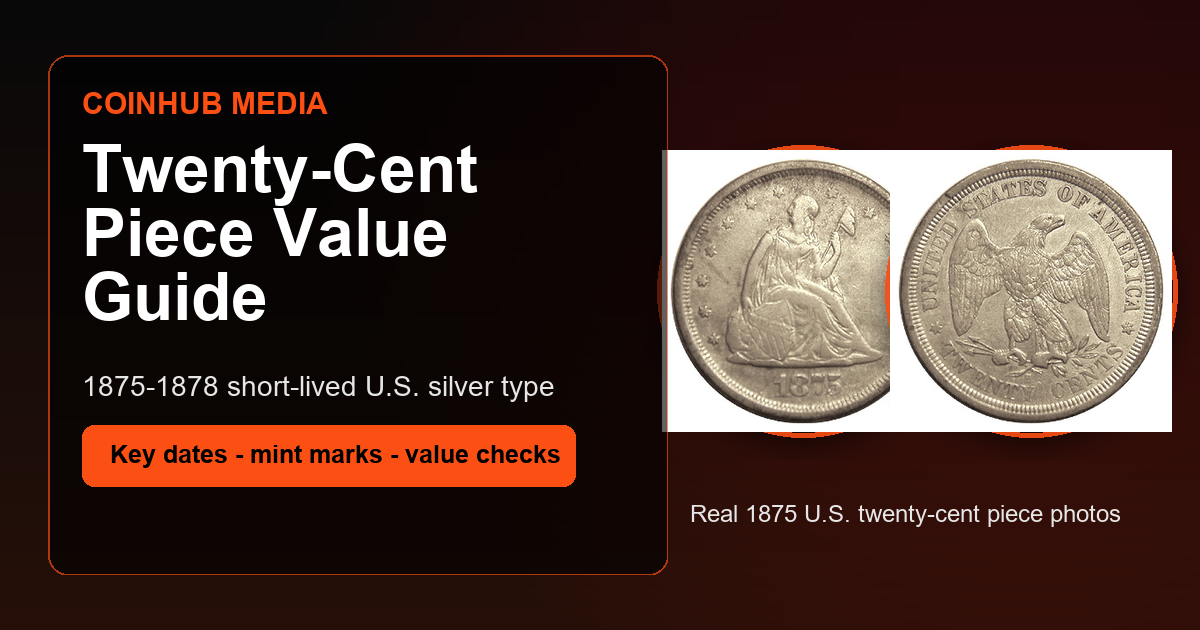
U.S. Twenty-Cent Piece Value: Start With the Date and Mint Mark
The twenty-cent piece is one of the strangest short-lived U.S. silver coins. It looks like a Seated Liberty quarter at a glance, but it has a plain edge, a different reverse, and a denomination that lasted only a few years. That combination makes it a useful coin to know if you are sorting an inherited collection or checking an old type set.
Twenty-Cent Piece Value by Date
Exact value depends on grade, surface quality, originality, and certification. The ranges below are practical collector-level ranges based on current public price-guide context and market behavior, not a guaranteed buy or sell offer.
| Date and mint | What to know | Typical collector-value context |
|---|---|---|
| 1875 Philadelphia | No mint mark. Lower mintage than 1875-S, but still collectible as a type coin. | Often hundreds of dollars in circulated grades; strong original Mint State coins can move into the thousands. |
| 1875-CC | Carson City issue with a CC mint mark below the eagle on the reverse. | Usually more valuable than common 1875-S examples; problem-free certified coins bring strong premiums. |
| 1875-S | San Francisco issue and usually the easiest twenty-cent piece to find. | The normal entry point for the type. Worn examples can still be valuable, while gem coins are much scarcer. |
| 1876 Philadelphia | Low-mintage second-year Philadelphia issue. | Scarcer than the common 1875-S and worth careful grading, especially with original surfaces. |
| 1876-CC | The key regular-strike rarity. PCGS lists a 10,000-piece mintage and very small survival estimate. | A major six-figure rarity in certified problem-free condition. Authentication is essential. |
| 1877 and 1878 proofs | Collector-only proof issues after circulation demand collapsed. | Specialist coins. Proof status, hairlines, toning, and certification drive value. |
Where Is the Mint Mark?
Look on the reverse below the eagle. A CC mint mark means Carson City, an S means San Francisco, and no mint mark means Philadelphia. This matters because an 1875-S and an 1876-CC are completely different value situations.
Why the Twenty-Cent Piece Failed
The coin was intended to help with small-change needs in the West, but it was too close to the quarter in size and appearance. The twenty-cent piece had a plain edge, but in quick everyday use it was easy to confuse with the Seated Liberty quarter. Demand faded quickly, and the denomination was abolished in 1878.
What Raises or Lowers Value?
How To Check One Before Selling
First, confirm that it says TWENTY CENTS on the reverse. Then check the date, flip to the reverse for the mint mark, and compare the edge to a quarter. The twenty-cent piece should have a plain edge, not a reeded edge. If the coin appears to be an 1876-CC, do not clean it, test it harshly, or sell it as a raw curiosity. Treat it as a coin that needs professional review.
If you are sorting a broader collection, compare this guide with CoinHub's silver melt calculator, coin grading services guide, and where to sell coins guide. A twenty-cent piece is not just a silver coin; the numismatic premium is usually the reason it matters.
Sources Checked
Research for this guide used PCGS CoinFacts for specifications, mintage, auction-record context, and rarity notes; the NGC U.S. Coin Price Guide for current public dealer-retail ranges; and Wikimedia Commons public-domain photos of an 1875 United States twenty-cent piece for the article image.