
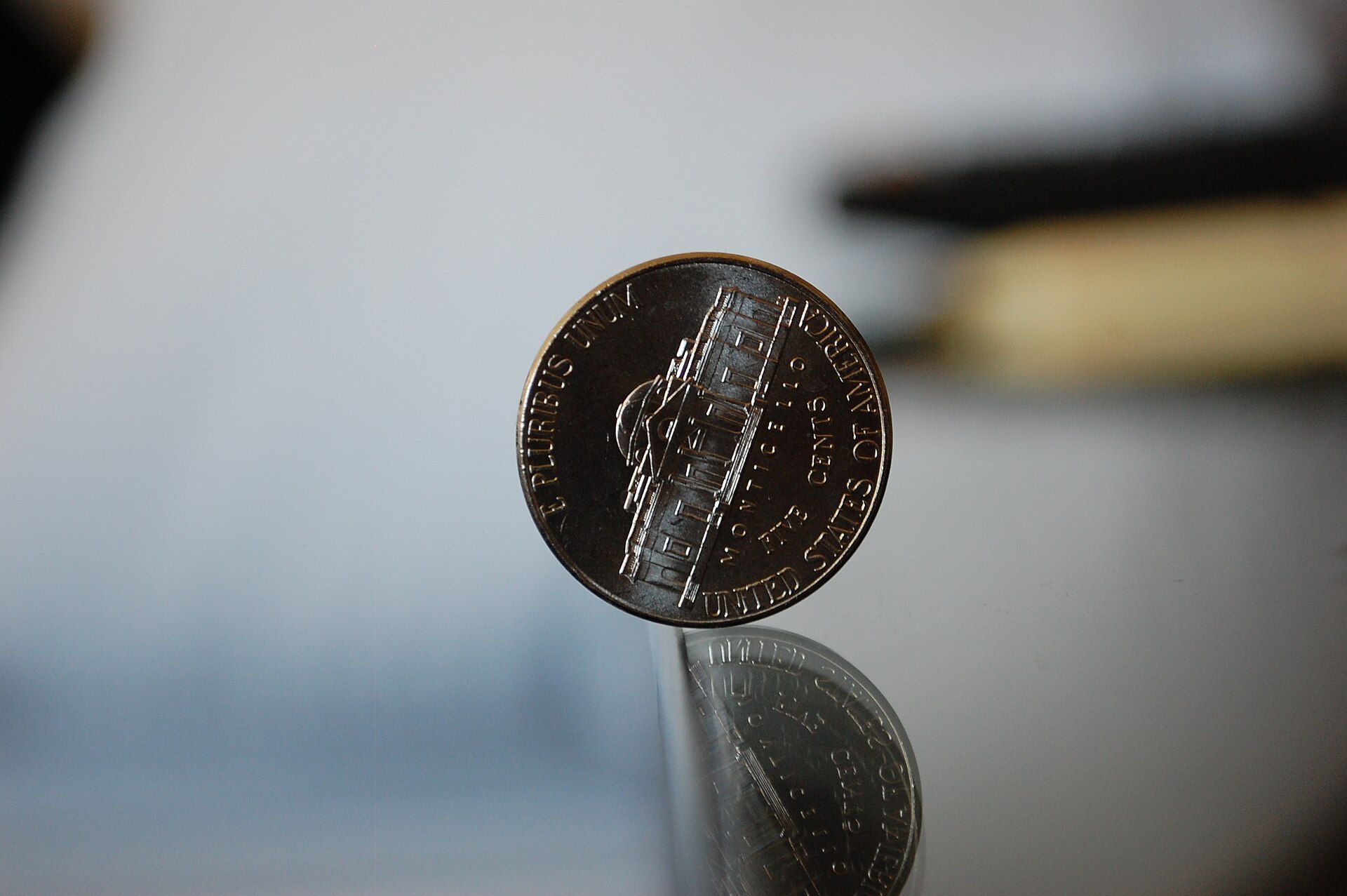
Quick answer: The U.S. nickel has not changed composition yet. The House of Representatives passed H.R. 3074, the Common Cents Act, on July 14, 2026. The House-passed bill would let the Treasury use a lower-cost five-cent coin with a zinc inner layer and nickel outer layer, but only after testing shows that it costs less and minimizes problems for coin-accepting machines. The bill still needs further action, and no production date for a redesigned-composition nickel has been announced.
The five-cent nickel may be the next familiar U.S. coin to get a major metal change. That possibility became more concrete in July when the House passed legislation giving the Treasury a path to make nickels with a zinc core and nickel outer layer.
That is important news, but it is not the same as the U.S. Mint announcing a new coin for circulation. The current Jefferson nickel is still made from the same 75% copper and 25% nickel alloy used during nearly all of the denomination's modern history. Before collectors start saving every nickel or labeling 2027 as a confirmed first year, it helps to separate what Congress approved from what the Mint has actually produced.
What the House-Passed Bill Actually Says
H.R. 3074 is broader than the nickel alone, but its five-cent provision is unusually specific. The House-passed text would allow the Treasury secretary to prescribe a nickel with an inner layer of zinc and an outer layer of nickel. The permitted weight range would be 4 to 6 grams; today's nickel weighs 5.00 grams.
The language is permissive. It says the Treasury may adopt the alternative, not that every nickel must immediately change. Before doing so, testing and evaluation must show two things: the coin would cost less to produce, and it would minimize adverse effects on machines designed to accept coins to the greatest extent practicable.
Congress.gov listed the bill as passed by the House, with the measure received in the Senate and referred to the Senate Committee on Banking, Housing, and Urban Affairs on July 15. That means the House vote moved the idea forward, but it did not finish the federal legislative process.
| Feature | Current 2026 Jefferson Nickel | Option in House-Passed H.R. 3074 |
|---|---|---|
| Composition | 25% nickel; balance copper | Inner layer of zinc; outer layer of nickel |
| Weight | 5.00 grams | Between 4 and 6 grams |
| Status | Current circulating specification | Permitted only if enacted and approved after testing |
| Design | Jefferson obverse, Monticello reverse, 1776 ~ 2026 dual date | The bill addresses composition and weight, not a replacement design |
| Release date | Already in 2026 production | No circulation date announced |
No, the Nickel Has Not Changed Yet
The distinction matters because the 2026 nickel already looks different in one visible way. As part of the United States Semiquincentennial, the date reads 1776 ~ 2026. That is a date treatment on the current Return to Monticello design, not evidence of a zinc-core coin.
The U.S. Mint's current specifications still list the 2026 five-cent piece at 5.00 grams and 21.21 millimeters, with a plain edge and a composition of 25% nickel and balance copper. Collectors can enjoy the dual-date issue without assuming its metal has changed.

Why Treasury and the Mint Are Studying Alternatives
The basic economic problem is easy to understand: the nickel costs more than five cents to manufacture and distribute. The U.S. Mint's fiscal 2025 annual report put the unit cost at 13.31 cents. It also marked the twentieth consecutive fiscal year in which both the cent and nickel cost more than face value to produce.
Even a modest reduction matters when hundreds of millions of nickels move through the Mint's annual production system. A cheaper alloy could reduce the gap between face value and production cost, but the metal cannot be selected on price alone. A five-cent coin must survive normal circulation, strike properly at high speed, resist corrosion, look and feel familiar, and work in existing machines.
The 2024 U.S. Mint Biennial Report to Congress shows that alternative-metals research was underway before the latest House vote. Among the materials discussed were an 80/20 copper-nickel alloy and manganese-bearing C99750 alternatives. Those studies are useful context, but they should not be confused with a finished zinc-core specification. The bill's zinc-and-nickel authority and the Mint's wider research program are related parts of the cost problem, not proof that one exact production formula has been selected.
Why Vending-Machine Testing Is a Big Deal
A coin can match the nickel's diameter and still fail in the real world. Modern validators may evaluate weight, dimensions, conductivity, and an electromagnetic signature before accepting a coin. Change the metal layers, and the signal seen by that equipment can change too.
That is why the House-passed language explicitly calls for minimizing adverse effects on coin-accepting machines. A lower-cost coin that forced widespread validator replacements could move costs from the Mint to vending, transit, laundry, amusement, and other cash-handling businesses. The testing requirement is meant to find a practical balance.
Collectors should also expect testing to influence the final weight and layer thickness. The bill allows a range of 4 to 6 grams rather than locking the coin at one new number. Until Treasury publishes a final specification, a precise weight claim for a future nickel is speculation.
What a Composition Change Could Mean for Collectors
A genuine first-year composition issue would be historically interesting. It could create a clear dividing line in Jefferson nickel sets, much as the wartime alloy creates a distinct chapter within the 1938-to-date series. But a new metal does not automatically make a coin rare or valuable.
- Watch official specifications: the U.S. Mint's circulating-coin page and product announcements matter more than social-media mockups or predictions.
- Record the transition dates: if old- and new-composition nickels share a calendar year, weight and composition diagnostics could become important.
- Save condition, not just quantity: high-mintage first-year coins are often common. Clean strikes, original surfaces, strong luster, and certified top grades may matter more than rolls alone.
- Do not assume every odd weight is an error: circulation wear, debris, scale accuracy, and allowed production tolerances must be considered before calling a coin an off-metal strike.
- Keep the current coin in context: the House-passed text does not cancel existing nickels or turn ordinary circulated pieces into instant rarities.
The collector signal that matters most
Look for an official final specification: composition, total weight, diameter, effective date, and first production or release notice. Until those details appear from Congress, Treasury, or the U.S. Mint, a "new nickel" image or 2027 label is a prediction rather than a confirmed U.S. coin.
The Wartime Nickel Is the Historical Precedent
The denomination has changed metal before. From part of 1942 through 1945, wartime Jefferson nickels used an alloy of 56% copper, 35% silver, and 9% manganese so nickel could be conserved for the war effort. Those coins are easy to separate from ordinary issues because they carry a large mintmark above Monticello.
A future lower-cost coin would have a different reason and could require a different identification method. If the design remains the same and no obvious marker is added, weight or other diagnostics may become more important. That is one reason collectors should wait for official guidance before trying to classify unfamiliar pieces.
For the earlier transition, see CoinHub's war nickel value and identification guide. For broader key dates, compare our list of Jefferson nickels worth money.
What Happens Next?
The Senate would need to act on the legislation, and any final bill would need to complete the normal lawmaking process. If the authority becomes law, Treasury and the Mint would still need to complete the required testing, settle on specifications, prepare production, and announce the change.
That makes a 2027 release possible to discuss but not responsible to promise. The more dependable timeline will come from official Senate action, enacted bill text, Treasury findings, U.S. Mint specifications, and production announcements.
CoinHub will also watch monthly production reports. Our guide to 2026 U.S. Mint coin production explains why changing demand and inventory can affect how many coins are struck even before a metal transition begins.
FAQ: A Possible New U.S. Nickel Composition
Is the U.S. nickel changing?
It could, but it has not changed yet. The House passed legislation that would permit a lower-cost zinc-inner-layer and nickel-outer-layer option after required testing. Further legislative and administrative steps remain.
What would the new nickel be made of?
The House-passed text describes an inner layer of zinc and an outer layer of nickel. Treasury has not announced final percentages, layer thicknesses, or a production specification.
Will old nickels still be legal tender?
The House-passed bill does not remove existing nickels from circulation or cancel their legal-tender status. A composition transition normally means old and new coins circulate together unless the government announces a separate policy.
Will a zinc-core nickel arrive in 2027?
No official 2027 circulation release has been announced. The bill still requires additional action, and testing would have to support the change before Treasury could approve it.
Are current copper-nickel pieces worth hoarding?
A pending composition change does not guarantee a collector premium. Most ordinary circulated Jefferson nickels remain common. Save pieces for a clear numismatic reason, such as a key date, recognized variety, wartime silver composition, exceptional grade, or a documented mint error.
Primary sources checked
Bottom line: Congress has moved a lower-cost nickel closer to becoming possible, but collectors are still looking at an authorization and testing story, not a finished new coin. The current nickel remains copper-nickel. Watch the Senate, Treasury, and U.S. Mint for the final specifications that would turn the proposal into a real circulation change.
Reporting status: Bill status, Mint specifications, production cost, and official source pages were checked on July 29, 2026.