
Read the date before searching for three tiny letters
A penny can seem to have “missing initials” simply because you are inspecting the wrong side—or a date that never carried them. Start with the date, then use a complete photograph to orient yourself. Do not use the appearance of a 1909 reverse as a template for every later Lincoln cent.
VDB location by date
| Date or issue | Where to look | What the result means |
|---|---|---|
| 1909 VDB | Bottom center of the wheat reverse | The original version carries the designer’s initials here. |
| 1909 without VDB | The same lower reverse area | A regular version followed removal of the initials. |
| 1910–1917 | No VDB location on the normal design | Absence alone is expected, not evidence of an error. |
| 1918 and later Lincoln cents | Base of Lincoln’s shoulder, obverse | Use magnification and a same-date reference; these initials are much smaller. |
PCGS’s explanation of the 1910s cents documents the removal and the 1918 relocation. The important boundary is between 1917 and 1918. A 1918 cent’s initials belong on the portrait side, even though it still has a wheat reverse.
Keep the designer initials separate from the mintmark
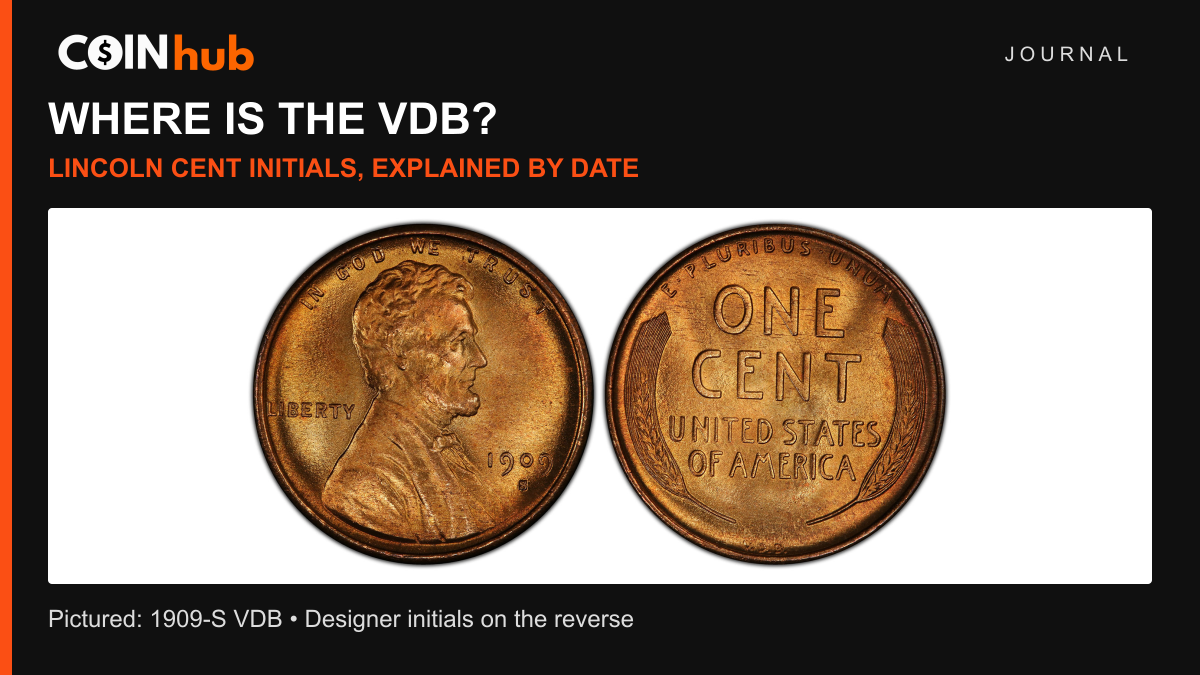
In the hero photograph, the S appears below the 1909 date on the front. VDB appears on the back. These are two different observations: the S identifies the mint, while VDB credits the designer. Turning the coin over is necessary to record both.
The familiar name “1909-S VDB” therefore combines the date, mintmark and initial-bearing reverse. Seeing VDB by itself does not establish the S variety. PCGS lists 27,995,000 Philadelphia 1909 VDB cents, a separate issue. Keep Philadelphia and San Francisco listings apart when researching your coin.
Our photograph shows one certified San Francisco specimen, not a comparison of two mintmarks. Its published grade is attached only to that example; a matching date and initials cannot transfer that grade to another penny.
Why the initials disappeared and returned
The Lincoln cent entered circulation in August 1909. The prominence of Brenner’s initials attracted criticism, and the design was revised to remove them. Brenner later saw his initials restored in 1918, before his death in 1924. PCGS’s Brenner history describes that sequence and reproduces the original coin photograph used here.
For a collector sorting pennies, the design history offers a useful rule: normal designs can differ without either coin being a mint error. Write down the date and the expected location before deciding that a letter is missing.
A practical inspection routine
- Take a complete obverse photograph. Include the date, the area below it and the base of the portrait. Read the date from the coin, not its envelope.
- Take a complete reverse photograph. Keep the bottom rim in frame. This is especially important for a 1909 coin.
- Compare the correct location. Use the date table, then open an enlarged reference showing the same issue. A later shoulder close-up cannot identify a 1909 reverse.
- Change the lighting gently. Try diffuse light from another direction and modest magnification. Do not polish or scrape the coin to expose lettering.
- Record uncertainty. “Initials not readable in this photograph” is a useful observation. It is more accurate than assigning a missing-initial variety without evidence.
For handling precautions, see how to handle coins without fingerprints. Keep both full photographs even if you also make a close-up; the surrounding design helps another collector understand what they are seeing.
Does VDB automatically make a penny valuable?
No single set of initials supplies a complete valuation. Identify the exact date and mint, assess condition and authenticity, and compare matching examples. An exciting price attached to another mintmark, grade or variety is not a useful shortcut.
Use our wheat penny collecting guide for broader series context. This page answers the narrower location question; it does not assign a price to an unidentified coin.
Is a 1916 penny without VDB an error?
Not for that reason alone. It falls within the normal 1910–1917 absence. If another feature looks unusual, document that feature separately instead of using the missing initials as proof.
Should I call a later coin “no VDB” when I cannot see the letters?
Describe what you can verify first. Save clear photographs and seek a qualified opinion if the apparent absence persists. A small, unclear detail is an observation to investigate, not a complete error diagnosis.
References and search results checked September 14, 2026. No current price, guaranteed premium or new error attribution is asserted.