
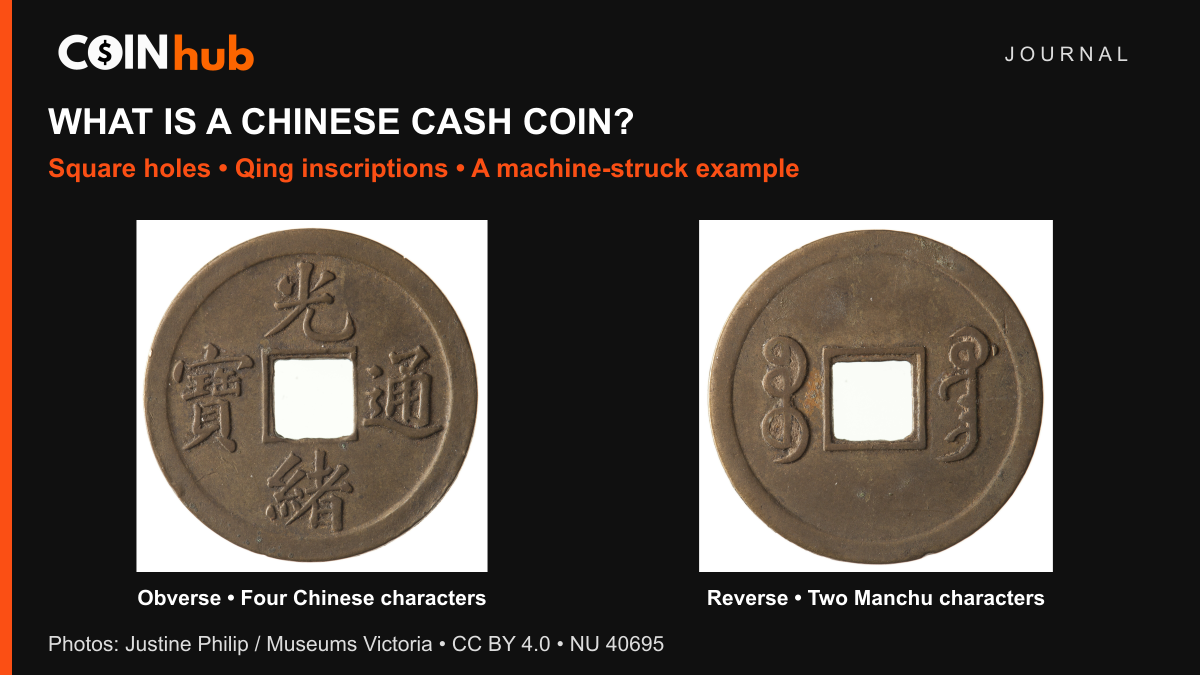
A Chinese cash coin is a small-value coin from a Chinese tradition that lasted for centuries. Most have a round body and a square hole in the center. Many were cast in copper alloys. But the shape alone does not tell you a coin's age, mint, method of manufacture or present value.
The coin pictured here is a useful surprise. It has the familiar hole, yet Museums Victoria identifies it as a machine-struck cash coin from Canton during the reign of the Guangxu emperor. Start with that documented example, then work outward from what you can actually see.
A familiar shape across many centuries
Cash is a coin name in this context, not simply a reference to money paid in person. A round Chinese coin with a square hole may look ancient to a new collector. The design, however, survived across a very long span of time.
The American Numismatic Association's Money Museum traces the round, square-hole form through Qin-period ban liang coins and later issues. It also describes the four-character inscription used on Tang coinage from 621 CE. Those milestones explain the long tradition; they do not date every coin that resembles those forms.
A late Qing coin and a much earlier piece can share the same broad outline. To separate them, examine the words and designs on both sides. A shape-based label is a starting point, not a finished identification.
Read the pictured Qing coin as an individual object
Museums Victoria's record NU 40695 identifies this piece as a cash coin of Guangxu, also written Kuang-hsu. It assigns the coin to Canton, now Guangzhou, and dates it to 1890–1906. The catalog gives brass as the material, a diameter of 24 millimeters and a weight of 2.92 grams.
The front, or obverse, has four Chinese characters around the hole. The back, or reverse, has two Manchu characters identifying the mint. Compare those arrangements in the photographs before trying to copy the lettering.
Keep the date qualified. “1890–1906” is the museum's range for this object. It is not a year visibly stamped in Western numerals on the coin. Write the range and its source in your notes rather than choosing a single year.
The emperor's reign and the cataloged range for a particular issue are different facts. So are the size of this museum specimen and the dimensions of every coin called cash. Keep each measurement tied to the coin you have in front of you.
How Qing inscriptions can help
Qin Cao's Qing coin identification guide from Lincoln Museum explains a common reading order for four-character Qing obverses: top, bottom, right, then left. The first pair gives the reign title; the other pair commonly reads tong bao, meaning circulating treasure.
That is a guide to this Qing pattern, not a rule for all Chinese coin inscriptions. The guide also distinguishes reverse legends written in Manchu, Chinese or combinations of the two. Use both sides when you try to name a coin.
If you cannot read a character, preserve its shape in a clear photograph. Note which side of the hole it occupies. Do not turn a partial resemblance into a confident translation. A reference plate is useful only when the visible features agree with the proposed match.
A square hole does not prove a coin was cast
Casting means forming a coin from molten metal in a mold. Striking means pressing a design into a prepared blank with dies. Many traditional cash coins were cast, but this example shows why “all cash coins were cast” is too broad.
The Museums Victoria record describes the Canton mint's modern machinery and identifies its cash output as struck. It catalogs the pictured piece's method as milled. Here, that term relates to machine production; it should not be read as a claim that the coin has a modern reeded edge.
The outline alone cannot settle the manufacturing question. Use the issue's documented history together with the object. The same caution applies to color: a photograph is not a chemical test of a copper alloy.
Build a useful first identification record
For an unfamiliar coin, make a short record before assigning a name. Photograph both sides straight on, record weight and diameter, and copy only the characters you can distinguish. Keep a separate line for the reference and proposed identification.
For example: “Round coin with square hole; four characters on one side and two on the other; possible Qing cash; comparison record attached.” That wording tells another reader what you observed and what still needs checking. It does not claim that a similar-looking coin shares the museum object's date or mint.
A name, proof that a coin is genuine, and a price are three different things. Matching a design does not by itself establish that an object is genuine. Nor does the broad name cash provide a market value. First work out which issue you may have. When the details do not fit, ask someone with the right knowledge to examine it.
Sources and photograph credit
Sources are linked beside the facts they support: the ANA Money Museum, Qin Cao's Lincoln Museum Qing guide, and Museums Victoria. Photographs: Justine Philip / Museums Victoria, NU 40695, licensed CC BY 4.0. Images resized and arranged in a CoinHub graphic; coin details unchanged. Enlarged, not actual size. The source institutions do not endorse this article.