
A denarius is a Roman silver coin first issued around 211 BCE. Its plural is denarii. It was a denomination: a coin with a set face value in Roman money. Rome used it for centuries, but its designs, weight and silver content changed. No single weight or modern dollar price fits them all.
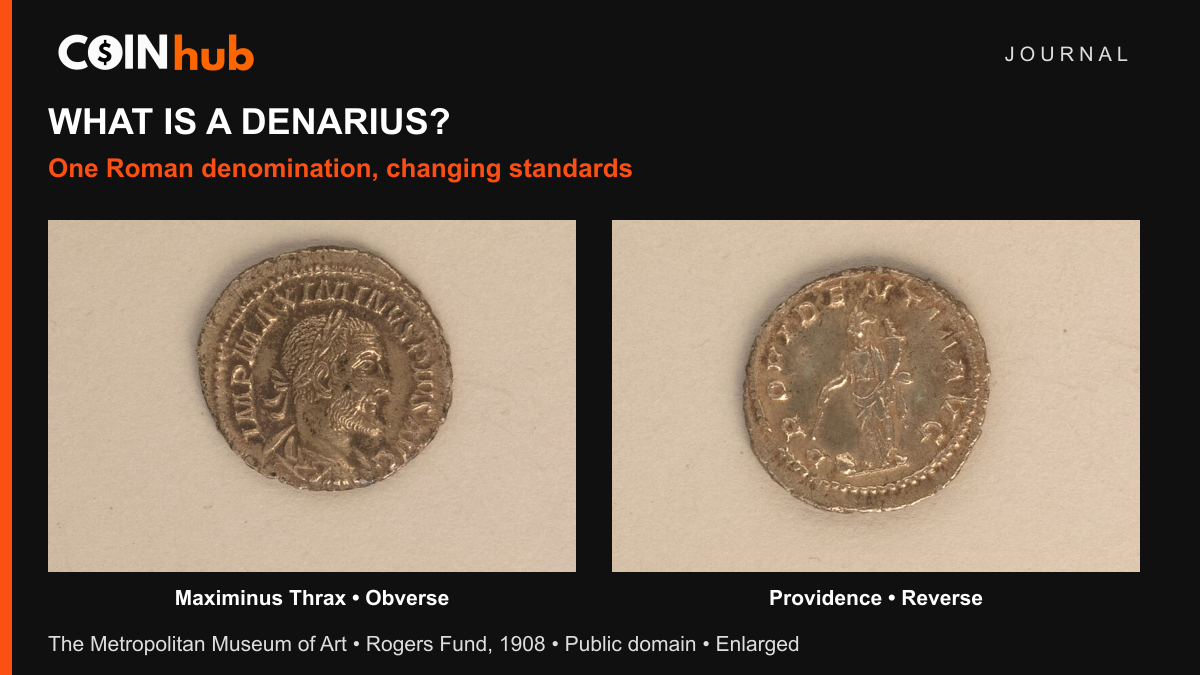
The name is a starting point. The ruler, date, designs and state of the coin help tell you which issue you have. The two photos above show a much later piece. It was made for the emperor Maximinus Thrax in 236 CE.
Keep three questions separate: What denomination is it? What is this particular coin made of? What would a collector pay for this example? A correct answer to the first does not settle the other two.
Where the denarius fits in Roman money
Ute Wartenberg Kagan of the American Numismatic Society dates its introduction to about 211 BCE in her introduction to ancient coinage. Early designs paired the helmeted head of Roma with the twin horsemen Castor and Pollux. Later issues used many other portraits and scenes.
The denarius was not Rome's first silver coin. NGC's Roman silver type-set study describes earlier didrachms and quadrigati before the smaller denarius. That sequence matters: “Roman silver coin” is a wider category than “denarius.”
Other names mark coins with other values. A quinarius was a half-denarius. The antoninianus, often called a double-denarius, appeared under Caracalla in the early third century CE. Its face value did not mean it held twice the silver. Do not give every silver-colored Roman portrait coin the same name.
Read the museum coin in the photographs
The Metropolitan Museum of Art catalogs the pictured coin as a silver denarius of Maximinus Thrax, Rome, 236 CE. Its object number is 08.170.346. The museum records a diameter of 1.9 centimeters and a weight of 2.3 grams.
The front shows the emperor's head and the inscription IMP MAXIMINVS PIVS AVG. The back has PROVIDENTIA AVG and a standing figure of Providence, holding a wand over a globe and a cornucopia. A cornucopia is a horn-shaped symbol of abundance.
Use the pair as a reading exercise. Find the head, then trace the letters around it. On the reverse, find the standing figure before trying to read the surrounding words. Those details are more useful than a guess based only on the metal's color.
The museum's weight belongs to this object. It is not a test for all coins of this type. If another piece weighs 2.3 grams, that does not prove it is real. The photos are enlarged and show the surface under the museum's lighting.
Why one fixed silver weight does not work
NGC gives about 4.1–4.4 grams for the earliest denarii and describes later reductions. The much lighter museum coin was issued centuries later. Comparing the two without their dates would hide the history that explains the difference.
Weight and fineness tell you different things. Weight is the mass of the whole coin. Fineness is the share of that metal that is silver. A scale measures the first; it cannot give you the second. A silver-colored surface cannot tell you the exact silver content either.
Look up the issue in a specialist guide. Keep its stated standard separate from the weight of one old coin. Pieces could vary when new. Wear and damage can also change what survives. One number cannot tell the whole story.
| Question | Evidence to look for |
|---|---|
| Is the denomination a denarius? | A catalog match for both designs, inscriptions and issue |
| When was it made? | The attribution and its supporting reference, not the ruler's full reign alone |
| How much silver does it contain? | Issue-specific composition evidence, separate from total weight |
| What is it worth now? | Comparable documented sales after identification and condition review |
Ancient purchasing power is a different question
Search results often connect the denarius with a day's wage. APMEX's historical overview discusses that association and the denomination's changing monetary role. Such an example needs its place, period and kind of work. It is not a conversion rate for every Roman century.
Prices paid by collectors answer another question. Two coins may have the same face value but different rulers, back designs and surfaces. Demand can differ too. The price of a famous auction coin does not set the price of an ordinary piece. Nor does the price of silver tell you all that a coin is worth.
Start with an attribution you can check
Keep clear photos of both sides, the weight and size, and the source of the coin's name together. If a seller calls the back design rare, ask which catalog entry supports that claim. Leave the answer open when key letters or details are missing.
Our ancient coin identification guide covers the broader process. For a denarius, the useful next step is a specific, checkable attribution. The familiar denomination name opens the investigation; it does not finish it.
Sources and photograph credit
Research: the ANS-authored PCGS article, NGC's Roman silver type-set study, the Met's object record and APMEX's overview, linked above. Photographs: The Metropolitan Museum of Art, Rogers Fund, 1908, object 08.170.346; public domain under the museum's Open Access program. Blank background may be cropped for layout; the complete coin and its details remain unchanged. Images enlarged, not actual size.