
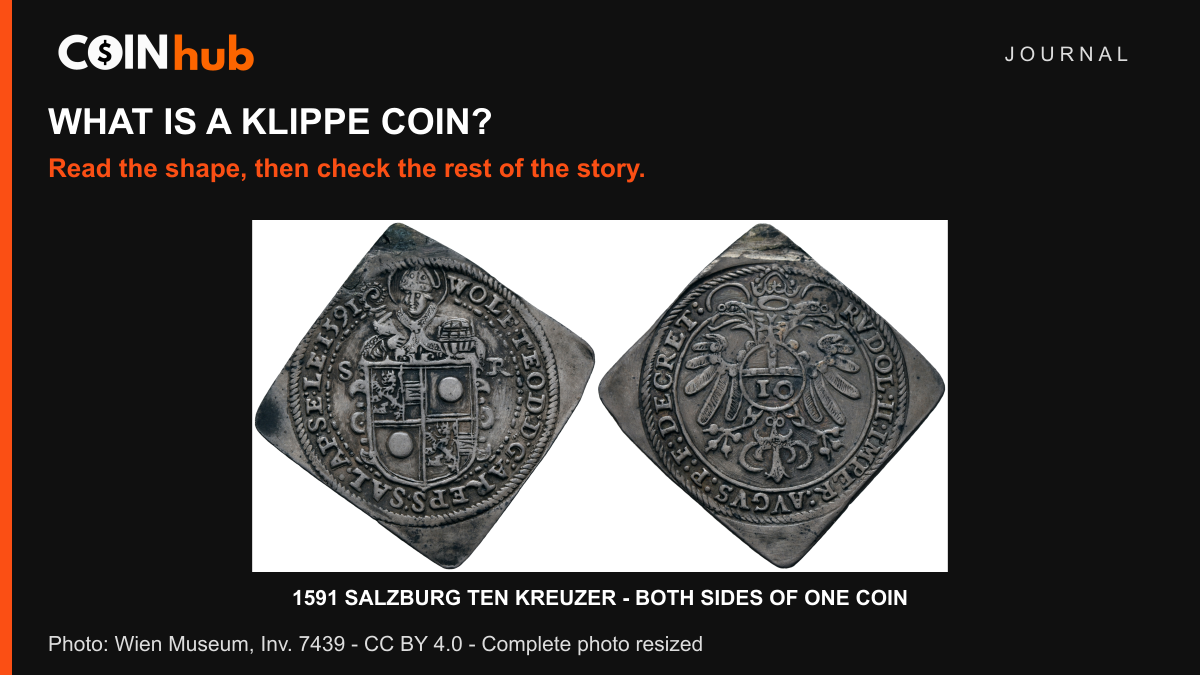
A klippe is a coin struck on a square or roughly square piece of metal. The word describes a form, not one denomination or one war. Some klippes were emergency money. Others were made as gifts or prizes. A square outline alone cannot tell you which story belongs to a coin.
Start with the whole object. Record both sides, its weight and its size, then compare the lettering with a reliable catalog. The corners are useful evidence, but the date and designs do much more of the work.
Shape is the first clue. It does not prove a siege origin, a mint error, a rare variety or a high price. Keep those claims separate from what you can see.
Why were some coins made square?
The NumiScience glossary at Heidelberg University explains the early emergency method: metal sheet was cut into square blanks when skilled workers and tools were scarce. A blank is the piece of metal that receives the coin design.
The same glossary notes later uses for trial pieces and prizes. That change matters. A shape that served an urgent need could also become a deliberate choice for a special issue. Do not turn the word klippe into a claim that every example came from a besieged city.
Read the pictured Salzburg coin
The Wien Museum identifies this silver ten-kreuzer klippe as Salzburg, 1591, under Wolf Dietrich von Raitenau. Its inventory number is 7439. Both faces of that one coin appear above.
Four corners extend beyond a round ring of lettering. At left, find the shield and date 1591. At right, find the double-headed eagle and the large 10. Record the features before trying to expand the shortened words.
The museum records 4.16 grams and 26.3 by 26.9 millimeters. These describe its specimen; a close match alone cannot authenticate another coin.
| Clue | Useful next step |
|---|---|
| Four projecting corners | Record the full outline rather than cropping to the round design |
| A visible date | Copy each digit and mark unclear digits as uncertain |
| A value such as 10 | Check which monetary unit the catalog assigns |
| Similar coat of arms | Compare the surrounding letters and both sides |
A small gold gift gives another example
The Salzburg Museum records a 1614 half-ducat klippe under Markus Sittikus. Its description calls it a small gift piece in half-ducat weight. It lists gold, a weight of 1.72 grams and a size of 14 by 14 millimeters.
This is a different object from the silver coin in our photograph. The pair of records makes a useful point: the term klippe does not supply the metal, face value or purpose. Each issue needs its own identification. The gold example should not be used to assign a price or history to the pictured ten-kreuzer piece.
Build a record before choosing a story
A seller may describe a square coin as siege money. Save that description, but look for a catalog reference that connects the specific type to a documented event. A dramatic explanation is not evidence by itself. If the reference identifies only a ruler and date, record that narrower result.
- Photograph both faces. Include every corner and leave the original files intact.
- Measure in two directions. Note whether you measured between opposite sides or opposite corners.
- Copy the inscription. Keep uncertain letters separate from your best guess.
- Save the reference. Record the museum or catalog number, page link and date you checked it.
If a coin seems to match, compare the details before treating it as the same issue. Similar arms can appear on more than one value. A close photograph can guide research, but it cannot establish that a piece is genuine. Leave uncertain identification and condition questions open for a qualified specialist.
Sources and photograph credit
Sources: Heidelberg University's NumiScience glossary, Wien Museum inventory 7439 and Salzburg Museum's 1614 half-ducat record, linked above. Photograph: Wien Museum, CC BY 4.0; issuing authority Wolf Dietrich von Raitenau, ten-kreuzer klippe, 1591. Complete photograph resized in a new CoinHub layout; coin details unchanged. Enlarged, not actual size.