
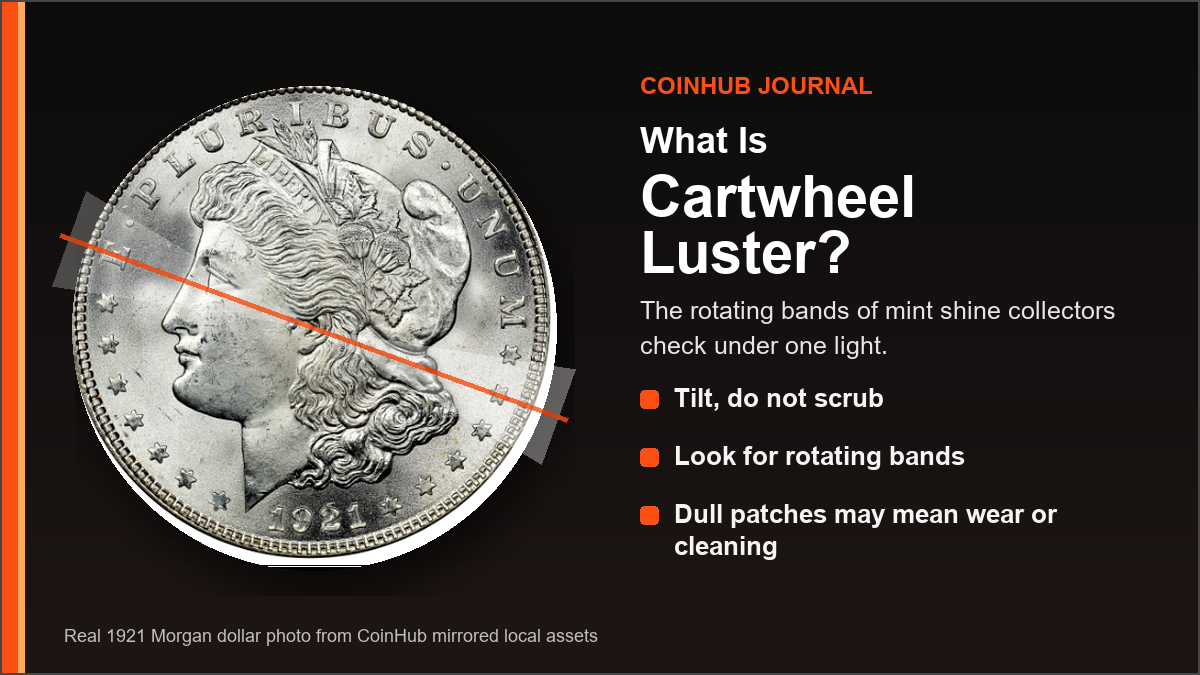
Cartwheel Luster on Coins: What It Means and How To See It
Quick answer: Cartwheel luster is the rotating light pattern you see when an original Mint State coin is tilted under a single light. The shine should move around the coin in bands, almost like spokes turning on a wheel. It is not just brightness. A cleaned coin can look shiny, but it usually will not show the same natural rolling luster.
Cartwheel luster is one of those coin terms that sounds strange until you see it in hand. Collectors use it when they are checking whether a coin still has original mint surface. On many silver dollars, half dollars, quarters, and other struck coins, tiny metal flow lines can reflect light in a rotating pattern. When the coin is tilted, the bright band appears to sweep across the surface.
This matters because luster is one of the clues that separates a true uncirculated coin from a coin that is merely bright, polished, dipped too hard, or photographed under flattering light. A coin can have marks and still show luster. A coin can also look clean in a photo and still have dead, flat, or wiped surfaces in hand.
How To Check for Cartwheel Luster
The strongest cartwheel effect is often easiest to see on larger silver coins because there is more open surface area. Morgan dollars and Peace dollars are classic practice coins. Modern clad coins can show luster too, but the look may be different from older silver coins.
Cartwheel Luster vs. Regular Shine
| Surface clue | What it may mean |
|---|---|
| Light rotates in bands as the coin tilts | Possible original mint luster, especially if the high points show no circulation wear. |
| Coin is bright but the light does not move naturally | May be polished, wiped, over-dipped, or artificially brightened. |
| High points are dull while protected areas remain bright | May show circulation wear, friction, or cabinet rub. |
| Parallel hairlines appear under light | Possible cleaning or wiping. This can hurt collector value quickly. |
Why Luster Gets Broken
Original luster is fragile. The metal flow lines that create the effect are on the coin's surface, so wear, friction, cleaning, harsh dipping, and mishandling can interrupt them. Once those surface lines are disturbed, the coin may never show the same natural cartwheel again.
That is why CoinHub tells collectors not to clean coins before getting an opinion. Cleaning can remove the exact surface evidence a buyer, collector, or grader wants to see. If you found a silver dollar, old quarter, or inherited coin collection, the safest first step is to handle coins by the edges and keep them in non-PVC holders.
Does Cartwheel Luster Mean a Coin Is Valuable?
Not by itself. Cartwheel luster is a positive sign, but value still depends on the date, mint mark, series, authenticity, strike, marks, eye appeal, and actual grade. A common Morgan dollar with blazing luster can be desirable, but that does not automatically make it rare. A key-date coin with impaired luster can still be important because of rarity.
Use luster as one piece of the evaluation. If the coin also has a better date, a scarce mint mark, or a condition that looks unusually clean, then it may deserve a closer look. You can compare your coin against CoinHub's free CoinHub Tracker, review the coin grading break-even calculator, or bring the coin to CoinHub for a local opinion before spending money on grading.
Best Coins for Learning the Cartwheel Effect
If you want to train your eye, start with coins where the effect is easy to see:
- Morgan and Peace silver dollars: large silver fields make the rotating bands easier to spot.
- Uncirculated Washington quarters: useful practice for modern clad luster and high-point friction.
- Silver commemorative dollars: helpful for comparing prooflike surfaces, satin surfaces, and normal mint luster.
- Original bank rolls: a good way to see how fresh coins differ from circulated pocket change.
CoinHub field test
Put the coin under one light, tilt it slowly, and ask: does the shine travel around the coin, or does it stay flat? Then check the highest design points for rub. If the light rotates but the cheek, hair, eagle breast, or other high areas look worn, the coin may have attractive remaining luster without being fully uncirculated.
Common Mistakes
- Calling every shiny coin uncirculated. Shine can come from cleaning, lighting, or camera exposure.
- Judging from one photo. Cartwheel luster is a movement test. Still photos rarely tell the full story.
- Ignoring dull patches. Dead spots can signal wear, friction, fingerprints, environmental damage, or cleaning.
- Cleaning to "bring back" luster. Cleaning usually removes originality instead of restoring it.
Sources and Research Notes
Research for this guide checked current search competition for "cartwheel luster coin" and "coin luster grading," including Bing results that surfaced The Spruce Crafts, CoinageRings, Coin Talk, and the current PCGS Grading Standards PDF. The article graphic uses a real 1921 Morgan dollar image from CoinHub's mirrored local assets.
FAQ
Can circulated coins have cartwheel luster?
Yes, a lightly circulated coin can retain some luster in protected areas. But full, uninterrupted luster is usually associated with Mint State coins.
Is cartwheel luster the same as prooflike surfaces?
No. Prooflike surfaces are mirrorlike. Cartwheel luster is a rotating mint-shine effect. Some coins can have both, but they are different surface qualities.
Can cleaning remove cartwheel luster?
Yes. Wiping, polishing, harsh dipping, or abrasive cleaning can break the surface flow lines that create natural luster.