
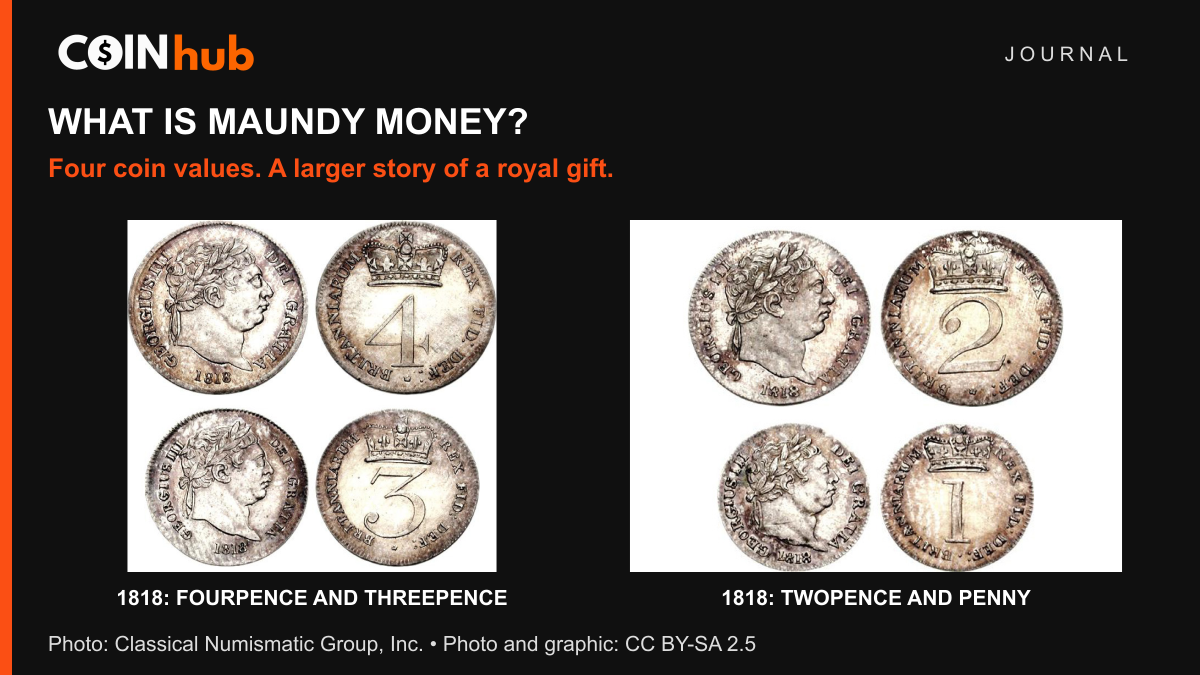
Maundy money is the special silver coinage given in the British Royal Maundy ceremony. A set contains four small coins: one penny, two pence, three pence and four pence. That four-coin set is not the same thing as the full gift a named person received at the ceremony.
This difference matters when you read an auction description or sort a family collection. You may have one coin, a matched set, or several sets kept with a recipient's papers. Each tells a different story. Start by counting denominations, then look for records that connect the coins to a person and event.
Four coins, ten pence: 1 + 2 + 3 + 4 = 10. That is the face-value total of one set, not its collector price or proof of a particular presentation.
What makes the coins Maundy money?
The Royal Mint Museum traces specially struck Maundy coins to Charles II in 1662. The first dated set with all four values followed in 1670.
The museum also notes a key change in 1971: the face values changed from old pence to new pence at decimalisation. The 1818 set pictured here belongs to the older system; do not describe its original face values as modern decimal pence.
Four coins can appear as eight pictures
The licensed photograph from Classical Numismatic Group shows an 1818 George III set. Each row pairs the portrait side with the value side of one coin. There are four coins in the set, photographed on both sides, not eight separate coins.

Read the large numbers beside the portraits: 4, 3, 2 and 1. Each sits below a crown. The portrait sides show George III and the date 1818. All four dates can be checked separately. A photograph of a complete set is useful for learning the pattern, but it does not identify a different coin in your hand.
| What the listing shows | What you still need to check |
|---|---|
| One crowned numeral | The other side, date and exact denomination |
| Four coin values | Whether every coin has the stated year |
| A purse or fitted case | Whether it has a documented connection to these coins |
| A named recipient | Letters or other records supporting that history |
A set is different from the ceremony gift
The Royal Mint's history describes two purses given at Royal Maundy: ordinary coins go in the red purse, and silver Maundy coins go in the white one. The service takes place on Maundy Thursday, the Thursday before Easter.
The Royal Mint Museum explains that the silver gift's total in pence matches the monarch's age. That rule concerns the total gift and the recipients. It does not mean that every recipient receives just one four-coin set.
A real museum record makes the distinction clear. In its April 2025 newsletter, the Royal Mint Museum describes Freda Meggs receiving nine complete sets from Elizabeth II in 2016. Those sets added up to 90 pence. Her later bequest included the coins and papers connected with the service.
Keep the personal history with the coins
Provenance means the recorded history of an object's ownership. With a ceremonial gift, a letter or program may explain why these particular coins were kept together. Do not discard those papers because a holder looks more convenient or a single coin seems easier to sell.
- Photograph both sides. Make one clear record for each denomination.
- Record each date. Do not assume that a group bought together is a same-year set.
- Keep the group intact. Store its description, case, purses and papers as one documented group.
- Separate evidence from a story. Write down who supplied a claim and what record supports it.
A complete set and a documented presentation group answer different questions. The coins show the types and dates. The paperwork may connect them to a recipient. Neither a crown design nor a loose purse proves that a specific person received a royal gift.
Sources and photograph credit
Sources: the Royal Mint Museum's Maundy history and April 2025 collection account, plus the Royal Mint's ceremony history, linked above. Photograph: Classical Numismatic Group, Inc., CNG, via Wikimedia Commons, CC BY-SA 2.5. Complete coin rows are arranged in two panels; coin details are unchanged. Adapted graphic: same license. CoinHub trademark rights remain separate. Coins are enlarged, not actual size.