
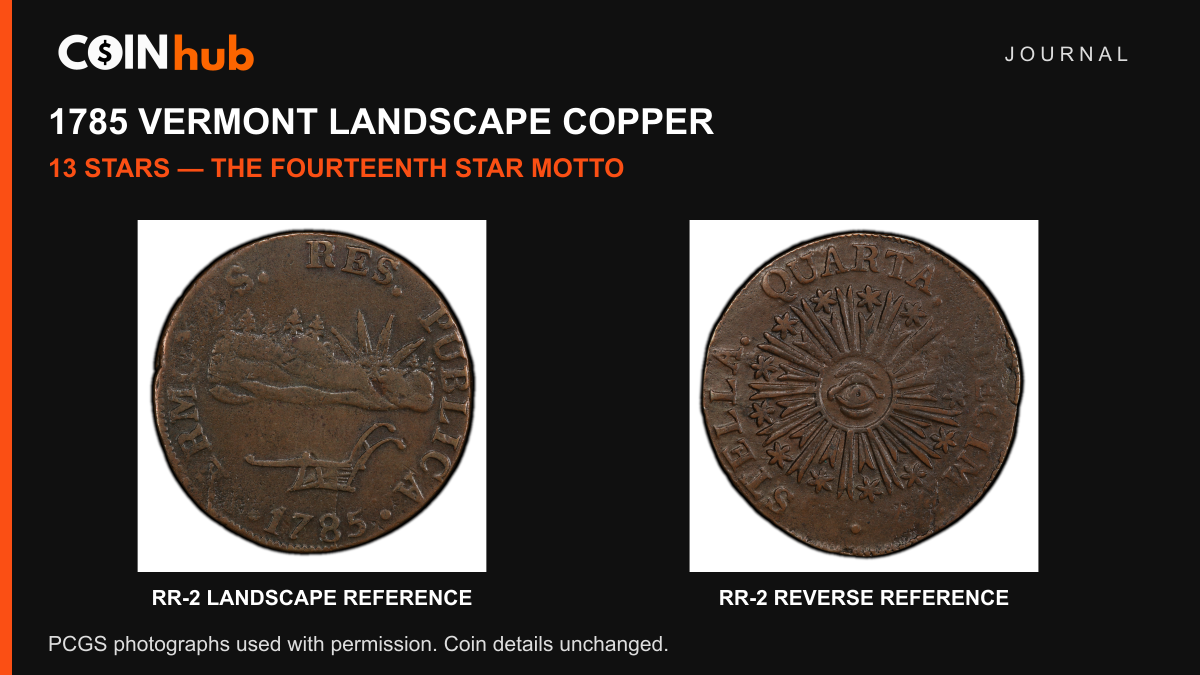
The 1785 Vermont landscape copper pairs a rising sun and plow with an eye, rays and thirteen stars. Its reverse motto means “The Fourteenth Star.” Those are different statements: thirteen stars appear in the design, while the words express Vermont's wish to join the Union.
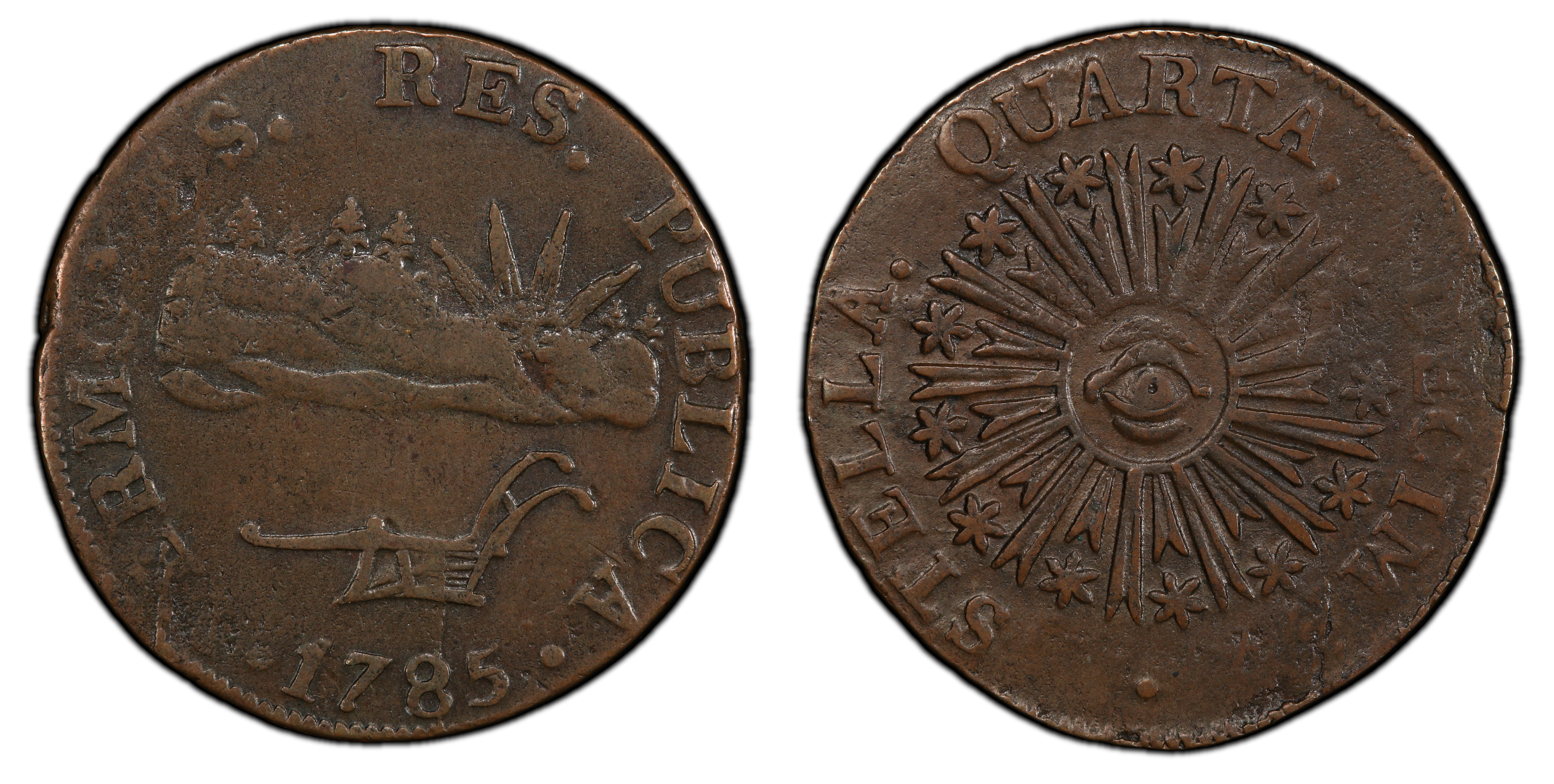
The genuine reference above is the 1785 VERMONTS variety cataloged as RR-2. It shows both faces of the same coin. Use it to learn the design before attempting a more detailed die attribution.
Follow the landscape from sun to date
On the front, the sun rises behind a mountain landscape with trees. A plow sits beneath it, and 1785 appears near the bottom. The outer wording on this reference reads VERMONTS. RES. PUBLICA.
The Smithsonian's 1785 Vermont copper record identifies this sunrise, landscape and plow arrangement. It places the coin's manufacture in Rupert, Vermont. The museum's record is a useful check on the type even though it describes a different collection specimen.
Do not replace unreadable letters with the spelling you expected to find. Vermont landscape coppers have several inscription forms. Record the letters that are actually visible, then compare a catalog entry with the same wording and date.
Why thirteen stars can mean a fourteenth star
Turn the coin over. An eye occupies the center of a field of rays and stars. Around it is STELLA QUARTA DECIMA. The PCGS Vermonts narrative describes thirteen stars and translates that motto as “The Fourteenth Star.” Count stars as separate design elements, rather than counting the points of each star or the rays between them.
The Colonial Coin Collectors Club's educational project explains the historical message. Vermont was an independent republic seeking a place in the Union. It became the fourteenth state in 1791, after this coin's 1785 date. The motto expresses that ambition; it does not require fourteen stars around the eye.
This distinction is useful when reading a partial photo or a short description. A missing-looking fourteenth star is not evidence of a mint error. First check what the documented design actually contains.
Separate the type from the RR-2 attribution
The letters RR refer to a specialist catalog numbering system. A number identifies a die variety, or version of the design made with particular steel stamping tools. Landscape type recognition is broader than identifying the exact dies.
The specific PCGS registry reference names the pictured coin as RR-2 and gives certification number 41490448. That documented identity belongs to the reference specimen. It is not an attribution of another coin that shares its general landscape.
PCGS notes that RR-2 and RR-3 share the VERMONTS wording. To compare them, its narrative uses the sun ray near the period after RES, the plow's relation to the date and a die defect on RR-3. Match the whole set of features. One weak punctuation mark should not decide the answer.
A simple record keeps the questions separate
- Photograph both complete faces and keep the rims in view.
- Write down the date and every readable part of the outer inscriptions.
- Locate the sun, plow, central eye and individual stars.
- Mark areas hidden by wear, glare or a weak strike as uncertain.
- Compare fine die details only after the basic design and wording agree.
You can open the complete PCGS reference photograph for a larger view. Changing the lighting on your own coin can reveal a feature hidden by shadow. Polishing it to improve a photograph can alter the surface and destroy useful evidence.
Keep history, authenticity and value distinct
C4 records Reuben Harmon Jr.'s 1785 coining privilege and the Rupert mint. That makes this a republic's copper issue, rather than a federal Mint cent. The broad term colonial appears in modern collecting catalogs even for some coins made after the Revolutionary War.
A matching date and design do not prove authenticity or establish a sale price. Early copper surfaces, manufacture and later copies need specialist examination. Keep any holder information and ownership history with the piece. For a different use of stars on early U.S. money, the 1797 half-dime comparison counts stars around Liberty; its varieties should not be applied to Vermont's eye-and-rays reverse.
References checked October 20, 2026. Photograph: PCGS, used with permission; complete 1785 RR-2 reference pair proportionally resized with the original coin details unchanged. The photographed coin is a reference, not CoinHub inventory or a promise of authentication or value.