
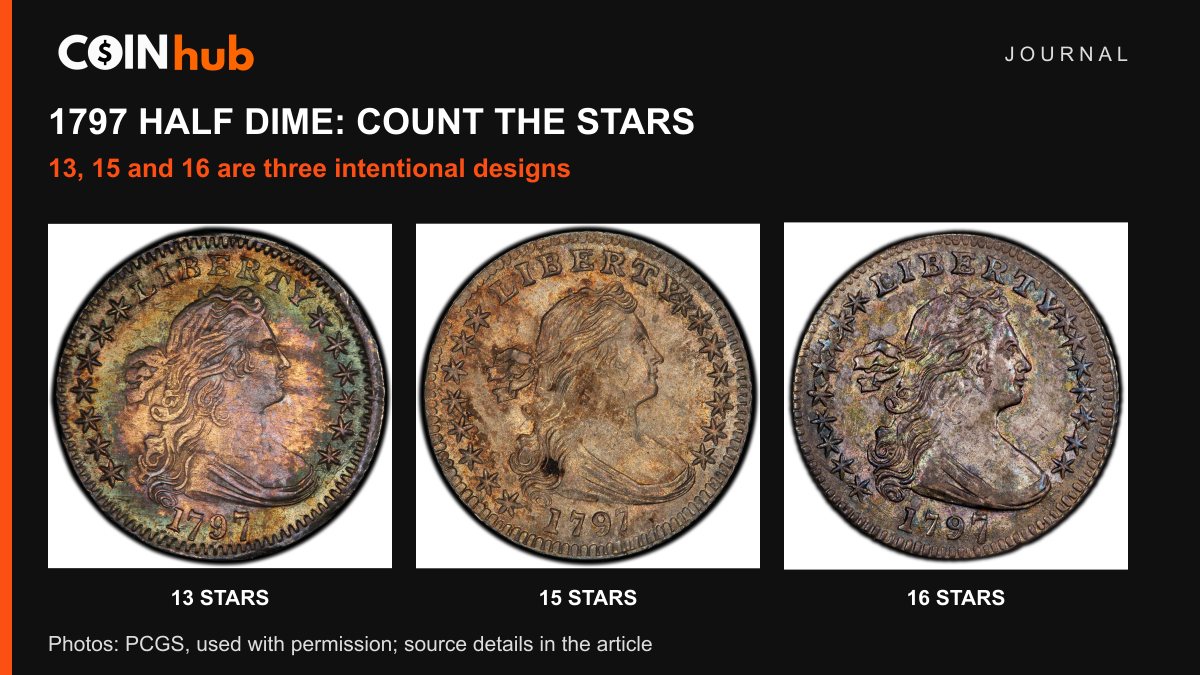
A 1797 Draped Bust half dime can have 13, 15 or 16 stars around Liberty on its front. All three are recognized designs. Count the whole ring of stars, with the date upright, before choosing a catalog entry. An unclear or worn star should remain uncertain rather than be filled in by guesswork.
A half dime is a silver five-cent coin. It is not a half dollar, and it is not the later copper-nickel five-cent piece. The same 1797 date can appear on other denominations, so first match the portrait, reverse and size.
Count the portrait side, not the eagle side
The obverse, or front, carries Liberty, the date and the stars used for this comparison. The reverse, or back, shows the Small Eagle design. The main graphic keeps the full front of each genuine reference coin visible, including its star ring and date.
PCGS lists the 13 Stars, 15 Stars and 16 Stars half dimes separately. The graphic places them in that order from left to right. They are three different reference specimens, not altered versions of one photograph.
- Read 1797 and orient Liberty upright.
- Start beside one end of LIBERTY and count down that side of the portrait.
- Count the other side separately, then add the two counts.
- Check the result again against the full-rim reference photograph.
- Save both the photograph and any uncertain star positions in your notes.
Count stars as design elements. A dark patch, a rim dent or a bright reflection is not an extra star. Do not count the points of one star as several separate stars.
Why one date has three star counts
PCGS's historical account relates the changing counts to the early practice of adding stars for states admitted to the Union. Vermont and Kentucky followed the original thirteen states, and Tennessee joined in 1796.
The small coin left little room for an expanding ring. The Mint returned to thirteen stars as a lasting design convention. A coin's date does not reveal exactly when its dies were prepared or when that particular piece was struck, so do not use the count to invent an exact production day.
These differences come from the designs on the dies, the steel tools that made the coin. A 13-star half dime has not simply lost three stars from a 16-star coin. The recognized types are not mint errors.
A star count is not a full die-variety name
Specialists can identify a die marriage, meaning a particular front die paired with a particular back die. That requires more detail than the number of stars.
NGC's Early Half Dimes listing recognizes these relationships:
- 15 Stars: LM-1.
- 16 Stars: LM-2 and LM-3.
- 13 Stars: LM-4.
LM is a catalog reference, not a grade or a price. A clear 16-star count does not choose between LM-2 and LM-3. Keep that more detailed attribution open until the other die features have been compared.
Let a worn star remain unresolved
Glare, blur, wear and weak striking can hide details. NGC's Draped Bust half-dime grading guide explains that these early coins often did not strike up fully. One weak patch is not enough to assign a grade.
Ask for a second lighting angle and a photo that includes the whole rim. If two stars merge into a worn area, record the visible positions and the gap. “Count uncertain near the upper right” is a useful result. A confident label based on an enlarged blur is not.
Keep denomination, variety and value separate
The PCGS references list a nominal diameter of 16.5 millimeters and weight of 1.35 grams. Those figures help distinguish the denomination; they are not measurements of a coin in your hand or proof of authenticity. Leave a certified piece sealed in its holder.
A later Liberty Seated half dime belongs to a different design series. Do not apply its identifying features or a half-dollar sale to this tiny Draped Bust coin. For value comparisons, match the same denomination, star type, condition and documented sale terms.
Preserve the coin as found and avoid rubbing it to sharpen the stars. When a purchase or an important attribution depends on the answer, an early-U.S.-coin specialist should examine the actual piece. This guide gives a count method, not an appraisal or a guarantee that a coin is genuine.
References and photographs reviewed October 14, 2026. Photos: PCGS, used with permission. Complete front views cropped from the original paired photographs and resized; no coin details changed. Reference specimens are not CoinHub inventory.