
The reverse gives you the best starting point
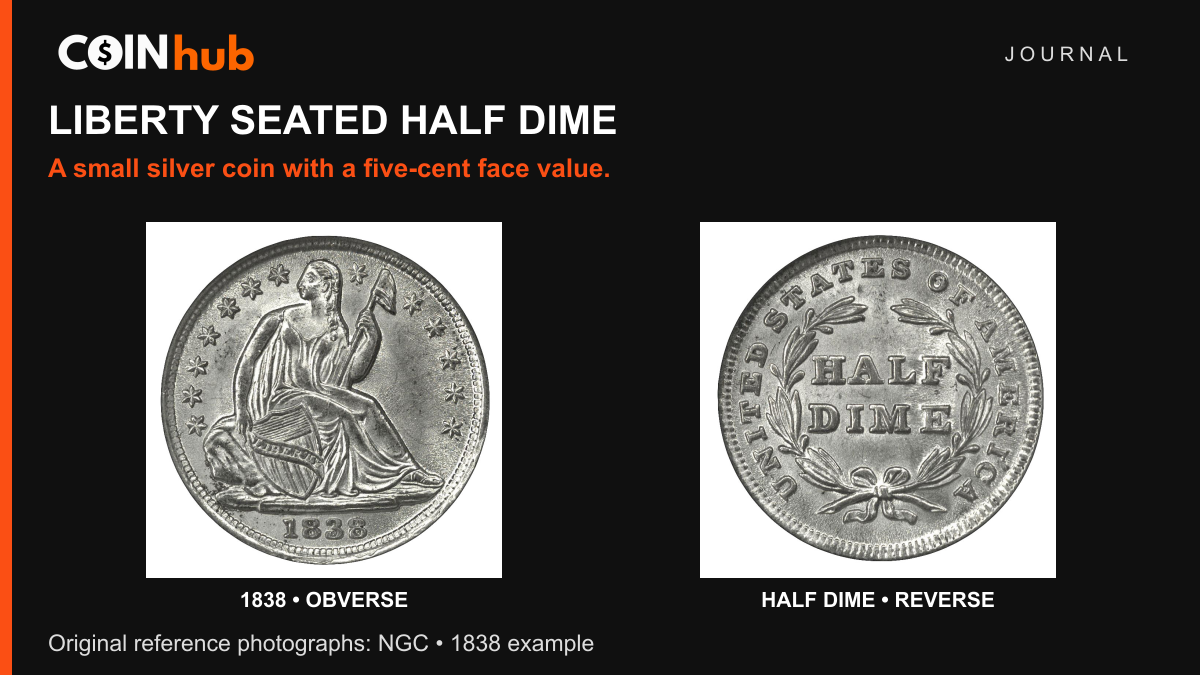
A tiny silver coin can be difficult to identify from a worn date alone. Before searching for a price, turn it over and read the center of the reverse. On the 1838 reference coin above, HALF DIME is explicit. The word “half” refers to half of a ten-cent dime; it does not describe a broken coin or a half dollar.
The U.S. Mint's denomination history explains that the silver half dime preceded the copper-nickel five-cent piece. The two denominations of the same face value overlapped: nickels began in 1866, while silver half dimes continued through 1873.
Recognize the Seated design before choosing a date listing
Liberty sits on a rock with a shield and a pole topped by a liberty cap. Christian Gobrecht's design entered the half-dime series in 1837. Over time, stars, drapery, lettering and the wreath changed. These are intentional design differences, so a coin that does not match the 1838 photograph is not automatically an error.
The reference photographs are from NGC's Seated half-dime grading guide. They show one type and one specimen. They are useful for identifying the denomination and layout, but they are not a grading template for every date.
| Major group | Dates in PCGS's type listing | What to look for |
|---|---|---|
| No Stars | 1837–1838 | An open obverse around Liberty. The 1838 No Stars issue is from New Orleans. |
| No Drapery | 1838–1840 | Stars surround Liberty; compare the arm and drapery details with a type reference. |
| Stars Obverse | 1840–1859 | The revised figure remains surrounded by stars. The Arrows subtype is listed separately. |
| Arrows at Date | 1853–1855 | Small arrows flank the date, signaling the weight change. |
| Legend Obverse | 1860–1873 | UNITED STATES OF AMERICA moves to the front; the reverse has a fuller wreath. |
These date spans describe major types, not a complete date-and-mint checklist. Overlapping transition years matter. Use the PCGS CoinFacts type directory to move from the broad design group to the appropriate issue.
What do the arrows mean?
The arrows introduced in 1853 identified the reduced-weight coinage. PCGS records a change from 20.625 grains to 19.2 grains. The arrows disappeared in 1856, but the lower weight remained. An arrowless coin is therefore not necessarily an earlier, heavier issue.
Read both sides of the date carefully. Wear or a poor photograph can hide a small feature. Do not call a missing arrow a variety until the date, type and actual surface have been checked. The related 1853 Arrows and Rays half-dollar guide discusses another denomination affected by the same era's changes; it is not a substitute identification chart for half dimes.
Check condition without mistaking weak detail for wear
NGC notes that some half dimes have localized striking weakness, including parts of Liberty and the wreath. A soft head or incomplete leaf alone cannot establish a grade. Look across both sides for a consistent picture of wear, luster and surface preservation.
Keep cleaning and damage separate from design identification. Scratches, polishing and altered surfaces can matter even when the date is clear. Do not rub the coin to make the lettering easier to read. If a holder says Details, our Details grade explanation helps interpret that description.
Build a useful record before comparing values
- Write down HALF DIME, the visible date and the major design group.
- Photograph both sides with the full rim visible, including any mintmark.
- Record holder wording and any variety attribution exactly, without treating an old label as proof.
- Flag unclear details and surface problems before selecting comparisons.
- Compare the same date, mint and condition category in credible sold records.
A general search for “half dime value” mixes very different issues. An exceptional auction result does not price a worn or unidentified example. For a coin that may be a scarce issue, or for a substantial purchase, obtain an examination by someone familiar with the series.
Common questions
Is a half dime the same coin as a nickel?
It has the same five-cent face value, but it is a different silver coin series. The Mint made both types during part of the nineteenth century.
Does every Seated half dime have stars?
No. The earliest No Stars type and the later Legend Obverse type have different arrangements. Identify the type before interpreting an absent feature.
Can the photo tell me my coin's grade?
No. Use it to compare the design. Grading requires evaluating the individual coin's wear, strike and surfaces.
Sources: NGC's Liberty Seated half-dime grading guide, PCGS CoinFacts type directory and U.S. Mint nickel history, consulted September 24, 2026. Original reference photographs courtesy of NGC; CoinHub layout.