
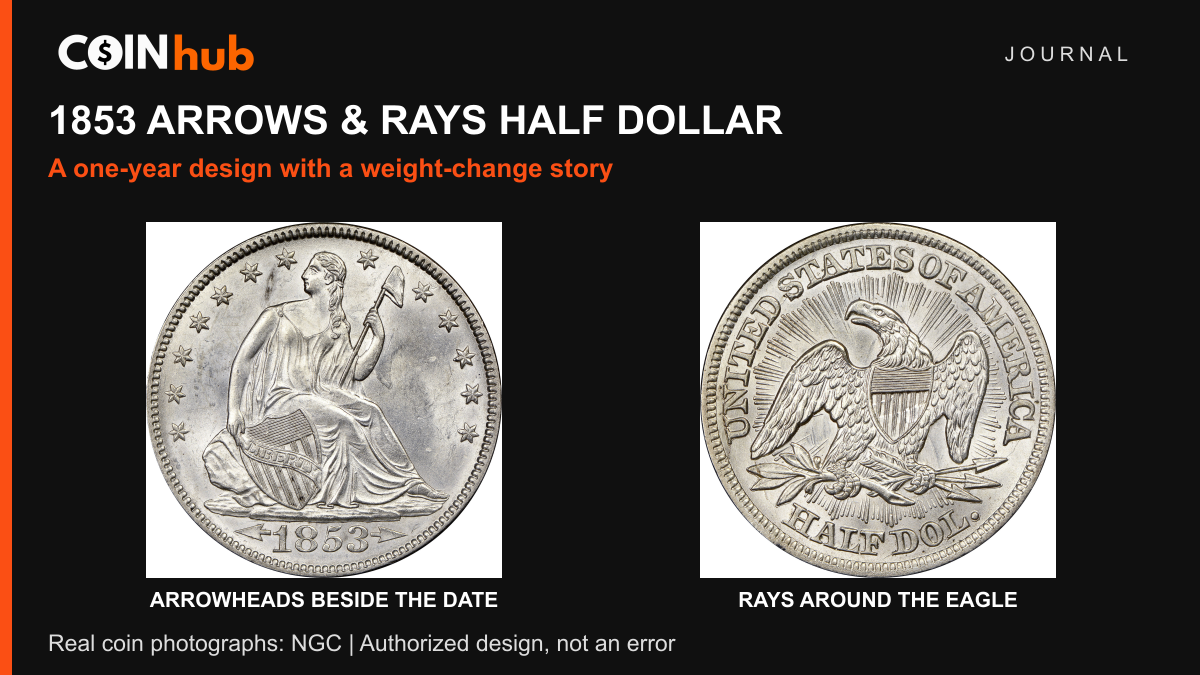
Read the date, then turn the coin over
An 1853 Arrows and Rays half dollar has two identifying features: arrowheads on either side of the date and a burst of raised rays surrounding the eagle on the reverse. Both belong to the approved design. They are not accidental marks, and their presence alone does not make the coin an error.
The combination is a one-year type within the much longer Seated Liberty half-dollar series. For a collector sorting an inherited coin or choosing a type-set example, the useful starting point is the same: identify the whole coin before attaching a value or rarity claim to it.
Four things to check on the actual coin
- Read the denomination. Do not rely on an auction thumbnail or the seller’s heading. An 1853 quarter can also have arrows and rays. The half dollar pictured here says HALF DOL. on the reverse.
- Look beside the date. The added arrowheads flank 1853 at the bottom of the obverse. These are separate from the arrows held by the eagle on the other side.
- Inspect the area around the eagle. Rays spread outward behind it. Check several areas rather than deciding from one weak or poorly lit patch.
- Record the mint. Philadelphia examples have no mintmark. New Orleans examples carry an O below the eagle. A missing P on a Philadelphia coin is normal.
Use photographs of both sides together. If an online listing provides only the front, request the reverse before deciding that it fills an Arrows and Rays slot. A title containing “Arrows” is not enough to establish the full design.
Why the Mint added arrows and rays
Changing gold and silver values created an incentive to remove silver coins from circulation. The Coinage Act of February 21, 1853 addressed the shortage by lowering the weight of several silver denominations. For the half dollar, the standard dropped from approximately 13.36 grams to 12.44 grams. The arrowheads and rays made the lighter issue recognizable. PCGS’s issue history explains the monetary background.
The alloy remained 90% silver. A lower total weight therefore meant less silver per half dollar, not a change to a base-metal coin. NGC’s specifications list a 12.44-gram weight, 30.6-millimeter diameter and reeded edge for the Philadelphia Arrows and Rays issue.
Arrows and Rays versus arrows only
| Half-dollar type | Beside the date | Around the eagle | Collector takeaway |
|---|---|---|---|
| 1853 Arrows and Rays | Arrowheads | Rays | The one-year combination discussed here |
| 1854–1855 Arrows | Arrowheads | No rays | A normal succeeding type, not missing-ray damage by definition |
| 1873–1874 Arrows | Arrowheads | No rays | A later type associated with a different weight adjustment |
The rays complicated die production and shortened die life. They disappeared for 1854 while the arrowheads continued through 1855. The later 1873–1874 arrows marked a small increase to 12.50 grams, so “arrows” does not always mean the same weight change. NGC’s series history separates these transitions.
Keep the famous 1853-O No Arrows rarity separate as well. It is a different issue from an ordinary 1853-O Arrows and Rays coin. A faint photograph, worn date area or seller’s claim is not enough to establish that rarity; such a claim calls for specialist authentication.
Does one-year type mean every example is rare?
No. “One-year type” describes how long a design combination was made. PCGS lists 3,532,708 Philadelphia Arrows and Rays half dollars and 1,328,000 from New Orleans. Original mintage is not a count of surviving coins, but it helps explain why the one-year label should not be confused with a tiny original production.
For a type set, decide what you want to see before shopping: a readable date, both arrowheads, clear reverse rays and surfaces you find appealing. That is a more useful brief than simply asking for the “rarest” example.
Compare condition before comparing prices
Separate Philadelphia from New Orleans, then compare coins with similar wear and surface quality. A cleaned or damaged coin described with a Details designation should not be compared as though it were an otherwise similar straight-graded piece. Read the complete description and look at the photographs, including the rim and fields.
Retail asking prices, published price guides and completed auction results answer different questions. When using a sale as a comparison, record its date, exact issue, grade, surface problems and whether the reported amount includes buyer’s fees. One exceptional auction result does not establish the value of every coin bearing 1853.
If the coin is certified, compare its holder information with the grading service’s verification record and available images. Our guide to reading PCGS and NGC labels explains that process. A matching number is one check; the coin and holder still need to match the record.
Correct weight is a check, not proof
NGC documented a counterfeit 1854-O arrows half dollar made of silver with the correct weight and broadly correct design. Surface evidence revealed the problem. That case concerns the neighboring arrows-only issue, but it demonstrates why a scale result cannot authenticate an 1853 coin by itself. See NGC’s original counterfeit report.
Record measurements with a suitable scale and inspect the complete design, edge and surfaces. Wear and measurement conditions matter, so do not turn a nominal specification into a single pass-or-fail test. Our coin-weighing guide covers the limits of that check. Leave an uncertain coin uncleaned and seek qualified review before paying a premium for a claimed rarity or error.
Common questions
Are the rays scratches or a mint error?
On a genuine Arrows and Rays half dollar, the rays form part of the raised reverse design. They should be assessed as a pattern around the eagle, not as isolated lines.
Is an 1854 half dollar without rays incomplete?
No. The normal 1854 arrows type has no reverse rays. Identify it by its own date and design rather than expecting it to look exactly like an 1853 example.
Should I clean the coin to see the arrowheads?
No. Start with better light, magnification and clear photographs. If the design remains uncertain, preserve the coin as found and ask for an expert examination.
Research checked September 21, 2026. This guide identifies a design type and explains comparison checks; it does not assign a grade or individual appraisal to the illustrated specimen.