
Decide what fills a slot before choosing the coin
The distinction changes the question you ask at a coin show. A type collector may need a representative Buffalo nickel. A date collector may need a particular year. A collector following a date-and-mintmark album may need one specific issue. The same attractive coin can fill a gap in one plan and be an unnecessary duplicate in another.
Why two sources can use “date set” differently
PCGS’s Set Registry rules distinguish a Date set, with one coin per year regardless of mintmark or variety, from a Basic set that includes each date and mintmark. NGC’s introductory collecting guide uses “date set” for every date and mintmark of a design.
That difference is a reason to ask for the slot list, not to assume that an album, dealer or fellow collector must share your definition. In this guide, “one-per-year” and “date-and-mintmark” state the rules directly. Use equally explicit wording in your inventory, especially if someone else may help buy coins for the collection.
Compare the collecting goals
| Approach | A slot represents | A useful question before buying |
|---|---|---|
| Type set | A required design or subtype | Does this design satisfy the version my checklist requires? |
| One-per-year set | A required year in a chosen series | Is this year missing, and is this manufacture eligible? |
| Date-and-mintmark set | A required dated mint issue | Do both the date and mintmark match the empty slot? |
| Variety-focused set | An additional specified variety | Is the attribution supported by the right diagnostics? |
A type set is not necessarily every U.S. coin design ever made. It might cover one denomination, a selected era or another stated boundary. The PCGS type-set directory illustrates how much the scope can vary. A personal collection can use your own rules; participation in a formal registry requires checking that registry’s actual eligibility and composition rules.
A Buffalo nickel shows why subtypes matter
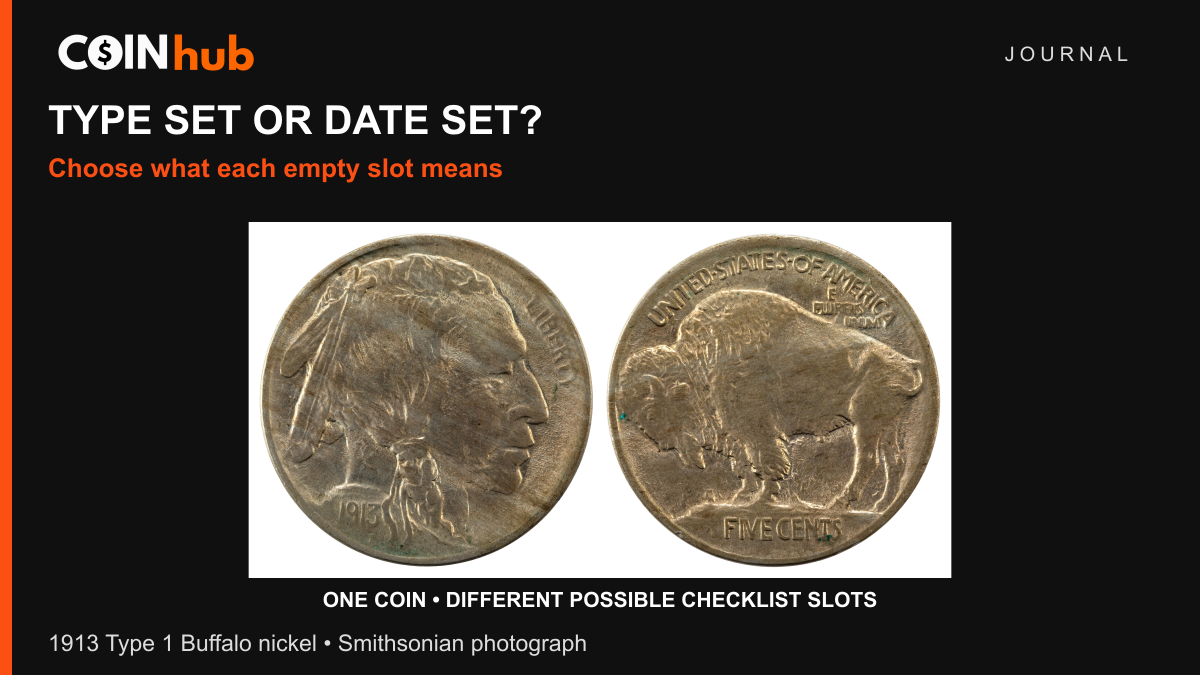
The photograph above shows a 1913 Type 1 Buffalo nickel. An informal checklist might have a single slot labeled “Buffalo nickel.” A more detailed checklist could separate the original raised-mound reverse from the revised reverse. Our 1913 Type 1 versus Type 2 guide explains the visible difference.
Neither scope is automatically right for everyone. The problem appears when the scope changes silently. If you thought one Buffalo nickel finished that part of your collection, discovering two subtype slots later can feel like a surprise expense. Write the subtype rule before buying the album or selecting the coin.
Write a six-line collecting plan
- Subject: Name the denomination, series, era or theme you want to study.
- Slot rule: State design, one-per-year, date-and-mintmark or a specific variety list.
- Manufacture: Decide whether circulation strikes, proofs or other formats belong.
- Subtypes: List the major design revisions you include and any you exclude.
- Condition goal: Describe the level of wear and surface quality you find acceptable.
- Stopping point: Say whether completion ends the project or begins a separate upgrade phase.
For example, an educational project could seek one recognizable example of several chosen nickel designs, with subtype expansion deferred. That is a defined personal type project, not a claim to have completed every nickel issue. Another collector could choose one coin from each required year of a single series. Both plans work better when their limits are written down.
Turn the plan into an inventory
Give each slot a name that does not change when you replace the coin. Keep the slot description separate from the current specimen’s date, mintmark, certification number, purchase record and photographs. An upgrade replaces the specimen occupying a slot; it does not create a new collecting requirement.
A simple status field can distinguish missing, candidate, owned and needs review. “Candidate” is useful when you are still checking attribution or condition. It prevents an uncertain listing from appearing as a finished part of the collection. Retain the old purchase record when you replace an example, rather than overwriting the history.
Check the hard slots before buying the easy ones
Look through the entire proposed checklist before committing to it. A project that begins with readily available coins can later encounter difficult dates, expensive subtypes or proof requirements. You do not have to buy the hardest coin first, but you should know whether the plan includes it.
PCGS’s set-building discussion emphasizes focus and the knowledge gained by studying a series. Put that idea to work with a short pre-purchase note: which empty slot does this coin fill, what evidence supports its identity, and why does its condition fit the plan? If the answer is “none, but I like it,” record it as a separate purchase instead of quietly expanding the checklist.
Do not confuse a collecting plan with a Mint product
A proof set or Mint set is a packaged product category; a type or date checklist is a way to organize a collection. Our proof-set versus Mint-set checklist covers those products separately. A single year’s packaged set should not be assumed to satisfy a full date-series project.
Choose the scope that makes the coins interesting to study and practical to maintain. Completion is meaningful when it means finishing the plan you actually wrote, not matching an undefined label or buying every coin another collector happens to include.
Definitions, registry references and current search results checked September 20, 2026. Example collecting plans are editorial suggestions, not official registry requirements or promises of investment performance.