
Identify the whole set before judging the coins
Two boxes marked with the same year can contain different products. A listing may show only one lens from a larger set, omit a folder, or use “mint set” as a loose description for coins someone assembled. Before comparing prices, establish what is actually being offered.
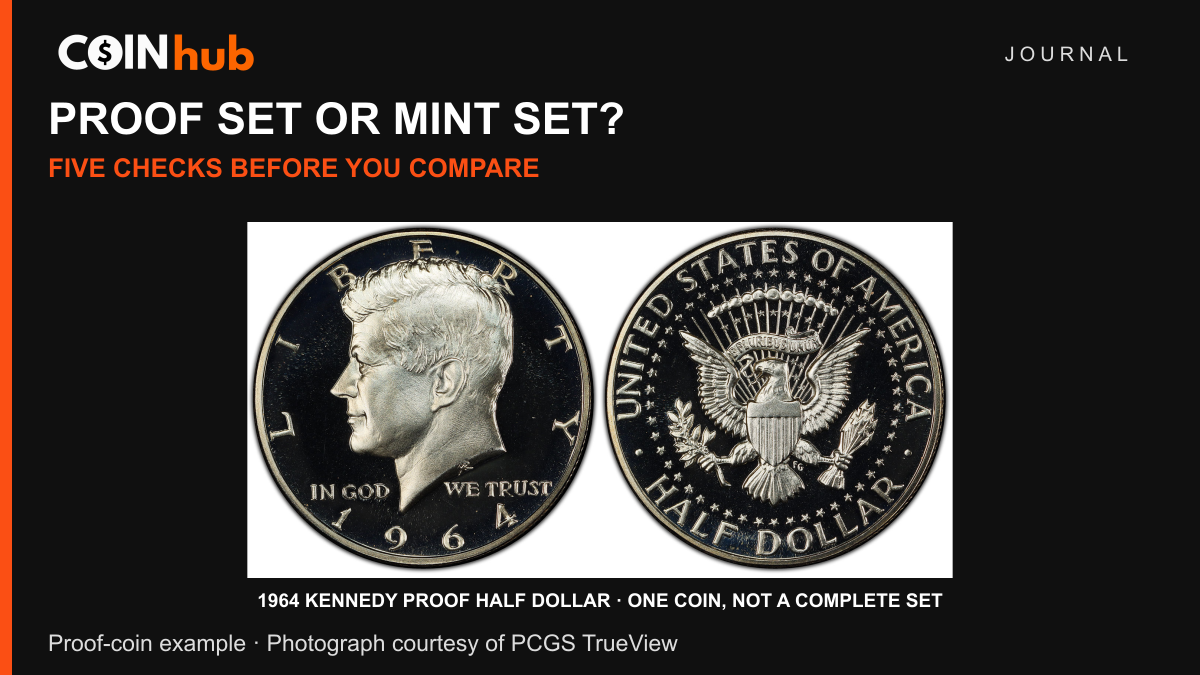
The photograph above shows one genuine Kennedy proof half dollar as a finish example. It does not establish which packaging that particular coin once occupied or show a complete set.
1. Copy the exact product name and year
Record the wording on the package and compare it with the original Mint description. Keep “Proof Set,” “Silver Proof Set,” and “Uncirculated Coin Set” separate in your inventory. Do the same for a product carrying additional wording such as “Limited Edition” or “Reverse Proof.” Do not delete those distinctions to make a shorter spreadsheet label.
If the seller calls something a mint set but provides only loose-coin photos, ask which official product is intended. You may be looking at an assembled year set rather than the original Mint offering. That can still be a useful collection, but your record should describe the contents you can establish.
2. Check the production method for that year
The Mint’s product FAQ describes proofs made with specially prepared blanks and polished dies, with at least two strikes. It also distinguishes collector uncirculated manufacture from ordinary circulating-coin production. “Uncirculated” on a product name therefore deserves more care than simply describing any coin that looks unused.
Year-specific evidence matters. The official 2011 uncirculated set announcement describes a brilliant finish and special presses using greater striking force than circulating coins. A blanket statement that all later mint sets have a satin finish would misidentify that product.
Use appearance to prompt a closer check, then verify the issue. If your question concerns a loose reflective coin, the separate prooflike versus proof guide addresses that distinction. A bright surface alone is not enough to identify an entire set.
3. Match the coin list, not a familiar coin count
Write down each denomination, design and mintmark expected for the particular product. Count the coins in the listing’s photographs against that list. Include every lens, folder or separately packaged component named in the official description.
The 2011 uncirculated set announcement lists 28 coins split between Philadelphia and Denver folders. The 2021 Silver Proof Set description lists seven coins in two lenses. These are examples of why a remembered count from another year or product is not a completeness test.
For a listing with several sets, label each photograph by year before counting. An overall image of a stack of boxes does not demonstrate that the correct coins remain inside every one.
4. Verify metal denomination by denomination
“Proof” describes a method of manufacture and finish, not a promise that a coin is silver. Even a set sold under a silver title needs a closer reading. In the 2021 Silver Proof Set, the Mint identifies the quarters, dime and half dollar as 99.9% silver, while the cent, nickel and Native American dollar have other compositions.
Make a composition column next to the coin list. Copy the specification for that denomination and year; do not infer metal from color, the S mintmark, a seller’s headline or another set’s specifications. If the exact product cannot be established, mark composition as unverified rather than filling the gap with an estimate.
5. Compare equivalent, complete offerings
Once identity is settled, record visible coin condition and what packaging is included. Request photographs of both faces through the holder, along with any missing views. Keep a cracked lens or absent folder in the description instead of letting the box title stand in for the whole offering.
Use the COA and packaging guide to check that paperwork matches. A certificate is supporting documentation; it does not replace inspecting the coins.
| Inventory field | What to write | Mismatch to resolve |
|---|---|---|
| Product identity | Year and full official title | Generic seller title or mixed years |
| Finish | Year-specific Mint description | Appearance substituted for evidence |
| Contents | Expected list and observed list | Missing coin, folder or lens |
| Composition | Alloy for each denomination | “Silver” applied to every coin |
| Offering | Coin condition, packaging and terms | Complete and partial sets treated alike |
A practical way to use the checklist
Suppose two listings both say “2021 proof set,” but only one identifies the silver product. Do not start by deciding which price looks attractive. Ask for the exact package title, coin list and composition evidence for each. Put unresolved details in a short question to the seller. If the answer remains unclear, keep the two listings out of the same comparison group.
Does a proof set guarantee perfect coins?
No. A product’s manufacture and its present condition are separate questions. Examine the actual coins; the word proof is not a numerical grade.
Should I open a sealed lens to identify the set?
Begin with exterior markings, clear photographs and the official product description. You do not need to dismantle packaging just to build the identification record described here.
Which type of set should I collect?
Choose a collecting goal first: a particular year, design program, finish or run of annual products. Then use the same identification fields consistently. This checklist establishes what you are comparing; it does not promise appreciation or rank one product as universally better.
Research note: Official Mint references and PCGS photograph attribution checked September 16, 2026. Historical examples illustrate product differences; current prices and stock status are intentionally excluded.