
Check the issue before judging the paperwork
Collectors often inherit a box containing coins, empty cases and folded cards. The tempting shortcut is to put each coin into the nearest fitting opening. A better starting point is an inventory that treats every item as separate until the matching details have been checked.
Not every U.S. Mint product includes a COA
The U.S. Mint’s product FAQ says certificates are not universal: proof sets contain them, medals typically do not, and sometimes the certificate language is printed on the packaging. Circulating coins sold in rolls, bags or boxes typically do not include certificates.
Those general categories help you start, but the exact product description is the better completeness reference. Save the year, product name and item code when available. “Missing COA” is not a meaningful defect if that product was never supplied with one.
Match three things separately
| Item | Check | Keep separate |
|---|---|---|
| The coin | Date, denomination, mintmark and the stated finish or issue | A box label does not change the coin inside. |
| The certificate | Issuer, product description, specifications and any issue-specific identifying information | Paperwork is not a numerical condition grade. |
| The packaging | Outer carton, case, lens or capsule, inserts and the expected number of coins | A replacement container does not establish original ownership history. |
If the certificate describes a silver product while the coin has not been identified, record the mismatch as unresolved. Do not assume the paper settles the metal question. Likewise, a year printed on the box should be checked against every coin in a multi-coin set.
The Mint advises looking for an appropriate senior official’s signature and a Treasury and/or Mint seal on its certificates. These are checks on the document’s appearance, not a substitute for examining the coin or confirming that the document belongs with it.
Why a case and certificate can become separated
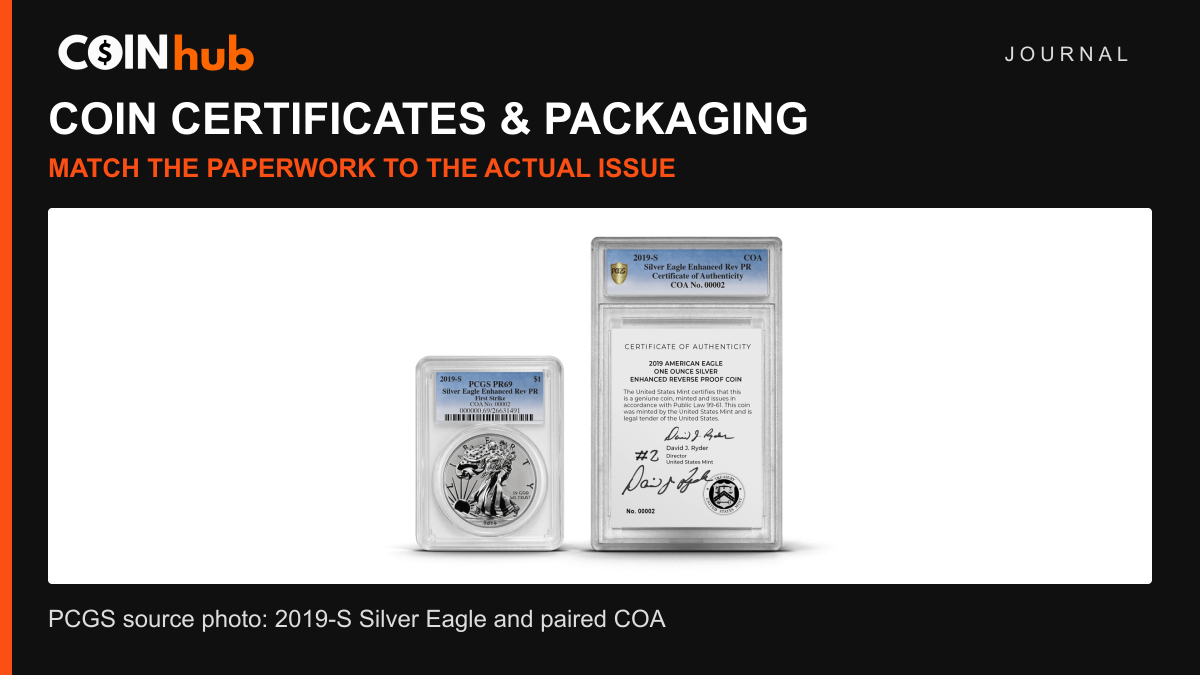
The PCGS example pictured above shows a coin and its COA in separate holders. PCGS publishes specific submission rules for pairing signed or serialized COAs with coins, including original sealed Mint packaging. Check the current rules before opening a package you intend to submit.
In the 2016 San Francisco production report, assembled lens sets move to another room to be combined with certificates and exterior cartons. This historical process helps explain why the coin container, certificate and outer carton are separate inventory items.
For your own collection, keep a reference photograph of the complete package when it arrives. Include the front and back of the certificate, any inserts and the item description on the box. Store that record with the purchase receipt rather than relying on memory when parts are later moved.
What to do when a certificate is missing
- Confirm it was supplied. Check the exact Mint product description or a reliable original listing, including all included components.
- Inspect the packaging. Look for printed certificate language and folded inserts without forcing open a sealed coin lens.
- Record what you actually have. List missing components plainly. “Coin with case; certificate absent” is more informative than “complete” when completeness is uncertain.
- Check replacement availability. The Mint directs customers to customer service to ask whether a replacement remains available. Availability is not guaranteed.
- Keep a replacement record. If paperwork or packaging is acquired later, note that fact alongside its source and date.
A scan is useful for your files, but describe it as a copy. Avoid printing a substitute and presenting it as the original certificate. If selling, photograph the exact items the buyer will receive and make the contents list agree with those photos.
Does original packaging add value?
There is no universal percentage to add or subtract. Compare the same issue in similar condition with clearly described contents. A sale that includes the complete set and packaging is a different comparison from one offering a single loose coin. Keep any price conclusion specific to the actual evidence.
For the physical storage decision, see coin capsules versus flips. For safe inspection, use our coin handling guide. Paperwork research should not require cleaning the coin or opening a certified holder.
Does no COA mean the coin is counterfeit?
No. Establish what the product originally included, then assess the coin itself. Missing paperwork and a counterfeit coin are different findings.
Is a COA the same as a grading-service certificate number?
No. Record the document’s issuer and purpose. Mint product paperwork and the record associated with a certified holder should not be substituted for one another.
U.S. Mint references and Google/Bing results checked September 15, 2026. Matching and inventory steps are CoinHub editorial guidance. No blanket packaging premium or coin-authentication guarantee is offered.