
Choose the material and fit before choosing the format
The question coin capsules vs. flips does not have one answer for an entire collection. A favorite proof you rarely remove, a group of circulated coins you are cataloging and an oversized medal create different storage problems. Start with what the holder is made from and how the coin will sit inside it.
First, know which “flip” you mean
Collectors may use “flip” for two different products. A plastic flip usually folds into two pockets, often with a coin in one and a paper label in the other. A cardboard 2×2 surrounds the coin with film-covered windows and is often stapled shut. A capsule is a rigid, usually two-piece holder. The American Numismatic Association’s storage guide explains these formats and their trade-offs.
| Format | Useful feature | Question before buying |
|---|---|---|
| Hard-plastic capsule | Rigid protection and viewing without opening | Is the interior designed for this coin’s diameter and thickness? |
| Two-pocket plastic flip | Compact storage with a separate label pocket | Is the material documented as PVC-free and suitable for coin storage? |
| Cardboard 2×2 | Writable exterior and a visible coin window | Are the cardboard and film appropriate, and can fasteners stay away from coins? |
1. Check the material—not just “archival” on the listing
Ask for the holder’s actual material and the maker’s intended use. The U.S. Mint recommends acid-free cardboard and PVC-free plastic. That is more useful than assuming any clear holder is harmless.
NGC explains that softening agents in flexible PVC products can migrate and leave residue on coins. Its holder guidance also warns against burning plastic to identify it. Treat an unknown old flip as an unanswered materials question, rather than conducting a home flame test or relying only on its smell.
Your decision: Save the product description or packaging that identifies the material. If the seller cannot tell you what touches the coin, choose a better-documented holder. Suspected contamination belongs in a separate assessment; see our PVC-damage guide before trying to remove anything from a coin.
2. Check the interior fit
A holder’s outside size is not the same as the space available for a coin. Before ordering, compare the maker’s interior dimensions with the specifications for your exact coin. Ask about thickness as well as diameter, especially for high-relief pieces, thick medals and irregularly shaped coins.
For a capsule that uses an insert or ring, check the material and the supported size range of that insert too. For a flip, inspect the pocket opening and closure arrangement. “It fits inside” is an incomplete test if placing or removing it requires dragging the surface against an edge.
Your decision: Do not force the lid shut or press on a coin to make an unsuitable holder work. If fit is unclear, keep the coin in its existing suitable holder while you obtain the correct specifications. This is a selection checklist, not a recommendation to repeatedly trial-fit a valuable coin.
3. Plan how often you really need to handle it
Choose a viewing arrangement that reduces unnecessary transfers. Can you see both sides through the holder? Can you read the label without opening it? Is a clearer photograph enough for the cataloging task you had planned?
NGC notes that some non-PVC flips can split with repeated use. The ANA also flags cardboard dust and projecting staples as hazards. Inspect worn holders before reuse; material suitability does not make a cracked pocket or exposed fastener harmless.
Your decision: Prepare the receiving holder, label and clear workspace before a necessary transfer. Handle coins by their edges over a soft surface, as the Mint advises. Keep the full routine in our coin-handling guide handy. Do not open a certified slab just to move the coin into a matching storage system.
4. Make room for the coin’s records
The coin and its history should stay connected. A flip’s second pocket or a cardboard holder’s exterior gives you an obvious labeling location; a capsule may need a labeled outer box or inventory slot. Avoid placing an improvised adhesive label against the coin.
Your decision: Assign an inventory number before rearranging a group. Record the date, mintmark, denomination and source of identification; keep the purchase record and any original documentation associated with that number. The U.S. Mint specifically advises saving certificates and information cards. Photograph the old label before retiring a damaged holder so a hurried transfer does not erase useful context.
5. Check the box, shelf and room too
A good holder cannot fix every environmental problem. PCGS’s storage guidance emphasizes protection from surroundings and limiting unnecessary exposure. The ANA explains that hard-plastic holders generally seal more tightly than flips, but perfect airtight protection is not assured.
Your decision: Choose a stable, cool, dry location and an outer arrangement that holds each package securely. Check that capsules fit the box and that binder pages support the intended holders. Inspect periodically for damage or visible changes instead of treating the word “capsule” as a permanent preservation guarantee.
A simple holder decision record
For each new holder type, write five short answers: material verified; interior fit confirmed; viewing/handling plan; record location; storage location. An unanswered item tells you what to resolve before moving the coin. This small record is more useful than a blanket rule that every coin must use the same format.
Common questions
Are all soft flips bad?
Judge the documented material and intended use, not softness alone. For long-term storage, avoid PVC and unknown materials. This guide does not promise a safe time limit for an unsuitable holder.
Should I replace original Mint packaging with capsules?
Check what is already there first. The Mint advises preserving original cases and capsules. A new outer storage box may solve the organization problem without disturbing the coin.
Does a hard holder mean the coin was professionally graded?
No. An ordinary capsule is a storage product. Certification requires a grading service’s identifiable holder and record; see how to read a certified coin label.
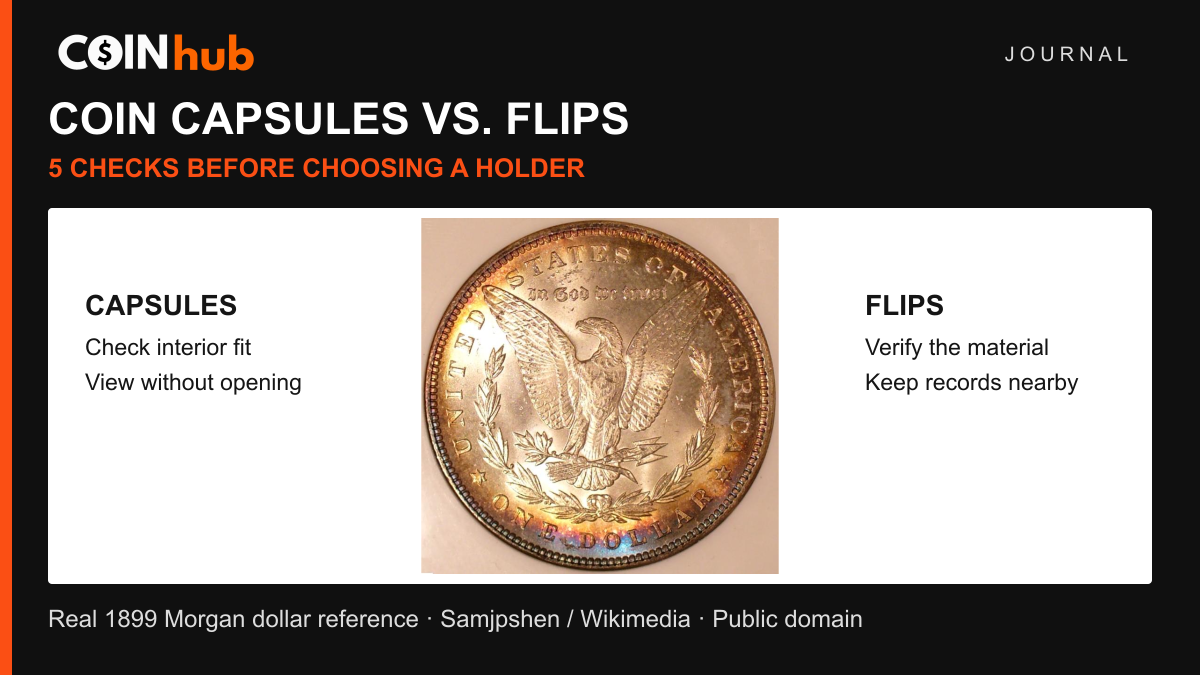
Sources reviewed September 14, 2026: U.S. Mint, ANA, NGC and PCGS guidance linked above. The photograph shows a real Morgan dollar as a reference coin; its toning is not evidence of any particular storage method. Checklist decisions are CoinHub’s practical application of the source guidance, with no product endorsement or guaranteed preservation result.