
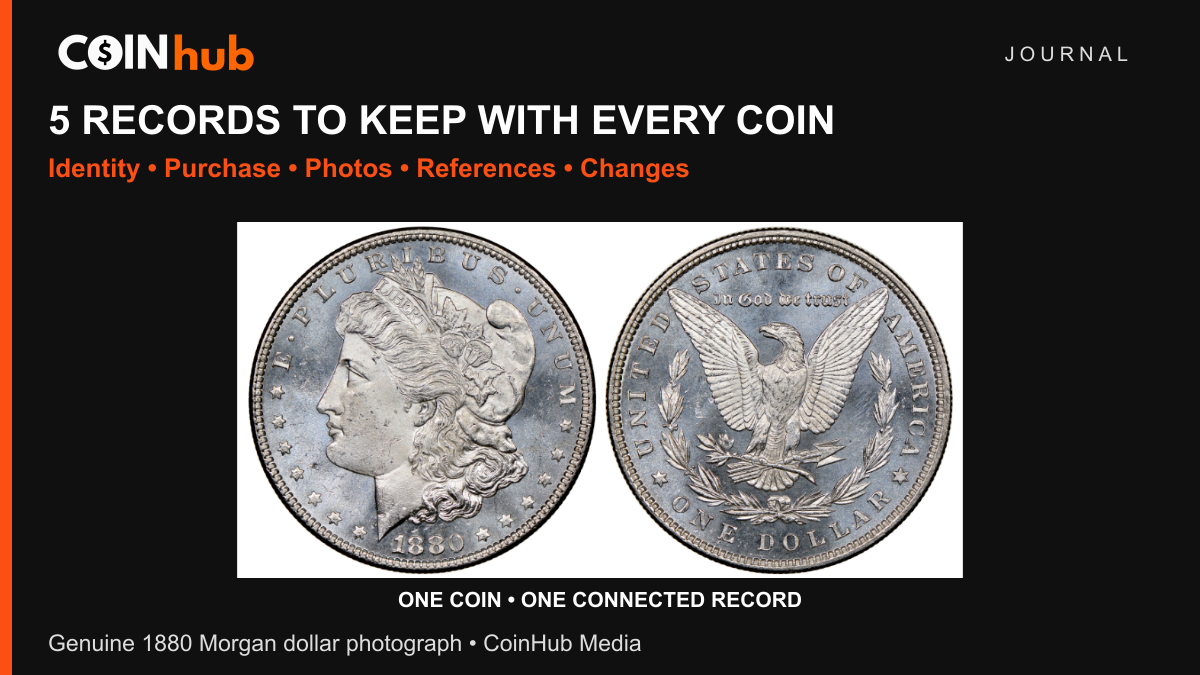
Keep the story attached to the right coin
A useful coin collection record connects five things: the coin's identity, its acquisition evidence, clear photographs, supporting references and a history of later changes. Give each piece one internal record number so those files stay together.
A checked box tells you that you own an 1880 Morgan dollar. It may not tell you which example you bought, what came with it or where its receipt went. When a collection grows, those missing connections become harder to reconstruct.
You can keep these records in a notebook, spreadsheet or inventory program. The American Numismatic Association provides label inserts and inventory resources, while PCGS describes inventory tools that can hold photographs, costs and other information. Whichever format you choose, the goal is a record you can understand and maintain.
1. A precise identity record
Start with country or issuing authority, denomination, series, date and mintmark. Add the variety when you have evidence for it. Record the grading service, full holder description and certification number for a certified coin. For a raw coin, identify any condition assessment as your opinion rather than making it look like a third-party grade.
Give the physical piece a simple internal number, such as C001, and use that number on the associated folder or holder label. Do not mark the coin. Two examples of the same date and mintmark need different records if you want to distinguish them later. Record uncertainty plainly: “mintmark not confirmed” is better than an unsupported guess.
2. The acquisition evidence
Save the receipt or invoice, seller's description, acquisition date and source. For an auction purchase, preserve the lot number and the listing you relied on. Keep the amount paid with its component charges when the invoice supplies them, rather than recording only the hammer price.
A purchase amount and a later market estimate answer different questions. Put estimates in a separate field with their source and date. Do not replace your original transaction record each time a price guide changes. For a gift or inherited coin, record what is actually known and who supplied that information; leave an unknown purchase price unknown.
3. Photographs of the actual piece
Keep clear images of both sides and, when practical without risking damage, the edge. For a holdered coin, include the complete holder and its label. Use the same internal number in the filenames so the images cannot drift away from the right record.
Photographs help you compare a coin with your own earlier documentation. They do not independently establish authenticity or a grade. Preserve the original image files and avoid filters that change the appearance of surfaces. CoinHub's coin photography guide explains a straightforward setup without cleaning the coin first.
4. The references behind the description
Save the source for a variety attribution, relevant certificate, auction description or documented pedigree. Include the page title, link and date checked, or the book edition and page. A short note explaining what the source supports will help when you return months later.
Keep a previous-owner claim separate from proof of that claim. A seller's description can be useful evidence of what was represented, but it does not automatically establish the entire ownership history. See how to check coin pedigree and provenance for that more specific research task.
5. A dated history of changes
Add an entry when a coin is reholdered, regraded, conserved, sold, gifted or traded. Preserve the earlier certification information and connect it to the new record where the connection is documented. Otherwise, an old photograph and a new label can start to look like two different coins in your inventory.
When a piece leaves the collection, mark its status and save the relevant transaction record instead of deleting its history. Review any collection totals so a sold coin is not still counted as owned. A simple “last checked” date also helps you distinguish a maintained record from one that has not been reviewed for years.
Make the system easy to keep
Start with the next coin you acquire, or one coin already on your desk. Create its record number, complete the five parts and note the gaps. Repeat that small process rather than waiting until you can catalog everything perfectly.
Keep a backup separate from the working copy and check that you can open it. Public collection pages should not expose receipts, private contact details or precise storage locations. If you use an online inventory, review its sharing settings before adding information you intend to keep private.
Do inexpensive coins need records too?
Use a level of detail you can sustain. A basic identification and acquisition note may be enough for a routine piece, while a specialist attribution deserves its supporting references. For interchangeable bulk items, clearly labeled quantity records can be practical. Individually attributed or photographed coins benefit from individual records.
Resources checked September 25, 2026: the American Numismatic Association's inserts and inventory page and PCGS Set Registry information, linked above. The five-part workflow is CoinHub's editorial guidance. Photograph: CoinHub Media's genuine 1880 Morgan dollar image, resized with editorial layout added; no transaction or grading claim is attached to the pictured specimen.