
Read the wear description and the problem together
“Details” can sound like a compliment about a sharp design. On a grading label, it has a more specific job. Read the whole assessment before deciding what the coin is, what happened to it or which other examples make a fair comparison.
This guide concerns professional grading terminology. A seller typing “great details” in a listing has not issued a grading-service assessment. If the holder or certificate is uncertain, begin with the separate guide to reading and checking PCGS and NGC labels.
What AU, XF and UNC Details tell you
NGC’s Details scale describes preservation in words rather than assigning a Sheldon-scale number. UNC Details indicates no wear or circulation evidence; AU Details indicates light wear at high points; XF Details describes well-defined features with light wear throughout. Those words describe one part of the assessment. They do not cancel the separately identified problem.
For example, record “AU Details — Cleaned” exactly as shown instead of shortening it to “AU.” The shorter entry drops the information that prevents you from treating it as an ordinary numerical AU grade.
| Label information | Useful interpretation | Unsupported shortcut |
|---|---|---|
| Wear description | A broad preservation category | Choosing a numerical grade yourself |
| Problem qualifier | A condition issue identified by the service | Assuming it lists every issue |
| Certification record | A record to match to the holder and coin | Assuming a copied number proves authenticity |
| Details assessment | A starting point for examining that specimen | Applying a fixed percentage discount |
A label may not list every problem
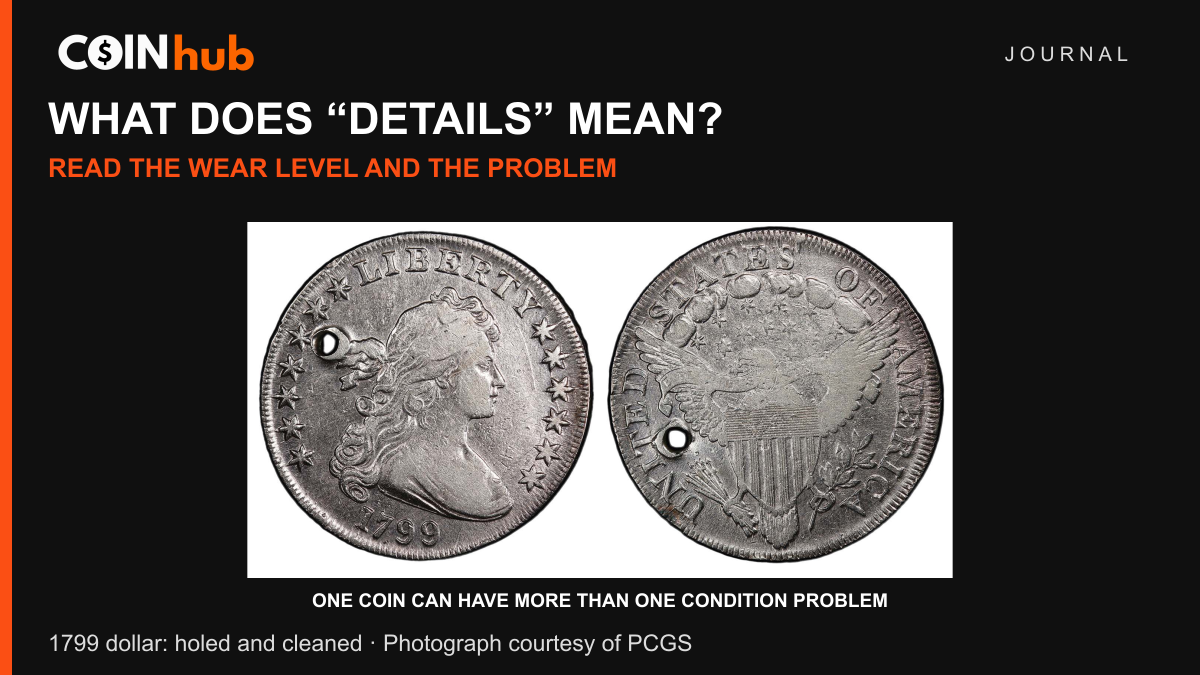
The 1799 Draped Bust dollar pictured above is a useful example. PCGS identifies both a hole and cleaning. Its explanation says that when a coin has multiple disqualifying issues, the most serious one takes precedence in labeling. For this dollar, the hole is the dominant physical problem.
The practical lesson is to inspect beyond the printed qualifier. A label naming a hole should not lead you to assume the remaining surfaces have no issues. Nor should a second visible concern automatically be described as something that occurred after grading. You need evidence to establish that history.
Keep the attribution attached to its source. Here, “holed and cleaned” is PCGS’s description of the illustrated coin. It is not a new diagnosis of a reader’s coin based on a similar-looking thumbnail.
Build a short specimen record
- Transcribe the complete label. Include service, coin identity, wear description, qualifier and certification number. Keep the punctuation or abbreviations needed to avoid changing the meaning.
- Save matching full views. Photograph the holder front and back, plus clear coin views. Keep close-ups linked to the complete images.
- Separate attribution from observation. Write “label says Cleaned” on one line and describe what you can actually see on another.
- Record the unanswered question. For example: “The reverse field is obscured by glare; need another angle.”
- Keep the original listing. Preserve the seller’s description, date and photographs so later comparisons refer to the same offering.
Do not add a numerical grade in an empty database field just because the software expects one. Use a text field or a separate Details category. A tidy-looking entry is less useful if it changes the grading result.
Compare the problem as well as the issue
NGC notes that the severity and location of a detrimental condition matter alongside the wear description. Two coins with the same broad label can therefore present quite different comparison problems.
Start a comparison sheet with the same date, mint and relevant variety. Then add the exact wear description, qualifier, visible location and extent of the issue, quality of photographs and sale date. Mark an asking price as an asking price. Record auction charges separately if the stated result does not include them.
A coin with an obscured reverse is a weak comparison for one photographed clearly on both sides. A listing that omits the qualifier is also incomplete evidence. Leave those limitations visible in your notes instead of averaging unlike examples into a precise-looking answer.
Why there is no automatic numerical conversion
PCGS’s Details explainer distinguishes problem coins from coins that receive ordinary numerical grades. Treating UNC Details as MS63, or AU Details as a particular AU number, adds a conclusion the service did not give.
Similarly, “subtract one grade” or “take off half” is not a specimen-specific appraisal. If you need a value for a sale or purchase, assemble genuinely comparable records and seek an opinion that addresses the actual issue and its severity. This guide supplies a documentation method, not a price estimate.
Does Details mean counterfeit?
A professional Details assessment is for a genuine coin with a grading problem. That does not authenticate an unverified online listing or prove that its holder and contents match the service’s record.
Can cleaning remove a Details problem?
Do not attempt to improve a coin simply to pursue a different label. NGC distinguishes destructive cleaning from conditions that may be suitable for professional conservation; permanent damage is not erased by conservation. See the cleaned-coin guide for the separate identification question.
Can a Details coin belong in a collection?
Yes, if you understand the condition and it suits your collecting goal. Decide which issues you are willing to accept, document them accurately and evaluate the actual specimen. The label is useful information, not a substitute for that decision.
Research and image note: PCGS and NGC references checked September 16, 2026. The complete PCGS photograph is reproduced with source credit under CoinHub’s standing photograph permission. No numerical grade, sales result or value is assigned to the illustrated dollar.