
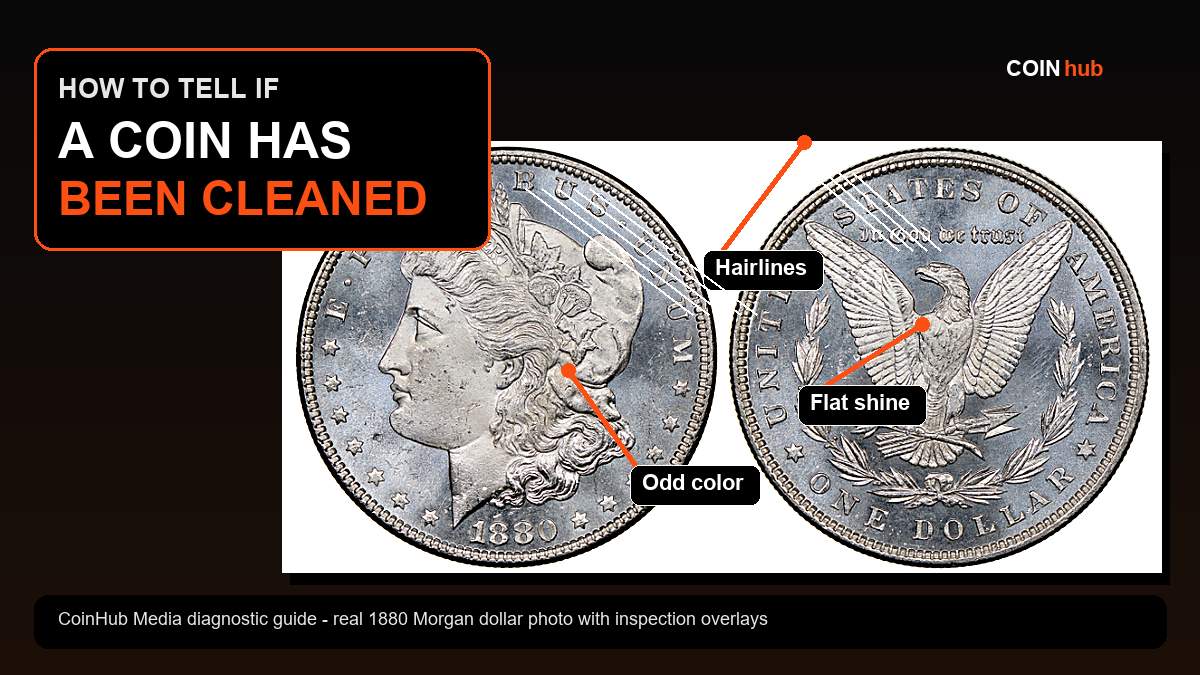
Quick answer: A cleaned coin often shows unnatural brightness, flat or broken luster, parallel hairlines, odd color, residue in protected areas, or scratches that run across both the fields and raised design. The best first test is to tilt the coin under one strong light. Original luster should move across the surface; cleaning hairlines often flash as fixed straight lines.
Cleaning is one of the most common value killers in coin collecting. Many coins get cleaned by people who think they are helping: a quick wipe, a jewelry cloth, baking soda, polish, an eraser, a dip left too long, or a brush used to remove dirt. The coin may look brighter for a moment, but the original surface can be permanently changed.
This guide is not about conservation by a professional service. It is about the everyday collector question: "Does this coin look cleaned, and should I still buy, grade, or sell it?" If you are sorting inherited coins, silver dollars, old copper, type coins, or modern bullion, slowing down before cleaning can save real money.
CoinHub rule: Do not clean a coin to make it easier to sell. If the coin might have collector value, photograph it, keep it dry, avoid rubbing the surface, and get a second opinion before doing anything permanent.
What Does "Cleaned Coin" Mean?
A cleaned coin is a coin whose surface has been altered by rubbing, brushing, polishing, wiping, dipping, chemical treatment, or another attempt to improve its appearance. Some cleaning is obvious. A harshly polished coin may look mirror-bright in the wrong way. Other cleaning is subtle and may show only as faint hairlines at a certain angle.
PCGS describes cleaning as a broad no-grade category that can range from a grossly polished coin to faint hairlines visible only under certain lighting. NGC's details-grading guidance separates several related problems, including improperly cleaned, brushed, burnished, polished, whizzed, wiped, and spot removals. The practical takeaway is simple: cleaning is not one look. It is a family of surface problems.
How To Check a Coin for Cleaning
Cleaned Coin Warning Signs
| Warning sign | What it may mean | What to check next |
|---|---|---|
| Parallel hairlines | A cloth, brush, eraser, or abrasive surface may have moved across the coin. | Tilt the coin. If the lines flash together and run across devices and fields, be cautious. |
| Flat shine | The coin may be polished or overdipped, with original cartwheel luster weakened. | Compare with an original coin of the same type if possible. |
| Bright fields, dark protected areas | Someone may have cleaned the easy-to-reach surface while dirt remains around letters and design details. | Look around stars, date digits, lettering, eagle feathers, wreaths, and portrait hair. |
| Odd copper color | Copper can look unnatural after chemical treatment, recoloring, or harsh cleaning. | Be extra careful with red-looking older copper that does not match normal surfaces. |
| Whizzed appearance | A rotary brush can create fake brightness and disturb design details. | Look for unnatural flow, wire-like lines, and distorted detail near letters. |
| Spot-removal patches | Small dark spots or stains may have been mechanically removed. | Check for isolated dull circles, scratches, or different texture where a spot used to be. |
Cleaned Coin vs Bag Marks vs Natural Toning
A cleaned coin is not the same thing as a coin with normal contact marks. A Morgan dollar can have bag marks and still be uncirculated. A Peace dollar can have chatter from storage and still retain original luster. Cleaning is different because it changes the surface itself.
Natural toning is also different. Toning can be attractive, neutral, ugly, or artificial depending on the coin and how it formed. Cleaning often removes or disrupts toning, leaving a coin too bright in the open fields but still dark in protected areas. When in doubt, look for the combination of unnatural shine plus hairlines or missing luster.
If you are comparing surface issues, read CoinHub's bag marks on coins guide, cartwheel luster guide, and milk spots on silver coins guide. Those pages help separate normal hits, original mint shine, silver spotting, and cleaning damage.
Does Cleaning Always Ruin a Coin?
Cleaning does not always make a coin worthless, but it can sharply reduce collector value. Common coins may still be worth silver melt, face value, or modest collector money. Better-date coins, early type coins, gold coins, key dates, and high-grade coins can lose a large share of their premium if harshly cleaned.
PCGS and NGC both use details-style outcomes for coins with surface problems that prevent normal numeric grading. A details coin can still be genuine and collectible, but the label tells buyers that the surface problem matters. That is why a cleaned coin often sells for less than a problem-free coin with similar wear.
Can a Cleaned Coin Be Fixed?
Sometimes professional conservation can safely remove certain residues, contaminants, or surface problems. That is not the same as undoing harsh cleaning. NCS explains that improper cleaning removes surface metal by mechanical or chemical means, and once that metal is gone it cannot be replaced. Trying to remove scratches usually means removing even more metal.
That is the collector lesson: do not turn a possible conservation issue into permanent cleaning damage. PVC residue, sticky contamination, or unattractive deposits may need expert review. Rubbing the coin at home is usually the wrong first move.
Should You Buy or Sell a Cleaned Coin?
A cleaned coin can still make sense if the price reflects the problem. Some collectors buy details coins as affordable examples of rare dates. Others avoid cleaned coins completely. The answer depends on rarity, eye appeal, price, and your collecting goal.
If you are selling, describe the coin honestly. Do not call a cleaned coin "brilliant uncirculated" just because it shines. If you are buying, assume cleaning matters most when the coin is expensive, scarce, copper, high grade, or being sold raw with no certification.
Cleaned Coin FAQ
How can you tell if a coin was wiped?
A wiped coin often shows fine hairlines in one area or across the surface. The lines may run in the same direction and become easier to see when the coin is tilted under one light.
Is dipping a coin the same as cleaning?
Dipping removes toning by chemical action. PCGS notes that dipping is not always treated the same as abrasive cleaning, but repeated or improper dipping can still damage a coin and hurt value.
Are cleaned silver dollars worth anything?
Yes, many cleaned silver dollars still have silver value and some collector value. The discount depends on date, mint mark, rarity, eye appeal, and how harsh the cleaning is.
Can a grading company grade a cleaned coin?
A grading company may authenticate the coin and assign a details grade instead of a normal numeric grade if the cleaning or surface problem prevents numeric grading.
What should I do if I already cleaned a coin?
Stop cleaning it. Store it safely, do not keep rubbing it, and get an honest opinion before selling or submitting it. More cleaning usually makes the problem worse.
Bottom Line
The easiest cleaned-coin mistake is chasing shine. Original surfaces matter more than brightness. If a coin has fixed parallel hairlines, flat shine, odd color, or polished-looking fields with dirt trapped around the design, slow down. The coin may still be collectible, but it should be priced and described as a problem coin.
Sources: PCGS No Grade Coins - Part IV; PCGS From the Grading Room: The Details Grade; NGC Details Grading; NCS/NGC Effects of Improper Cleaning.