
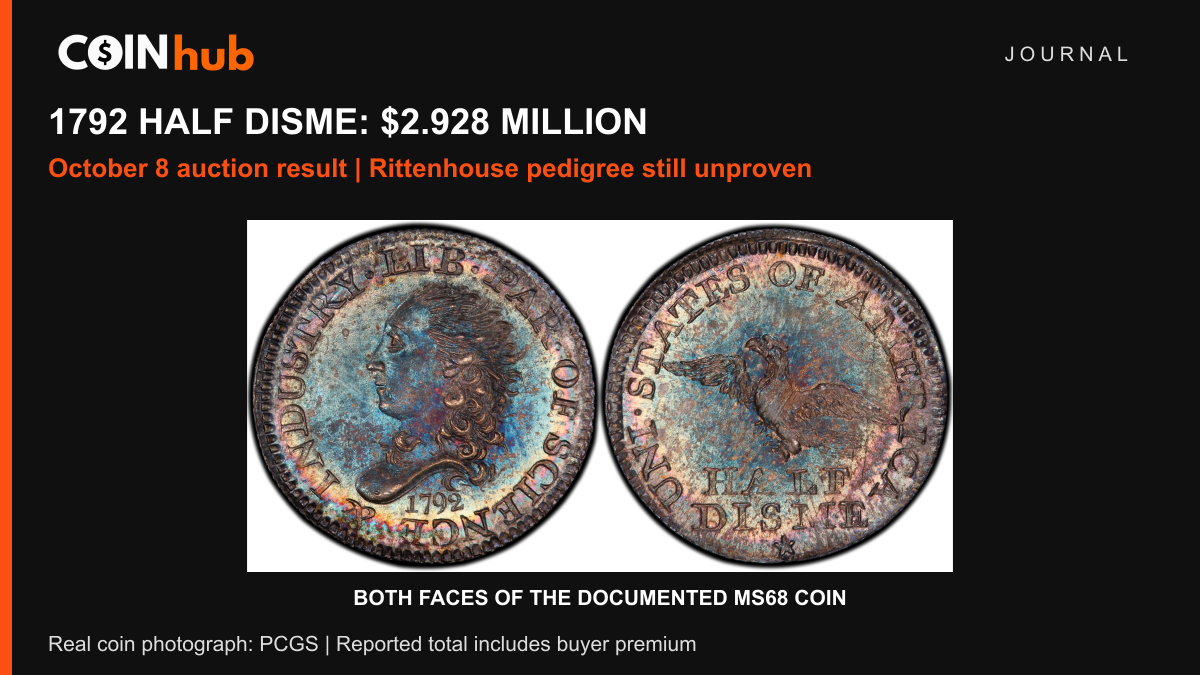
A 1792 half disme sold for $2,928,000 at Heritage Auctions on October 8, 2026. Heritage reported the result on October 12 and called it an auction record for the issue. The coin, from the Ronald Firman Collection, is graded PCGS MS68.
One part of its story remains less certain. The auction catalog does not claim to have proved that this coin belonged to David Rittenhouse, the first U.S. Mint director. The sale does not settle who owned the coin long ago.
The sale date and the report date are different
The October 12 Heritage announcement covers the October 8–9 GACC U.S. Coins auction. The individual half-disme lot, number 3414, gives October 8 as its sale date. The sale is over. The report describes what happened then.
| Record | What it identifies |
|---|---|
| 1792 | The date on the coin |
| October 8, 2026 | The lot’s sale date |
| October 12, 2026 | Heritage’s result announcement |
| $2,928,000 | The reported total, including buyer premium |
| PCGS MS68 | The recorded grade of this specimen |
A half disme was a five-cent silver denomination. Its name does not make it a modern Jefferson nickel. Our half-dime guide explains the later silver denomination; this 1792 issue belongs to a much earlier chapter.
Read the total with its buyer premium
The reported $2.928 million is the total with the buyer’s fee, not a stated hammer bid. A buyer premium is the auction fee added to the successful bid. The lot’s auction information lists a 22% premium.
Using those two figures gives a calculated hammer of $2,400,000: $2,928,000 ÷ 1.22. The fee works out to $528,000. These amounts come from that math. They explain the total; the release does not quote them as separate results. No tax or shipping costs have been added.
When comparing auction records, check whether each figure includes fees. A total with fees and a hammer bid alone use different bases. They can make two sales look farther apart than they are. Save the lot link, sale date, grade and price basis together.
A grade and an ownership claim answer different questions
The PCGS record linked by the lot gives this half disme an MS68 grade. MS stands for Mint State. The record reports one example at that grade and none higher at PCGS when checked for this article.
That is one grading company’s record for this issue and grade. It is not a count of every surviving half disme, including worn coins or coins held by other services. The photo above comes from that linked PCGS record. It shows both faces in full.
The record also carries the name David Rittenhouse. A pedigree is a coin’s claimed chain of past ownership. A name on a label records the claim. Proof needs more: records or old photos that can be linked to the same coin.
What the catalog says about Rittenhouse
Heritage cites a 1919 lot with no photo. That old lot described a half disme said to come from the Rittenhouse family. The catalog says a connection to the present coin is possible but unverified. It also rules out a proposed 1921 sale link: the photo shows a different coin.
For this coin, the firm trail backed by matching photos starts at an October 1988 sale. The years before that remain a gap. Good condition alone cannot identify who saved a coin two centuries ago.
The lesson applies to less costly coins, too. Keep a historical claim separate from its supporting record. If a catalog casts doubt on a pedigree, keep that doubt in your notes. Do not pass on just the famous name.
What this result tells collectors
The result is a price paid for one very well-preserved coin at one sale. It does not price a different coin with the same date or face value. Wear, surfaces, proof that a coin is genuine and its own history still matter.
For an early coin you do not know, save photos of both faces and the edge. Keep all its papers. Leave a certified holder sealed. An expert needs to assess the coin itself. A large sale price makes sound proof more useful; it does not replace that work.
Sources and price basis: Heritage’s October 12 release and October 8 lot record; the lot-linked PCGS certification, checked October 14, 2026. The reported total includes buyer premium; hammer and premium amounts above are explicitly calculated from the listed 22% rate. Record acceptance and a holder label do not resolve the unverified early pedigree.
Photograph: PCGS, from the linked certification record. Complete coin faces resized for the CoinHub layout; headline and branding added. No coin detail was reconstructed and no source endorsement is implied.