
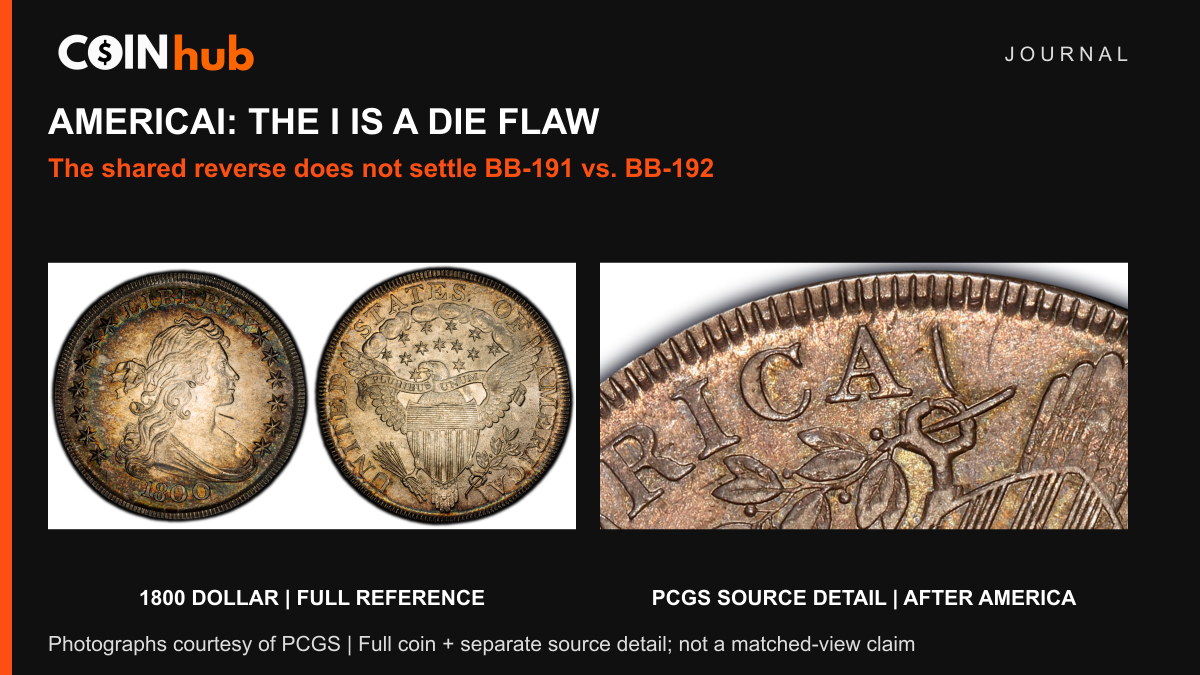
Look just after the final A in AMERICA
Quick answer: The 1800 AMERICAI dollar has a raised die feature after AMERICA that resembles an extra I. It is not a deliberately engraved extra letter. Two cataloged die pairings, BB-191 and BB-192, share this reverse, so the I-like mark alone does not distinguish them.
Turn the coin to the eagle side, called the reverse, and read the outer lettering. The feature sits after the last A in AMERICA. Keep it in the same view as that letter and the surrounding design. A tight crop of an isolated line can hide where it came from.
The main photograph shows a PCGS reference dollar. The separately supplied PCGS detail is a diagnostic reference view. It should not be treated as proof that a reader's coin is genuine or as a grade assigned to that coin.
The nickname describes the appearance
In the PCGS CoinFacts account, Ron Guth explains that a die flaw resembles an I in just the right place to make the word appear misspelled. The distinction is small but useful: the coin carries the impression of a feature in the die, not a normal extra letter in the intended legend.
A die is the tool that stamps a coin's design. A recessed flaw in that tool can leave raised metal on the struck coin. A later cut into the coin is a different process. The word AMERICAI is the familiar collector label for the appearance, rather than an instruction to expect a neatly shaped letter identical to the rest.
Use the broad term die flaw when describing this feature. Older catalog language may call a die feature a scratch or gouge. That does not mean somebody scratched an I into the finished coin. What matters for this identification is the repeated raised feature and the rest of the documented design.
One reverse, two different front dies
A die marriage is a specific pairing of a front die and a back die. PCGS identifies both BB-191 and BB-192 within the AMERICAI group. They share the distinctive reverse but use different obverses, or front dies.
That creates two levels of identification. You may recognize the broad AMERICAI feature while still lacking enough evidence to assign a BB number. Do not fill that gap by choosing whichever catalog photograph seems closest in color or wear. The front-die details need their own comparison.
| Observation | What it supports | What it does not settle |
|---|---|---|
| I-like raised feature after AMERICA | A possible AMERICAI reverse match | Authenticity or a complete die marriage |
| Both sides match a recognized reference | A stronger attribution record | An automatic grade or current price |
| Only one unclear close-up | A reason to seek better photographs | A confident variety label |
Separate a raised die feature from later damage
A scratch can push metal up along the sides of a groove. From one lighting angle, that raised edge can look like the whole feature. Take a second view with the light moved, and look for a central cut or disturbed nearby detail.
Our die crack versus scratch guide explains why height is a starting clue rather than a complete diagnosis. For the AMERICAI dollar, position and the surrounding design also matter. An unrelated raised line somewhere near AMERICA is not enough.
Do not trace the mark with a point, polish it or apply a chemical to improve the view. Keep the surface as found. Better light and sharper photographs preserve more evidence than a physical test that changes the coin.
Build a record that can be checked
- Photograph the complete dated front and the complete eagle reverse.
- Make a detail view containing the final A, the I-like feature and nearby design.
- Record the catalog source you used, including whether it names BB-191 or BB-192.
- Keep an uncertain front-die match separate from a more confident reverse observation.
- Have a promising coin examined in hand before offering it with a firm attribution or authenticity claim.
A practical note might read “1800 dated dollar; possible AMERICAI reverse; front die not established.” That is a useful record of the evidence. It avoids turning one visible clue into a conclusion about every part of the coin.
A familiar name does not supply a value
Certified auction coins can differ in die marriage, wear, surface condition, repairs and ownership history. Compare those details before using a sale as evidence for another coin. A record price or a seller's advertised amount cannot establish what an unverified example will bring.
This is also why an old population or survival estimate should not become a claim that only that many coins exist today. Identify the coin and the relevant evidence first. Price and rarity statements require their own dated support.
Sources checked October 17, 2026: PCGS CoinFacts entries 6892, 40081 and 40082. Photographs courtesy of PCGS under CoinHub's saved photo permission. The complete dollar photograph and a separate source detail are reference images; no matched-specimen claim is made. No coin details altered and no current price or survival count claimed.