
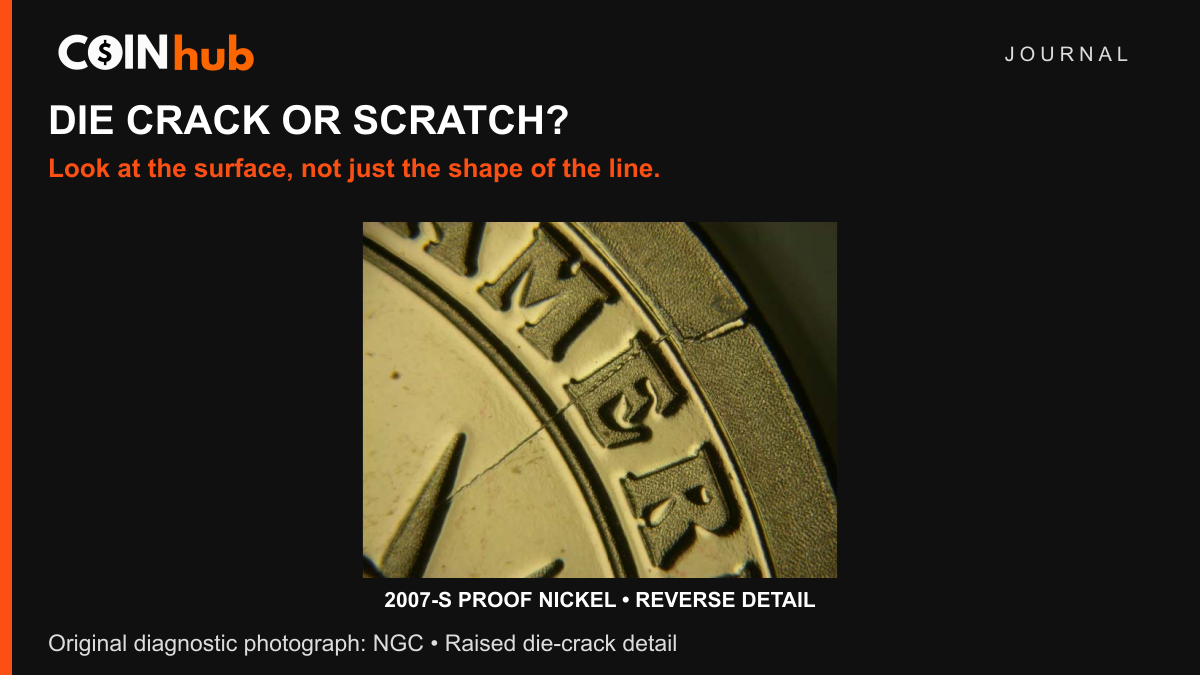
Start by asking whether the line is raised or cut into the coin
Do not trace the line with a needle, fingernail or abrasive. Keep the coin unchanged. The task is to observe what happened to its surface, not to test how easily a mark can be removed.
The photograph above is an NGC-identified crack on the reverse of a 2007-S Proof Jefferson nickel. In its original report, NGC locates the crack near the two o'clock position. The source photograph is already a close-up; it is not a full-coin identification image.
How a cracked die makes a line on a solid coin
A die is the hardened tool that impresses the design into the blank. When that tool develops a fissure, metal can enter the gap during the strike. The resulting ridge belongs to the struck surface. The coin itself need not be split.
That distinction matters when describing a find. “Crack on the coin” is ambiguous: it can mean a raised impression of a damaged die, a separation in the coin's own metal, or simply a scratch. Describe what you can see before selecting a label.
| Observation | What it may suggest | What still needs checking |
|---|---|---|
| Raised, irregular ridge | A die-crack impression | Whether the line is truly raised and follows a coherent surface feature |
| A groove with pushed-up edges | Post-strike scratching or scraping | The central cut, disturbed design and lighting from another direction |
| Fine raised lines in the field | Possible die-polish lines | The pattern and relationship to the design, rather than height alone |
| Opening, peeling or separated metal | A problem involving the planchet or later damage | Whether metal is actually separating; this is not the same mechanism as a die crack |
A short photo check that preserves the evidence
- Take a full view of each side. Record the denomination, date, mintmark and finish. A close-up without this context can hide an important difference.
- Photograph the line under a second light direction. Highlights and shadows can reverse the apparent height of a feature. Compare the images rather than deciding from one bright edge.
- Follow the entire feature. Note where it starts and ends, whether it branches, and how it meets lettering or the rim.
- Look for a central groove. A raised lip beside a gouge does not turn damage into a die crack.
- Keep the description provisional. “Possible raised die-crack line” is more useful than a confident rarity claim when the surface remains unclear.
Our coin photography guide explains how to document a coin without cleaning it. Do not increase sharpening until ordinary texture becomes a network of apparent ridges.
Raised does not always mean die crack
A scratch on the die can also produce a raised line on a coin. That is why fine die-polish lines and cleaning hairlines need their own comparison. The height of a line is one clue; its pattern and origin still matter.
A rim-connected raised blob may instead require the separate die-cud diagnostic. Flaking or split surface metal belongs in a lamination assessment. Keep these categories distinct instead of calling every unusual mark a cracked die.
Why the Proof example needs context
NGC's report emphasizes that Proof production normally screens out cracked-die pieces. Small cracks can be treated differently in that setting than on ordinary circulation strikes, where minor die wear and breakage may be tolerated. The pictured Proof nickel is evidence of the mechanism, not proof that every similar-looking pocket-change coin is equally unusual.
NGC also explains in its discussion of minor varieties that familiar small cracks may not qualify for attribution under its services. Before paying for certification, check the service's current eligibility and consider the specific coin, severity and purpose of the submission.
Does a die crack make a coin valuable?
There is no automatic premium. Identify the feature first, then look for sold examples of the same issue and a comparable crack, condition and certification. A dramatic break on a different coin is a poor comparison for a faint line on yours. A seller's asking price is not a confirmed sale.
Common questions
Must a die crack start at the rim?
No. A rim connection can help document its path, but do not reject or accept a possible crack on that feature alone.
Does a raised line prove the coin is an error?
No. Several processes can create raised features, and attribution policies depend on the feature and its degree. A clear surface assessment comes first.
Should I clean the coin for a closer look?
No. Preserve the surfaces and improve the lighting or photographs instead. Seek an in-hand examination when the line remains ambiguous.
Sources: NGC's 2007-S Proof nickel die-crack report, Collectors Edge discussion of minor varieties and variety-versus-error guidance, consulted September 24, 2026. Original diagnostic photograph courtesy of NGC; CoinHub layout.