
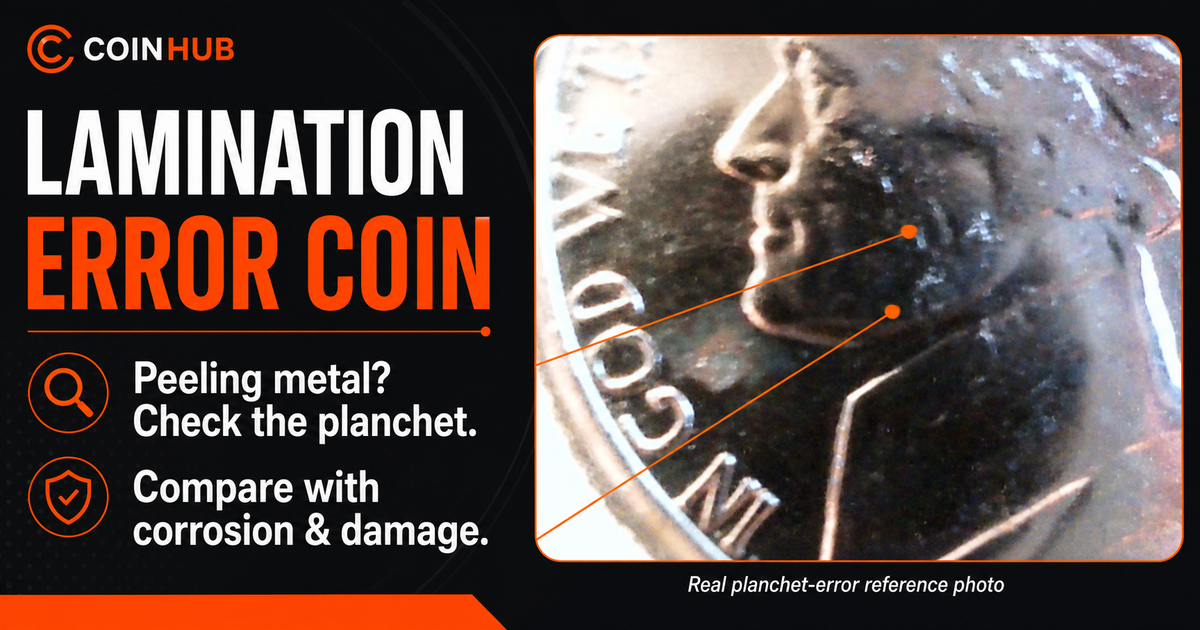
How To Spot a Possible Lamination Error
A lamination error coin is a planchet error where part of the coin's surface cracks, peels, flakes, or separates because the metal was flawed before or during striking. The key is that the defect comes from the coin metal itself, not from a scratch, corrosion, glue, or later damage.
A real lamination error often looks like a thin layer of metal lifting, peeling, cracking, or missing from the surface. It can appear before the strike, after the strike, or remain partly attached as a retained lamination.
Small lamination flaws are usually modest. Larger, dramatic, high-grade, or clearly retained laminations can bring more collector interest, but many damaged coins are mislabeled as lamination errors online.
What Is a Lamination Error on a Coin?
A lamination error starts with a problem in the planchet metal. Error-Ref describes lamination errors as planchet errors where the surface cracks and flakes, usually because contaminants or alloy problems allow the metal to separate along a horizontal plane. PCGS describes a lamination as a planchet defect where a portion of the coin metal separates due to impurities or internal stress.
That is different from a die crack, gouge, scratch, or corrosion spot. A lamination problem is inside the coin's metal layer. It may show as a crack, a missing skin-like flake, or a raised flap that is still attached.
Use this quick checklist:
- Look for peeling metal: a lamination often looks like a thin sheet, flap, or skin of metal lifting from the coin.
- Check the edges of the flaw: real lamination can have irregular, natural-looking split edges rather than sharp scratch lines.
- Inspect the design under and around it: if design detail continues naturally around the flaw, it may support a planchet defect.
- Separate it from corrosion: green, powdery, black, bubbly, or pitted surfaces usually point toward environmental damage.
- Do not pull the flap: a retained lamination can break off easily and hurt both value and diagnostics.
CoinHub tip: If the coin looks like someone cut, scraped, glued, soldered, heated, or chemically damaged it, treat it as damage until proven otherwise. A true lamination error should make sense as a metal-layer separation, not as a random surface injury.
Lamination Error vs Damage, Die Crack, and Strike-Through
| What You See | More Like Lamination | More Like Something Else |
|---|---|---|
| Raised or loose flap | Thin metal layer still attached to the coin | Glue, solder, corrosion buildup, or foreign material sitting on top |
| Missing surface area | Flaky or sheet-like metal loss with irregular split edges | Scrape, gouge, acid damage, parking-lot damage, or tool marks |
| Line across the coin | Cracked surface layer that may lift slightly | Raised die crack, scratch, or split-die feature |
| Weak or missing design | Possible if a lamination was lost before striking | Grease-filled die, struck-through debris, weak strike, or normal wear |
| Value potential | Best when obvious, stable, large, attractive, or retained | Minor flakes and damaged coins usually bring little premium |
Types of Lamination Errors Collectors Mention
Retained lamination: the separated metal is still attached to the coin. Do not bend it, lift it, or try to clean underneath it.
Lamination crack: the coin surface cracks because the metal layer is separating. Error-Ref notes these can be mistaken for die cracks by newer collectors.
Lamination loss before strike: part of the surface layer was missing before the coin was struck, so the design may form differently over the affected area.
Lamination loss after strike: the coin was struck first, then the defective layer later detached. This can leave a missing patch where design detail may look interrupted.
Are Lamination Error Coins Valuable?
Some are, but most are not jackpot coins. Value depends on denomination, date, condition, size of the lamination, eye appeal, whether the detached piece is retained, and whether the coin is otherwise collectible. A tiny flake on a common circulated cent may be worth only a small premium, while a dramatic retained lamination on a nicer coin can be more interesting to error collectors.
Be careful with online asking prices. A seller can list a damaged coin as a lamination error for almost any price. Completed sales, specialist opinions, and PCGS or NGC authentication matter more than a title in an online listing.
What To Do If You Find One
- Handle it by the edge and do not clean it.
- Do not push, lift, or remove any retained lamination flap.
- Take clear photos straight on and under angled light.
- Photograph both sides and the edge.
- Compare it with CoinHub's error or damage checker before paying for grading.
For related diagnostics, check CoinHub's clipped planchet error guide, grease-filled die error guide, penny error list, and quarter error list. A lamination article should support those broader resources without replacing them.
Lamination Error Coin FAQ
Is a lamination error a mint error?
Yes, when the separation comes from a flawed planchet or coin metal rather than later damage. It is usually treated as a planchet error.
Can lamination happen after the coin leaves the Mint?
The metal flaw can exist from production, but the visible flake may detach later. That is why photos and careful inspection matter.
Is a lamination error the same as a die crack?
No. A die crack is a raised line struck from a cracked die. A lamination error is a separation in the coin's metal surface.
Should I get a lamination error graded?
Only if the coin is dramatic, valuable, high-grade, or hard to diagnose. Many minor lamination flaws are not worth the certification cost.
Bottom Line
A lamination error coin should show metal separating from the coin itself. Look for peeling, cracking, or missing surface layers, rule out corrosion and scratches, and avoid disturbing any retained flap. When the error is dramatic enough, professional authentication can help separate a real mint-made planchet error from ordinary damage.