
How To Spot a Real Cud
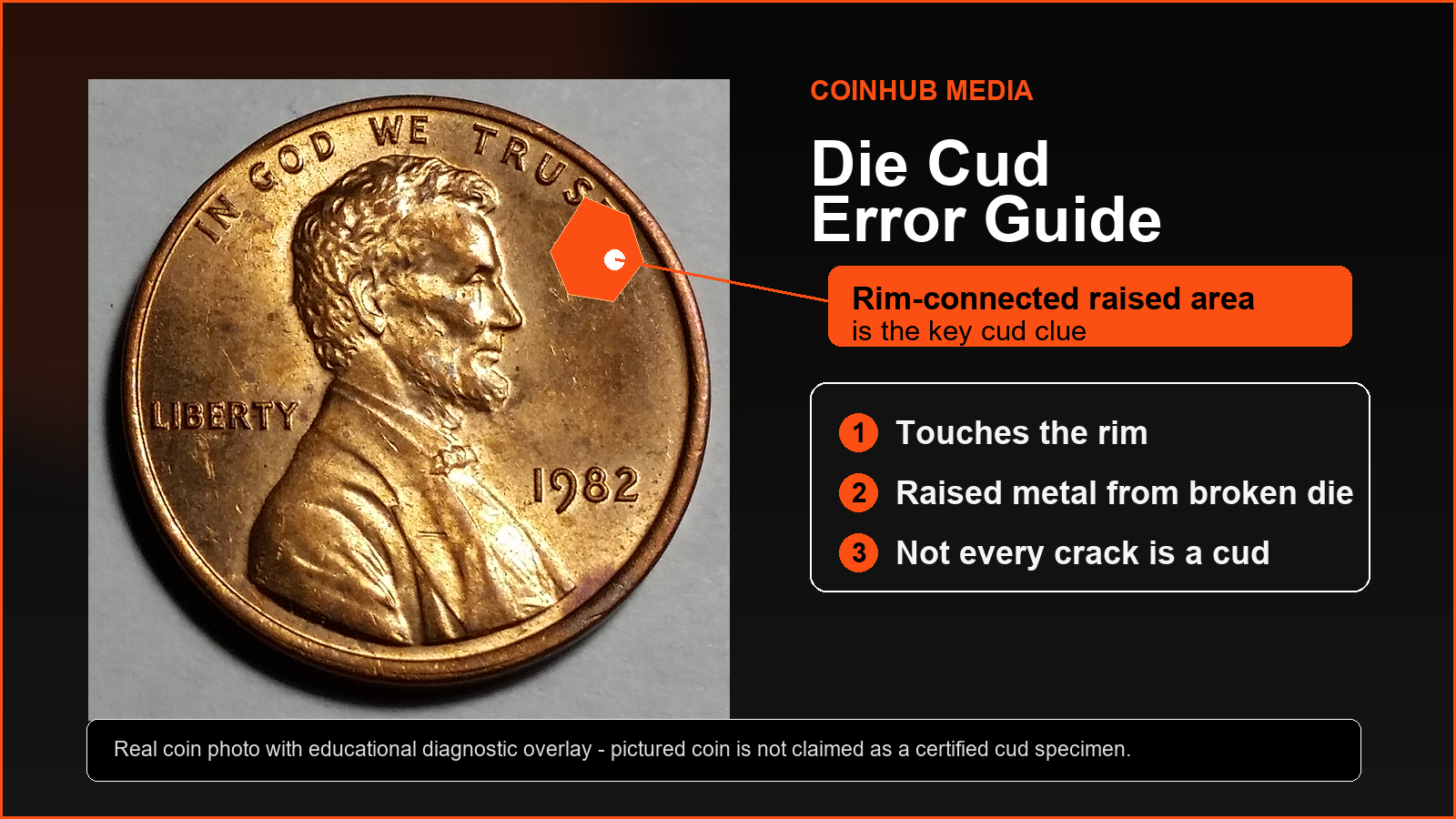
A die cud error is a raised blob of metal caused by a broken coin die. The key clue is location: a true cud connects to the rim because the missing piece of die steel included the rim and part of the adjacent field or design.
A cud is a die break at the rim. It usually appears as a raised, irregular mass connected to the edge of the coin. If the raised blob is floating inside the design and does not touch the rim, collectors usually call it an interior die break or die chip instead.
Size, visibility, coin type, grade, and collector demand matter. A large dramatic cud can bring a premium, but a tiny rim break on common circulated pocket change may be more educational than valuable.
What Is a Die Cud Error?
Coin dies are hardened tools that strike the design into blank planchets. After repeated use, a die can crack. If a piece of die steel breaks away at the rim, the next coins struck by that damaged die can show a raised, unstruck-looking mass where metal flowed into the void.
Error-Ref defines a cud as a die break involving the rim and at least some nearby field or design. PCGS also describes cud formation as coin metal flowing into the void left by a missing die piece. That is why a cud is raised on the coin, not cut into it.
Use this quick checklist:
- Start at the rim: a true cud should connect to the coin's edge or rim area.
- Look for a raised mass: the cud is raised because metal filled a broken area of the die.
- Check the shape: cuds can be crescent-shaped, oval, blocky, or irregular, but they should look like added metal rather than a gouge.
- Compare the opposite side: large cuds can leave opposite-side weakness or a soft bulge because metal moved into the broken-die void.
- Separate it from damage: cuts, dents, corrosion, glue, solder, and post-mint blobs do not have the same struck-in relationship to the design.
CoinHub tip: the word "cud" gets overused online. If the raised area does not touch the rim, describe it more cautiously as a die chip, interior die break, or raised anomaly until an error specialist confirms it.
Cud vs Die Crack, Die Chip, and Damage
| Feature | More Like a Cud | More Like Something Else |
|---|---|---|
| Location | Touches the rim and enters the nearby field or design | Floating raised spot is usually a die chip or interior die break |
| Shape | Raised mass, often irregular or crescent-like | Thin raised line is more like a die crack |
| Surface | Struck-in raised metal with no fresh scrape or cut edge | Sharp cuts, dents, glue, solder, corrosion, or tooling suggest damage |
| Opposite side | Large cuds may show weakness opposite the break | Random damage may affect only the surface that was hit |
| Collectibility | Bigger, clearer, rim-connected examples draw stronger interest | Tiny chips and vague bumps often stay low value |
Are Die Cud Error Coins Valuable?
Some are, but not every cud is a major find. Value depends on how dramatic the break is, whether the coin is common or scarce, the coin's grade, eye appeal, and whether error collectors actively want that specific type. A certified major cud on a popular U.S. coin is more marketable than a small rim break on a heavily worn coin.
Be careful with online asking prices. A listing price is not the same as a completed sale, and dramatic language can make ordinary die breaks sound rarer than they are. If the coin might justify grading fees, compare sold examples and consider professional attribution.
Where Cuds Show Up on U.S. Coins
Cuds can appear on cents, nickels, dimes, quarters, half dollars, dollars, tokens, and many world coins because the issue is the die, not a single denomination. Collectors often notice them first on Lincoln cents and other circulating coins because those are easy to search in quantity.
When checking pocket change, look around the rim under angled light. Rotate the coin slowly and watch for raised metal that interrupts the normal design. Then photograph both sides before deciding whether the piece is worth a closer opinion.
How To Photograph a Suspected Cud
- Take a full obverse photo and a full reverse photo.
- Take a close-up of the raised rim-connected area.
- Use angled light from two directions so the raised metal is visible.
- Include the whole rim near the suspected cud so the connection to the edge is clear.
- Photograph the opposite side in the same location to show any weakness or bulging.
For related diagnostics, compare CoinHub's grease-filled die error guide, clipped planchet error vs damage guide, penny error list, quarter error guide, and error or damage checker.
Die Cud Error FAQ
Is a cud the same as a die crack?
No. A die crack usually appears as a raised line. A cud is a larger die break that includes the rim and nearby field or design.
Can a cud be inside the coin design?
If the raised area is completely inside the design and does not connect to the rim, it is usually not called a cud. It may be an interior die break or die chip.
Does a cud mean the coin was damaged after leaving the Mint?
A true cud is mint-made because it came from a broken die during striking. Post-mint dents, gouges, corrosion, glue, or added metal are damage, not cuds.
Should I grade a die cud error?
Consider grading only when the cud is dramatic, the coin is valuable, the attribution is uncertain, or a certified holder would help prove the error for sale.
Bottom Line
A real die cud error is raised, connected to the rim, and created by a broken die. Start with the rim connection, compare it with die cracks and damage, and keep value expectations realistic unless the cud is large, clear, and marketable.