
How do you identify the 1804 half-cent varieties?
The 1804 half cent belongs to the Draped Bust series. Its variety label can combine a date feature with a wreath feature. Reading just the front leaves half the identification unfinished. Neither label describes damage that must have happened after the coin left the Mint.
Plain 4 versus Crosslet 4
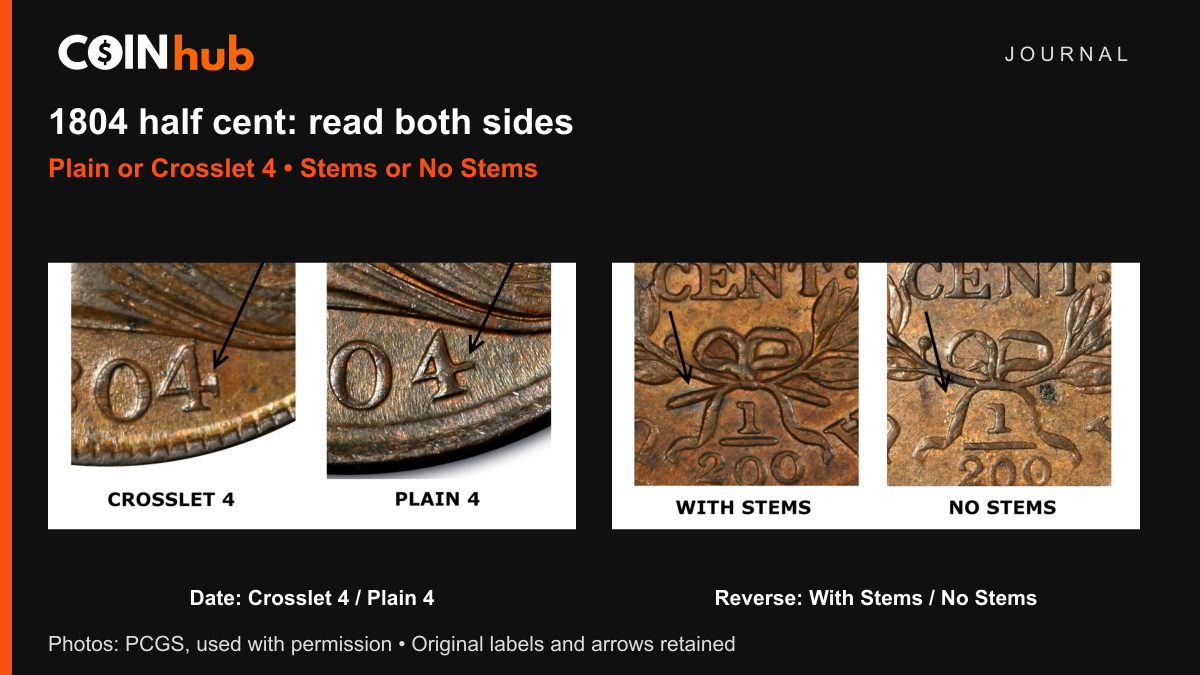
Follow the horizontal bar of the numeral 4 all the way to its right end. The short vertical finish there is the crosslet. It is a small detail, so compare its shape with the close-up, not with the apparent size of the whole date.
PCGS's Plain 4, No Stems reference provides the original date comparison used above. The left photograph shows Crosslet 4; the right shows Plain 4. The source arrows point to the relevant end of the crossbar.
Do not treat a dark patch, glare or a worn edge as a decisive stroke. If that small area is unclear, record “4 type uncertain” and keep a full-date photo. Enlarging a blurry image cannot restore metal that is worn away or hidden.
With stems versus no stems
Turn the coin over and find the bow at the bottom of the wreath. Look for the stem ends in that area. The second PCGS comparison shows With Stems on the left and No Stems on the right. Read the labels as well as the arrows; the ribbon and the nearby fraction are separate details.
The date and wreath tests work independently. A Plain 4 does not automatically mean No Stems. PCGS lists both Plain 4, Stems and Plain 4, No Stems. Its Crosslet 4 reference also distinguishes stems from no stems.
- Plain 4, Stems: No crosslet on the 4; stem ends at the wreath base.
- Plain 4, No Stems: No crosslet; the no-stems reverse design.
- Crosslet 4, Stems: Crosslet present; stems present.
- Crosslet 4, No Stems: Crosslet present; the no-stems reverse design.
These are useful broad descriptions. They do not mean that every coin with a weak wreath belongs to a No Stems variety. Wear can make a positive match difficult. An uncertain observation should stay uncertain until the rest of the design supports it.
What does the Cohen number add?
Collectors also use Cohen numbers to identify particular die combinations. A die is a steel tool that strikes one face of the coin; a die combination joins a particular front die with a particular back die. That is more specific than a broad Plain 4 or Crosslet 4 label.
PCGS identifies Plain 4, Stems as Cohen 11 and Plain 4, No Stems as Cohen 13. Its Crosslet 4, Stems category includes several Cohen varieties. Do not assign a detailed catalog number from one small feature when that broad category contains several possibilities.
Photograph both diagnostic areas
Begin with full front and back photos. Add one sharp close-up of the date and another of the wreath base. Keep the coin level and try a second light angle if a reflection hides the crossbar or bow. Avoid digital sharpening that makes bright outlines look like extra metal.
Your notes can be simple: “Crosslet visible; wreath stems uncertain.” That preserves what you can actually see and tells a specialist which area needs review. It is better than choosing a scarce label because a seller's photograph looks similar.
A variety name alone does not establish the value of your coin. Attribution, wear, surface condition and authenticity still matter. Use the two feature checks to describe the coin clearly before comparing it with a price entry or an auction specimen.
For a different half-cent comparison, the 1828 guide explains 12 versus 13 stars. Those star counts belong to another date and design; they are not a shortcut for identifying an 1804 Draped Bust half cent.