
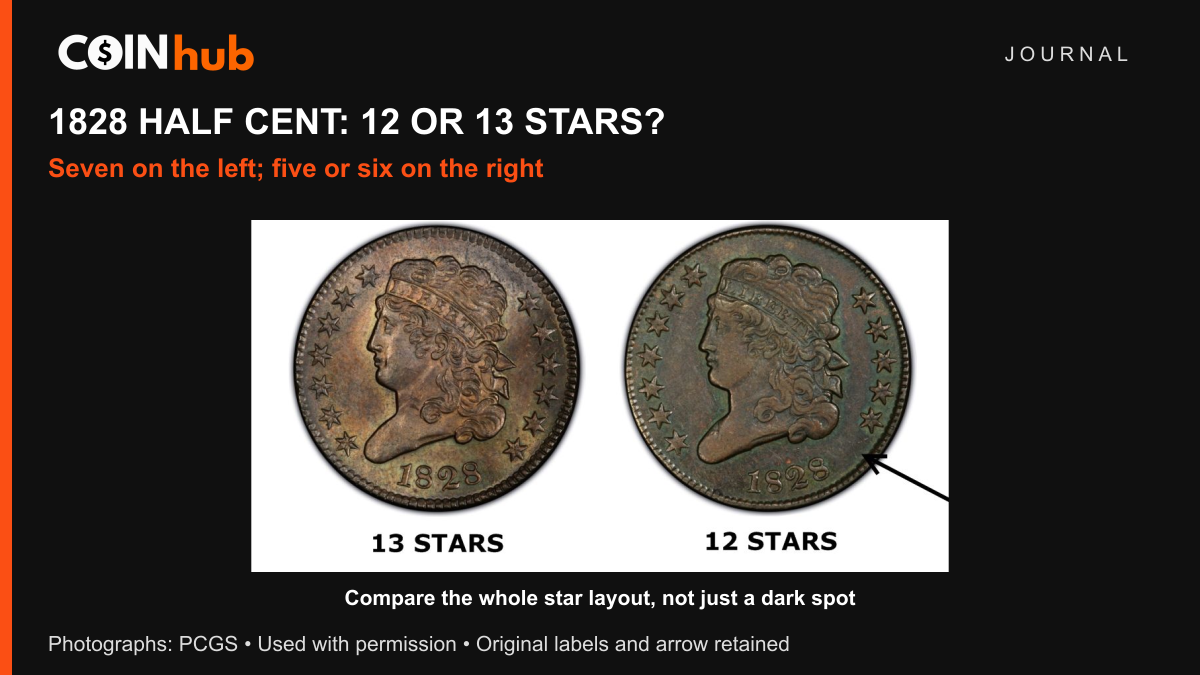
Count each side of Liberty’s portrait
The useful comparison is the whole arrangement, not just the number of bright points in a seller’s photo. Start with a straight-on view of the front. Turn the image so the date reads normally, then count the stars on each side. Keep left and right tied to your view of the coin, rather than Liberty’s own left and right.
This guide covers one date and one design distinction. For the denomination and the rest of the series, use our Classic Head half-cent guide. An 1828 date on its own does not identify the star variety.
Read the real comparison photograph
In the PCGS image above, the 13-star coin is on the left and the 12-star coin is on the right. The original arrow points toward the lower-right gap on the 12-star design. It marks a place to compare, not a test that proves any coin genuine.
PCGS CoinFacts describes the seven-and-five arrangement and the wider gap near the date. Trace the entire arc on each side before focusing on that gap. A cropped photo may hide a star near the rim, while glare or dark surfaces may make one hard to see.
A star variety and a die marriage are different levels of detail
A die is the tool that impresses one face of a coin. A die marriage identifies the particular front and back dies used together. Counting stars sorts these half cents into two broad groups; it does not finish every possible attribution.
NGC’s VarietyPlus listings identify the 12-star coin as Cohen-2, often shortened to C-2. The 13-star coins include C-1 and C-3. Thus “13 stars” does not choose between those two die marriages. Read both faces and use the matching specialist reference before adding a more specific number to a label.
Our die-marriage explanation shows why a shared front design can lead to more than one attribution. Keep a broad identification when that is all the evidence supports. It is better to leave a reference number blank than to copy one from a similar-looking sale.
Do not turn an invisible star into a missing-star claim
Suppose a photo shows seven clear stars on the left and only five clear stars on the right. That observation alone leaves two questions: was the design made with five right-side stars, or is another star simply hard to see? Wear, surface problems, lighting and an incomplete image can all limit what the photo shows.
Ask for a full, sharp image with even light and the entire rim visible. Compare the spaces between the stars as well as their count. Record an uncertain spot as uncertain. Do not clean the coin to make a weak detail show, and do not treat a star count as a substitute for authentication.
Keep a useful identification record
A short record might read: “1828 half cent; seven stars left, five right; lower-right spacing compared with reference; reverse and edge photographed; authenticity not assessed.” Save the original photographs and the reference link with that note. Keep a seller’s grade or attribution separate from what you can see yourself.
Once the coin is identified, compare sales for the same variety and similar condition. Surface quality, damage and the strength of the identification matter. A price attached to a different grade or an exceptional specimen is not the value of every 1828 half cent. Avoid assuming that one star count always means a fixed premium.
References checked October 10, 2026. Comparison photographs: PCGS, used with permission. The complete source comparison, including its labels and arrow, is resized within the CoinHub layout. These are reference photographs, not CoinHub inventory.