
Read HALF CENT before searching the date
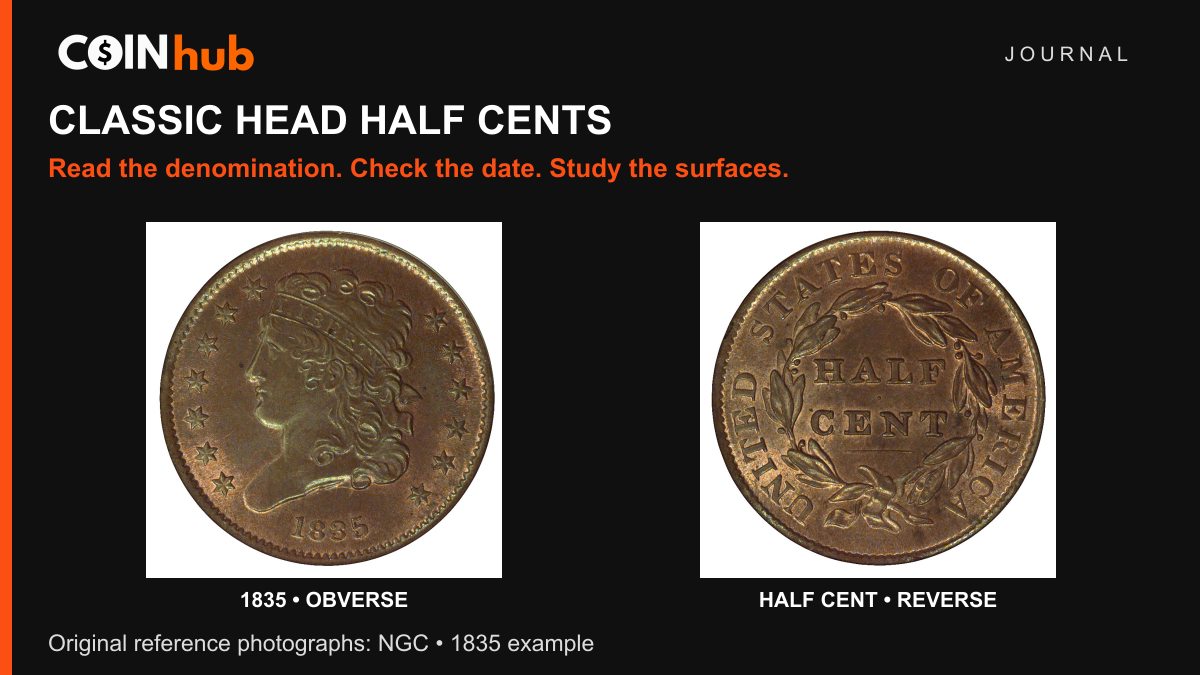
An old copper coin can arrive with a handwritten label, a family story, or no identification at all. The most useful first step is often the simplest: turn it over. On the reference coin above, the reverse spells out the denomination. That establishes a better starting point than a search for “old penny,” which mixes different sizes, countries and series.
The photographs show an 1835 example from NGC's grading guide. Use them to recognize the type, not to assign your coin a grade or assume that its color should match a photograph.
What identifies the Classic Head design?
Look for Liberty's left-facing portrait, a band bearing LIBERTY, stars around the portrait, and the date below. The reverse carries UNITED STATES OF AMERICA around the wreath. John Reich's design replaced the Draped Bust half cent in 1809. PCGS's 1809 CoinFacts reference provides a useful first-year comparison.
Do not use the portrait alone to decide the denomination. Classic Head large cents are a separate series. If the central reverse lettering is worn away, photograph both sides and retain the uncertainty instead of choosing whichever internet image looks closest. A holder or old attribution is useful evidence, but it still needs to agree with the coin.
Why the date range has missing years
A date range describes the span of a design, not a promise that every year exists. NGC explains that production stopped after 1811 and resumed in 1825. The long interruption reflects weak demand for the denomination. An album gap for 1818 therefore is not a scarce coin you need to hunt down.
| Dates or feature | What to understand | Useful next step |
|---|---|---|
| 1809–1811 | Early Classic Head issues can have uneven manufacture. | Compare wear separately from weakly struck detail. |
| 1812–1824 | No dated issues in this interval. | Recheck an apparently matching date and denomination. |
| 1825 onward | Production resumed, but the series still is not a simple uninterrupted run. | Use a specialist date checklist. |
| 1831 and 1836 | Rare issues with Proof and restrike questions that require specialist treatment. | Seek attribution before a price comparison or purchase. |
The status of some 1831 pieces has been debated by specialists. A general identification guide cannot settle an individual coin's original-versus-restrike or Proof attribution. NGC's VarietyPlus listings are a better next reference than a seller's short description.
Separate wear, strike and surface problems
Missing hair detail can reflect circulation, a weak strike, or a combination. NGC specifically notes uneven quality in early issues and weaknesses on the 1828 twelve-star variety. A single soft area does not tell the whole grading story.
Inspect the open fields as well as Liberty's portrait. Roughness, scratches and unnatural-looking surface patches deserve attention even when the main design is sharp. Compare photographs taken under different light directions. If a seller supplies only one glossy image, ask for clear front-and-back photographs before making a condition judgment.
Do not polish an early copper coin to reveal the date. Cleaning can alter the surfaces you need to evaluate. If a grading label says Details, read the stated reason; our coin Details grade guide explains why a sharp design and a problem-free numerical grade are different questions.
What determines a useful value comparison?
Start with the exact date and any recognized variety, then compare condition, surface problems and certification. The PCGS price guide separates those categories. A headline auction result for an exceptional example is not an estimate for an unidentified coin in a drawer.
For actual sold comparisons, save the full listing: date, grade, holder, photographs, sale date and any buyer's fee information. Reject comparisons with materially different damage or attribution. Asking prices show what a seller hopes to receive; they do not prove a completed sale.
A practical checklist for your coin
- Record the reverse denomination and the date exactly as visible.
- Photograph both sides, including the full rim, without filters or sharpening.
- Record any holder wording or variety attribution separately from your own observations.
- Flag roughness, cleaning, scratches or unclear detail before choosing price comparisons.
- For an unusual date or a substantial purchase, ask an early-copper specialist to examine the coin.
You do not have to build a complete date set to enjoy this denomination. A single well-chosen example can represent the type; our type set versus date set guide helps frame that decision. Understanding what the coin is—and what remains uncertain—makes the next collecting choice easier.
Research checked September 23, 2026 against NGC and PCGS references. Photographs are identified reference examples, not an appraisal or an offer of inventory. No grade or current market price is assigned here.