
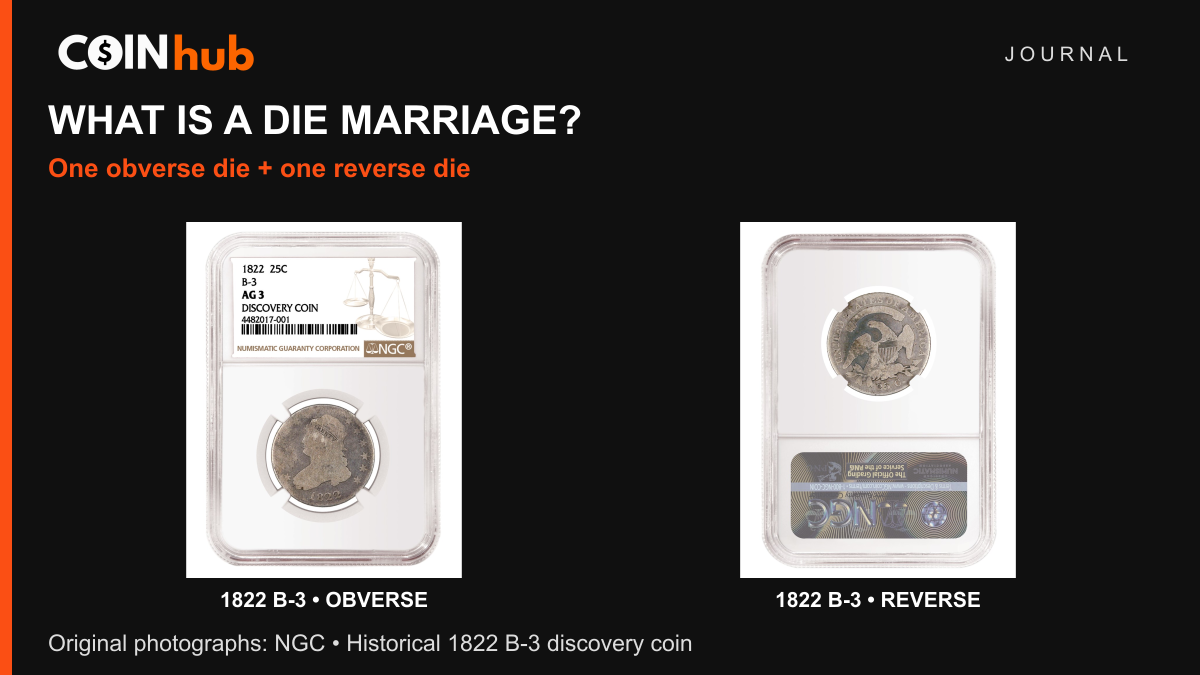
Two dies make the pairing
A catalog might describe a coin by date, denomination and a short attribution such as B-3 or O-102. The number can identify something more specific than the design type: the dies responsible for that coin. To understand the attribution, think about the two working tools as a pair.
The obverse is the side commonly called heads; the reverse is the other main face. For die-marriage research, recognizing a familiar obverse is only part of the job. A mint could use that obverse die with more than one reverse die. You need evidence from both sides to establish the combination.
A simple example: same face, different partner
Imagine three dies labeled Obverse A, Reverse X and Reverse Y. These labels are invented for the explanation; they are not an attribution for a real coin.
| Dies used | What changed? | Result |
|---|---|---|
| Obverse A + Reverse X | The original pair | One die marriage |
| Obverse A + Reverse X, after X develops a crack | The condition of an existing die | A later state of the same marriage |
| Obverse A + Reverse Y | A different reverse die joins the obverse | A different die marriage |
This is why an attribution based only on the date's position or one obverse feature can stop too soon. That feature may identify Obverse A while leaving X versus Y unresolved. A seller's photograph of only the front cannot answer a question whose evidence lies on the back.
How specialists tell dies apart
NGC's guide to U.S. die varieties explains that individually placed design elements on early dies can leave distinctive arrangements. Depending on the series, the reference may use the positioning of a date, letters, stars or other features to identify a die.
A useful diagnostic must distinguish the relevant candidates. “The coin has stars” is a description; a documented relationship between a particular star and a nearby feature may be evidence. Use the specialist reference's actual comparison rather than inventing a diagnostic from a photograph.
Wear, weak detail, toning and damage can make a feature hard to read. Keep “not visible in this photograph” separate from “not present on the coin.” Better lighting or an in-person examination may resolve the first problem. No amount of certainty in a caption can replace missing evidence.
A real historical example: the 1822 B-3 quarter
In a June 6, 2017 announcement, NGC reported a newly recognized die marriage for the 1822 Capped Bust quarter. Its explanation is especially helpful because the three marriages discussed share the same obverse die.
The report pairs Obverse 1 with Reverse R for B-1, Reverse S for B-2 and Reverse T for B-3. The change is the reverse partner, not a new date or a different major design. NGC also connected Reverse T with quarters dated in other years, illustrating how tracking one die can connect several issues.
The photographs above show the discovery coin's holder, labeled AG 3. They document the reported example, rather than serving as magnified attribution plates. The announcement's statements about what was known in 2017 should not be read as a current population count or a present-day rarity claim.
A die state is not the coin's grade
A working die can develop cracks or other changes while it continues to strike coins. Specialists may use those changes to place examples in a sequence. That manufacturing history is different from the wear and surface condition of an individual coin after striking.
A worn coin can preserve evidence of a particular die state. An unworn coin does not necessarily come from an early die state. If you are trying to separate manufacturing weakness from later circulation, our weak strike versus wear guide addresses that separate condition question.
Not every scratch or raised line is a useful state marker. Check whether the specialist reference identifies it and whether it appears consistently in the expected position. A single unexplained mark should remain an observation until the evidence supports a stronger conclusion.
Read the attribution in its own reference system
Catalog letters and numbers are not a universal language across all U.S. coins. Different series use different specialist works and numbering conventions. NGC's early-gold discussion, for example, identifies the Bass-Dannreuther reference for that field. Do not transfer a number's meaning from one series to another.
Record the date, denomination and reference name together with the attribution. A bare “3” in an old envelope is not enough. When working with Morgan or Peace dollars, our VAM number guide explains that series-specific terminology. The right book or database depends on the coin you actually have.
A two-sided attribution checklist
- Identify the basic coin. Establish date, denomination and series before choosing a reference.
- Keep the complete label. Photograph any certified holder or old attribution envelope along with the coin.
- List the candidates. Find the plausible marriages for that issue rather than choosing the first similar image.
- Check each side independently. Record the obverse evidence and reverse evidence separately.
- Then consider die state. Use documented changes to refine an identification that fits both dies.
- Keep uncertainty visible. If a necessary feature is obscured, obtain better photographs or a specialist opinion.
Attribution and value are separate conclusions. A specific die marriage is not automatically rare, and a scarce marriage is not automatically valuable in every condition. First establish what the coin is. Then consult current, relevant evidence for its rarity and market, with the attribution and any uncertainty kept intact.
References checked September 23, 2026. The 1822 quarter discussion and NGC photographs concern a discovery announced in 2017; this is an educational explanation, not a new discovery report or current population estimate.