
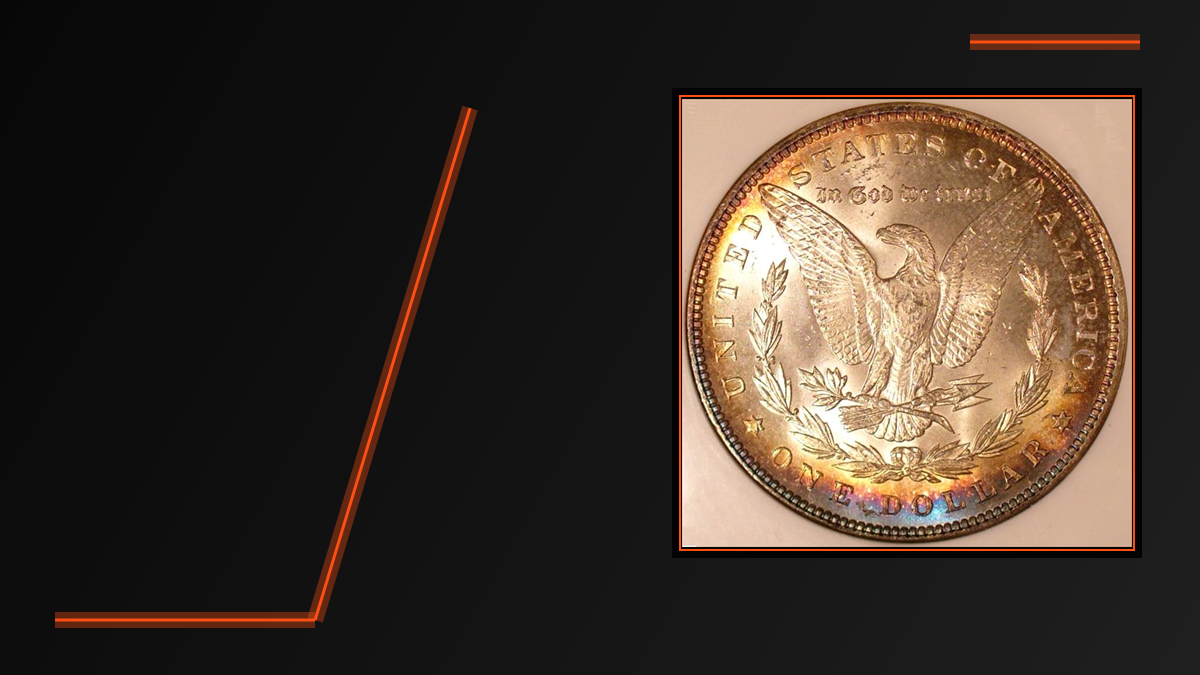
VAM means Van Allen–Mallis
The VAM system is named for Leroy Van Allen and A. George Mallis, whose work cataloged die varieties of Morgan and Peace dollars. A VAM entry gives collectors a common way to describe a particular obverse-and-reverse die pairing and, in some cases, a later die state. It turns “my dollar has a funny line” into a question that can be tested against documented diagnostics.
VAMWorld organizes the catalog by date and mint. That detail is essential: a number belongs within the correct issue context. A feature that is meaningful for one date and mint cannot simply be carried over to another Morgan or Peace dollar because the coins look similar.
What a VAM number does—and does not—tell you
| A VAM number can help establish | A VAM number does not automatically establish |
|---|---|
| Which documented die pair or die state a correctly attributed dollar matches. | That the coin is genuine, problem-free, or professionally graded. |
| A shared vocabulary for studying die markers, doubled features, repunching, clashes, or die damage. | That every diagnostic-looking mark is a VAM marker rather than damage, toning, dirt, or a scratch. |
| A possible reason to research collector demand for a specific variety. | An automatic premium, a retail price, or a guarantee that a grading service will attribute it. |
| A way to compare the exact date-and-mint coin against a reference. | Permission to apply the same number to a different date or mint. |
The word “variety” can tempt a collector to skip the evidence. Resist that impulse. Some VAMs are highly collected, some are useful catalog entries with modest demand, and some need a particular grade or recognized attribution before they matter commercially. The catalog is a research tool first.
Why you may see VAM-1 and lettered suffixes
Within a date-and-mint listing, VAM-1 is commonly the normal die pair—the baseline from which other named die-pair differences are distinguished. It is still a valid catalog entry. “Normal” does not mean defective, and it does not mean the coin has no collector value; it simply means it is the catalog’s standard pairing for that issue.
VAM references can also use letters or other notation for die states. Dies change while they are used: cracks grow, polish changes, clashes occur, and other markers develop. The exact notation must be read in the relevant reference rather than guessed from a label. A suffix can indicate a later state of the same underlying die pair, not a different date, grade, or mint.
How to begin a safe VAM attribution
- Identify the coin before the variety. Record the date, mint mark, denomination, and whether it is a Morgan or Peace dollar. Photograph both sides and the edge in diffuse light.
- Find the correct date-and-mint page. Use VAMWorld or another established reference for that exact issue. Do not search a feature name alone and force your coin to fit the first result.
- Compare more than one marker. Look for the documented relationships among date, mint mark, lettering, stars, devices, and die features. If only one mark agrees, call it a lead—not an attribution.
- Separate Mint-made features from later damage. A die-created marker is normally part of the strike and repeatable. Scratches are often incuse, random, and unique to one coin.
- Decide whether formal attribution is worthwhile. Consider the exact VAM, grade, eye appeal, grading-service policy, submission expense, and evidence of current collector demand before you pay for attribution.
Why a VAM is not automatically a premium variety
PCGS notes that VAMs catalog the die pairs used for Morgan and Peace dollars, while the number of cataloged varieties is far larger than the subset a grading service recognizes for attribution. That is a useful reality check. A VAM can be historically interesting and still lack enough demand, condition, or service recognition to justify a major premium.
That does not make variety study less rewarding. It simply changes the question from “How much is every VAM worth?” to “What does this exact variety mean for this exact coin?” A well-preserved common die pair, a scarce but poorly preserved variety, and a recognized high-demand VAM are three different collecting situations.
Before you submit or sell
- Confirm the correct date and mint mark; take sharp full-coin and close-up images.
- Record the proposed VAM as provisional unless a recognized source confirms the diagnostics.
- Check whether your intended grading service attributes that variety and under what service tier.
- Compare recent completed sales of the same VAM and a similar grade—not generic Morgan-dollar prices.
- Never clean the dollar to expose a marker. Better photography is safer than altering the surface.
Where VAM study fits in a Morgan or Peace dollar collection
Many collectors begin with date-and-mint sets, then notice that two dollars of the same issue are not truly identical. VAM attribution adds another layer: die history. It pairs well with a basic understanding of dates, mintages, grades, and surface preservation, but it does not replace those foundations.
If you are still deciding which dollars deserve closer attention, start with CoinHub’s guides to Morgan dollars worth money and Peace dollars worth money. Use this VAM guide when a specific die-pair question arises—not as a reason to label every dollar in a roll rare.
Frequently asked questions
What does VAM stand for?
It stands for Van Allen–Mallis, the names behind the cataloging system for Morgan and Peace dollar die varieties.
Is VAM-1 rare?
Not necessarily. VAM-1 commonly denotes the normal die pair for a particular date and mint. It is a catalog baseline, not an automatic rarity ranking.
Can any Morgan dollar be a VAM?
Morgan and Peace dollars can be studied within the VAM system, but a coin must match a documented die pair or die state. A random mark does not create a new VAM.
Does every VAM receive a grading-service attribution?
No. Grading services recognize only defined subsets of cataloged VAMs and can change their attribution policies. Check the service’s current policy before submitting.
Does a VAM number prove a dollar is authentic?
No. Attribution and authenticity are related but distinct questions. A variety comparison can be part of the evidence, but it is not a substitute for a full authenticity evaluation.