
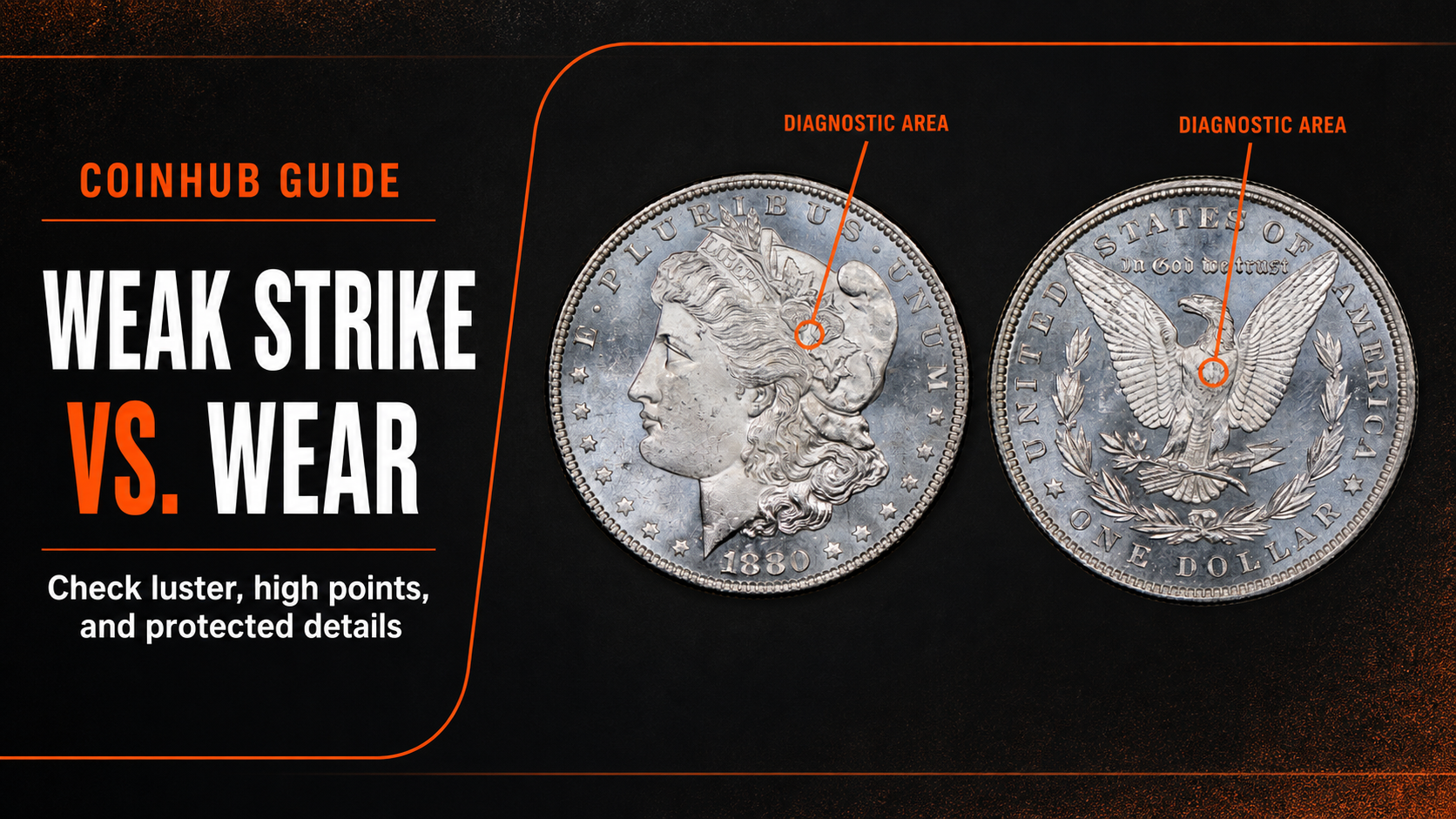
How To Tell The Difference
Quick answer: A weak strike leaves parts of the design soft from the moment the coin is made, while circulation wear removes metal and luster after the strike. Do not judge by missing detail alone. Tilt the coin under one small light and compare luster on the high points, protected areas beside the devices, and any matching weakness on the opposite side.A coin can look worn even when it never circulated. That sounds contradictory, but grading standards separate strike quality from wear. If the dies did not fully press the planchet into every recess, hair, feathers, lettering, or other high-relief details may look flat on a Mint State coin.
The reverse can also happen: a sharply struck coin may later lose only a thin layer of luster on its highest points and fall into an About Uncirculated grade. Learning the difference helps you avoid dismissing an uncirculated coin, overgrading a lightly worn one, or spending grading money on the wrong candidate.
What Is a Weak Strike?
A weak strike occurs when metal does not flow completely into the deepest parts of the dies. Strike pressure, die spacing, planchet hardness, die wear, relief, and the design's metal-flow demands can all contribute. The result is soft or incomplete detail even though the surface may retain original mint luster.
PCGS and NGC grading standards make the key distinction clear. PCGS describes Mint State as a business-strike coin that has not circulated, yet its Mint State descriptions still allow varying strike quality. NGC is even more explicit: MS 60 through MS 62 can have a weak or average strike with no trace of wear. In other words, weak detail is not automatic proof of circulation.
What Does Circulation Wear Look Like?
Wear is post-strike friction. It first affects the parts of the design that sit highest and receive contact when the coin moves against pockets, drawers, counters, bags, or other coins. Those points may become smoother, duller, or slightly different in color from protected areas.
NGC describes AU 58 as slight wear on the highest points of the design. That threshold is useful because a coin can retain almost all of its detail and luster yet still show true friction in a few exposed places. The question is not simply, “Is the detail sharp?” It is, “Does the surface still behave like original mint surface where wear would occur first?”
Weak Strike vs. Wear: The Best Clues
| Clue | Weak strike | Circulation wear |
|---|---|---|
| Luster on soft areas | Original luster may continue through the weakly defined area. | Luster is usually broken, muted, or missing on exposed high points. |
| Protected recesses | Softness can appear near full-luster protected details without a gradual wear pattern. | Recesses often retain more luster and texture than exposed high points. |
| Opposite-side relationship | Weakness may align with a high-relief area on the other side where metal flow competed. | Wear follows exposed surfaces and does not need to match opposite-side relief. |
| Surface texture | May look softly formed or granular but not rubbed smooth. | Can look smooth, flat, or slightly glossy from friction. |
| Pattern across the coin | Often localized to known difficult design areas. | Usually follows the coin's highest and most exposed points. |
A Five-Step Inspection
Why Luster Matters More Than Sharpness Alone
Sharpness tells you how completely the design formed. Luster tells you about the surface. A weakly struck area can retain the same moving light pattern as the surrounding coin, while friction disturbs that pattern. That is why experienced graders rotate coins instead of judging a still image.
If you are new to the light test, review CoinHub's cartwheel luster guide. Also separate wear from bag marks: a Mint State coin can have contact marks without circulation wear, just as it can have a weak strike without wear.
Design Areas Collectors Commonly Misread
Every series has different high points and strike challenges. On Morgan dollars, collectors often inspect Liberty's hair above the ear and the eagle's breast feathers. On Buffalo nickels, the horn and hip receive attention. Standing Liberty quarters are judged partly by head and shield detail, while Mercury dimes are famous for central band separation.
Those examples are guides, not automatic rules. A flat eagle breast may reflect strike weakness, wear, die state, or a combination. Use multiple clues and compare coins from the same issue before assigning a condition.
Can a Weak Strike Lower the Grade?
Yes, strike quality can affect a Mint State grade even when there is no wear. PCGS and NGC descriptions for higher Mint State grades expect better strikes than the lower Mint State range. Eye appeal, marks, luster, and strike all work together.
But a weak strike does not automatically push an unworn coin into AU. AU requires wear. That distinction is the central lesson: an imperfect strike is a production characteristic, while wear is a condition change after production.
When Photos Are Not Enough
Online images can flatten luster, hide friction, or make a soft strike look smoother than it is. Diffused light is excellent for showing design detail but may conceal the moving luster break a grader would see in hand. Ask for a short tilt video or several lighting angles before buying an expensive raw coin.
For a key date, valuable type coin, or close MS/AU decision, get an experienced in-hand opinion. Before submitting, use CoinHub's coin grading break-even calculator to compare likely value, fees, shipping, and the risk of a lower grade.
FAQ
Can a Mint State coin have flat details?
Yes. Mint State means the coin shows no circulation wear; it does not guarantee a fully struck design. Lower Mint State grades can include weak or average strike quality.
Does a shiny high point mean there is no wear?
Not necessarily. Friction can sometimes create a different shine, while lighting can be deceptive. Look for whether original luster moves continuously across the area.
Can a coin have both a weak strike and wear?
Yes. A coin may leave the Mint with soft details and later circulate. In that case, graders still look for friction and luster loss on the surfaces that were actually formed.
Should I clean a soft area to see the detail?
No. Cleaning cannot restore missing strike detail or worn metal, and wiping can add hairlines that make evaluation harder.