
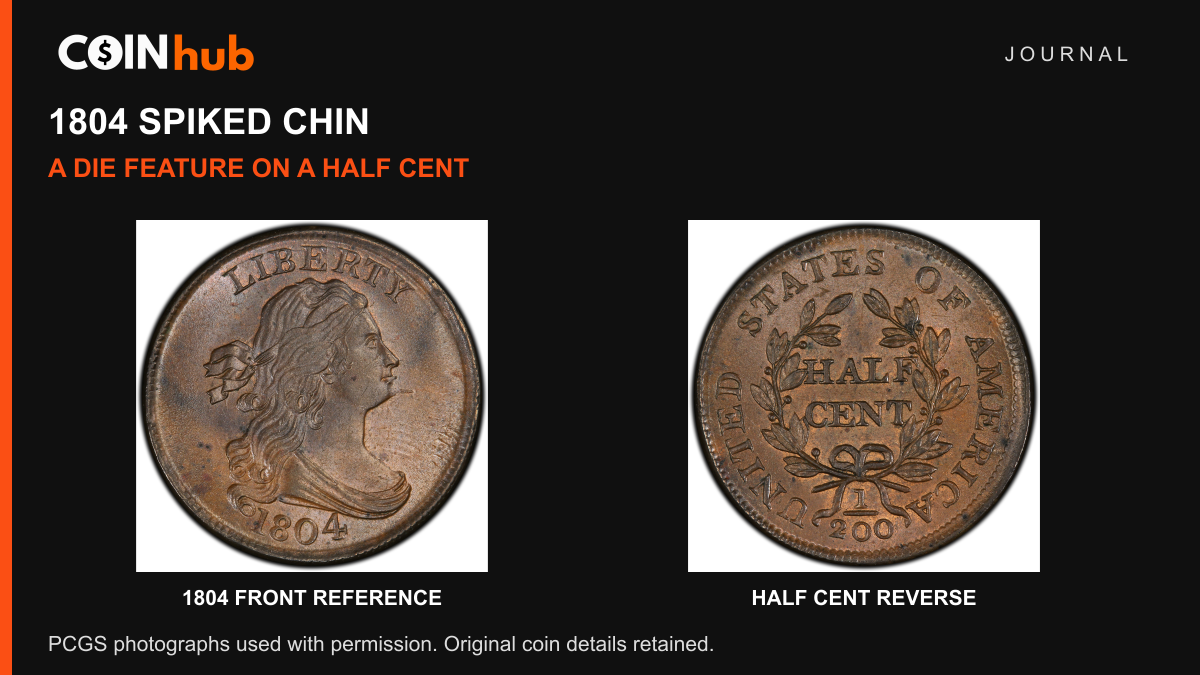
What caused the spike on an 1804 half cent?
The recognized Spiked Chin feature came from damage to the die, not a scratch added to each coin. It appears as a projection extending from Liberty's chin on an 1804 Draped Bust half cent. Compare its position and shape with the reference photograph before naming an unusual mark.
PCGS's Spiked Chin reference explains why collectors use both “die state” and “die variety” for this feature. Those terms describe the tool and its use. They do not mean that every damaged 1804 coin belongs to the variety.
Find the chin before judging the mark
On the obverse, or front, Liberty faces right. Follow the outline of her face down past the lips to the chin. The diagnostic projection extends into the open field, the flat background beside the portrait. Keep the whole profile in view so you know which part you are comparing.
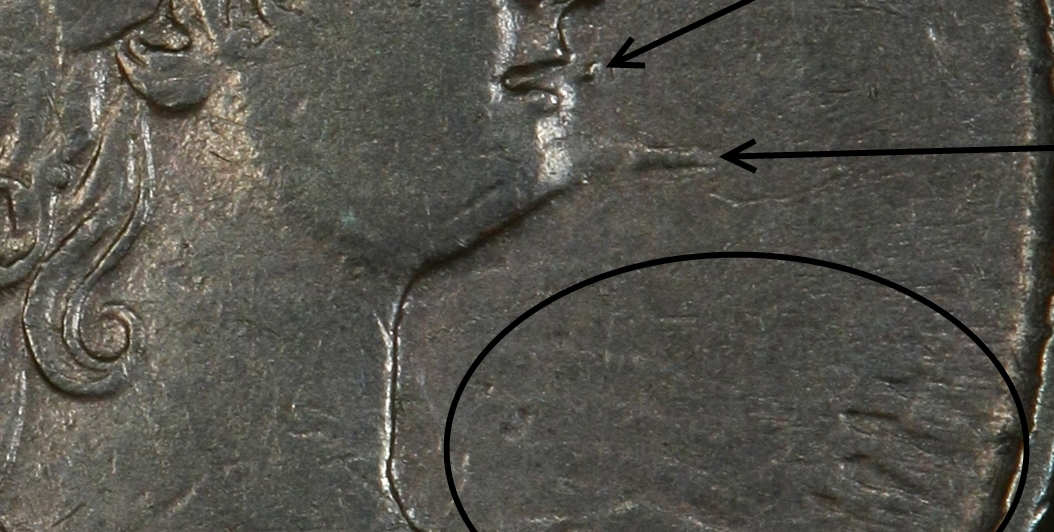
The close-up gives the feature room that a small full-coin image cannot. Its lower arrow points toward the chin projection. Do not treat every other mark, arrow or circled area in the source illustration as a second test that this guide has independently attributed.
A die state records a change in the tool
A die is the steel tool used to strike a coin's design. Its condition can change while it is in use. A die state describes a stage in that tool's life, such as before or after a particular flaw develops.
Ron Guth's PCGS account notes that coins from this same front die are known without the chin damage. That makes the spike a change in the die's state. It is not evidence that someone scratched an identical line into every surviving coin after it was made.
The distinction also helps explain why a catalog photograph is a reference rather than a promise of an exact visual match. Wear, lighting and surface problems can affect what is visible. If you cannot see the feature clearly, preserve that uncertainty.
Why one chin does not identify every die pairing
Coins are struck between a front die and a back die. A die pairing, often called a die marriage, identifies a particular combination of the two. The Spiked Chin front was used with more than one back die, according to PCGS.
That is why a chin match alone does not establish a detailed Cohen catalog number. You also need the reverse and the other required markers. Keep a full image of HALF CENT, the wreath and the fraction on the back instead of photographing only the spike.
The separate 1804 Plain 4, Crosslet 4 and wreath-stems guide covers those date and reverse features. They are useful observations to record alongside the chin, but they do not replace a complete die-pairing check.
Separate a raised feature from a damaged surface
A groove cut into a coin, a scrape with displaced metal and the recorded die feature are different possibilities. One dark line in a photo may not reveal which you have. Take another picture with light from the side rather than trying to decide from its color alone.
Do not poke, scrape or polish the area to test it. A specialist can review the shape with the rest of the coin. Better evidence is more useful than making the mark brighter or damaging nearby surfaces.
- Keep full front and back photographs.
- Add a sharp profile close-up with the chin in context.
- Record the reference and the visible match, using “possible” while identity remains uncertain.
- Leave a detailed catalog number and value unresolved when the necessary checks are incomplete.
Use the name as a starting point for research
The CoinHub Variety Attribution Assistant helps organize the date, side and feature for comparison. It does not authenticate an early copper, identify its exact die marriage or guarantee a variety result.
A recognized variety name also does not establish a price. Condition, corrosion, cleaning, damage and the exact attribution can all matter. Compare dated completed sales only after identifying the coin. The useful first result is a clear record of what you can see and what still needs review.