
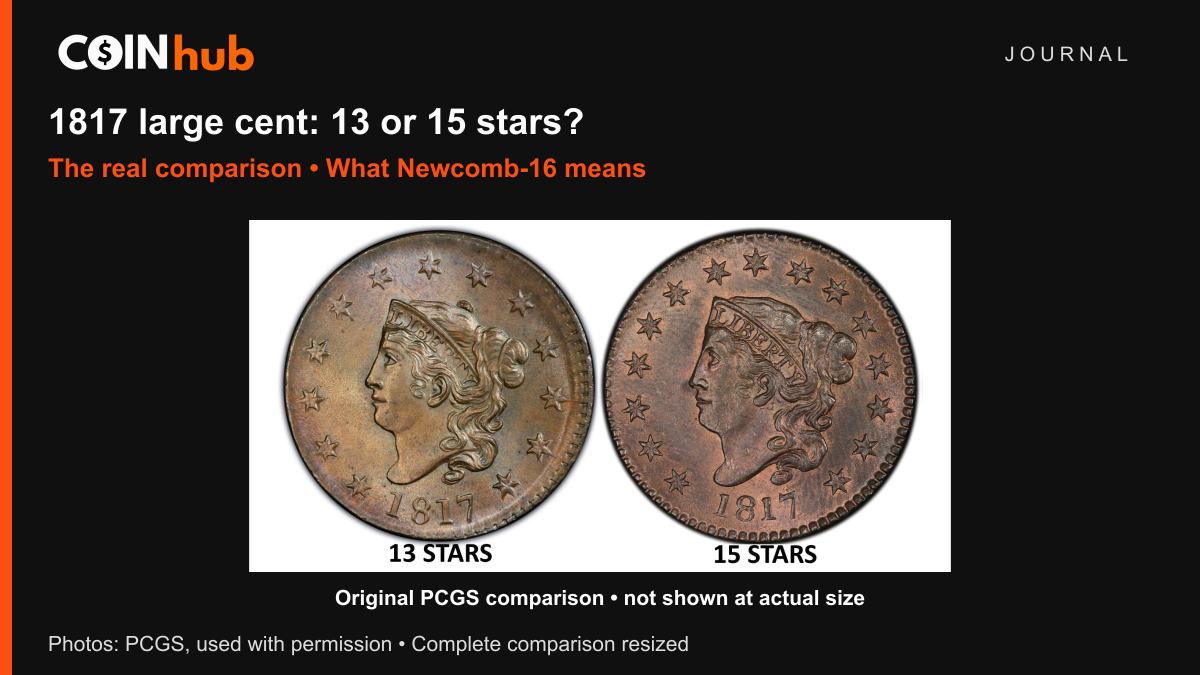
The star count identifies a real design variety
Both versions belong to the Coronet, or Matron Head, large-cent series. The side-by-side photo above places the 13-star example on the left and the 15-star example on the right. They share the same date and basic portrait, so the date alone does not settle the variety.
PCGS CoinFacts lists the 15-star issue as a copper cent from Philadelphia, with a standard weight of 10.89 grams and a diameter of 28 millimeters. Those figures help place the coin in the series. They do not prove that it is real or settle its star variety.
Count once around the portrait, then check the spaces
Use a straight-on photo with the date at the bottom and the whole rim visible. Begin at a star beside the date and work in one direction around Liberty until you reach the other side of the date. Mark each star you count on a copy of the photo, keeping the original image unchanged.
Next, compare the arrangement with the illustrated reference. The 15-star design fits more stars into the border around the portrait. Do not rely on an impression that the border looks crowded. A complete count is clearer than a guess based on one gap.
If glare, surface damage or wear hides a spot, record it as uncertain. A count of the stars you can see is not by itself the number the die carried. Better lighting and a second photo may help; cleaning or scraping the coin can harm the surface without settling the variety.
What the N-16 label means
The N refers to the Newcomb cataloging system for these large cents. A number identifies a particular die marriage: the front and back dies used together. Stack's Bowers identifies the 1817 15-star cent as N-16. It gives more detail than the broad label “1817 large cent.”
A die is a tool that impresses the design into the metal. Because the star arrangement was part of that tool, it could appear on multiple coins. This is a die variety, not a claim that someone added two stars to one finished coin or that every example is unique.
Our die-marriage guide explains that level of detail. Keep photos of both faces even when the front provides the most obvious clue. They allow a later reviewer to assess the whole coin instead of inheriting only a star-count claim.
Why 15 stars? Separate the coin from the explanation
The count is clear. The reason is less certain. PCGS's account attributes it to an engraving mistake involving close star spacing. In his 2022 Stack's Bowers discussion, Q. David Bowers treats the explanation as unresolved and discusses possibilities rather than establishing the engraver's intent.
It is therefore safer to identify the described variety than to tell a confident story about what a Mint worker was thinking. Nor should the 15 stars be treated as a reliable count of states in 1817. Earlier U.S. star-count changes do not explain this cent merely because both involve stars.
Variety and value are separate decisions
Recognizing N-16 does not assign a grade or price. PCGS notes that worn examples are easier to find than Mint State pieces. Mint State means a coin has no wear from use. A worn coin should not be compared with a top-grade auction result simply because both have 15 stars.
For a useful comparison, record the variety, wear, surface condition and any cleaning or damage. Compare dated sales with similar descriptions. Keep asking prices separate from completed sales, and do not turn the price of one exceptional specimen into a fixed premium for the star count.
A concise collection note can read: “1817 large cent; 15 stars counted on full obverse photo; N-16 reference compared; back also photographed; grade and genuine status not checked.” That preserves a useful record while showing what remains unresolved.
References checked October 11, 2026. Comparison photos: PCGS, used with permission. The complete original comparison and its labels are retained and resized. The illustrated coins are reference examples, not CoinHub inventory.