
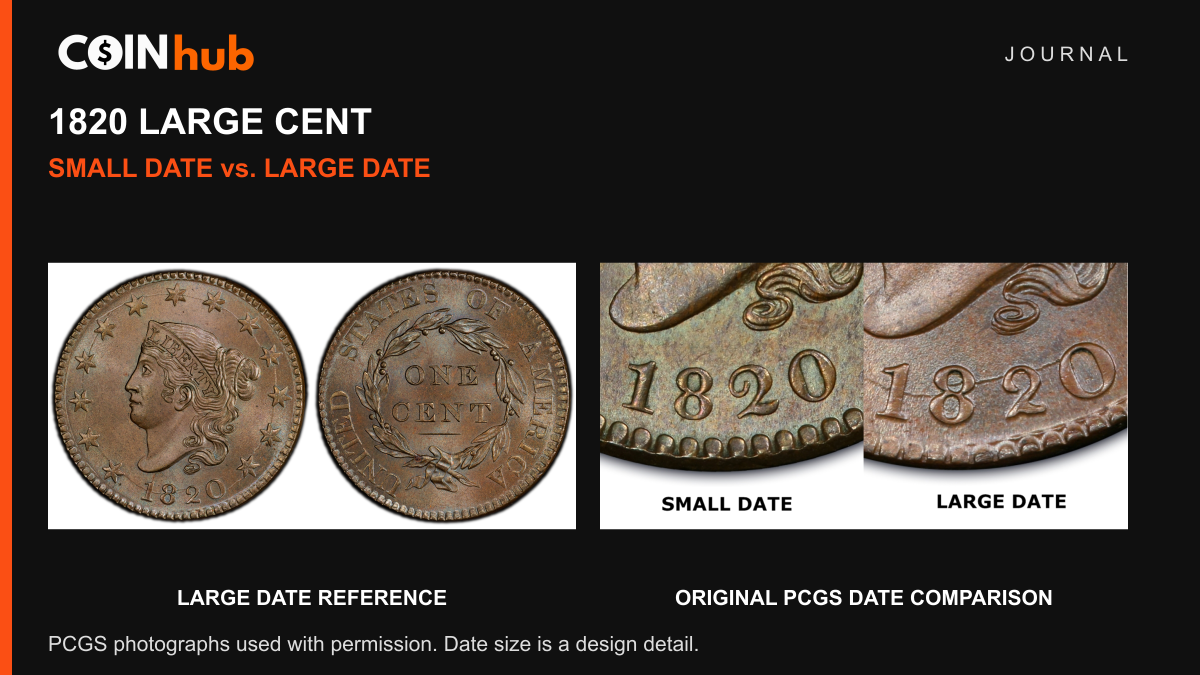
Look at the date punches, especially the 0
An 1820 U.S. large cent can have a Small Date or a Large Date. These names describe the numerals on the coin, not two sizes of cent. Start with the whole date and compare the 0 with a labeled reference. A large photo of a Small Date coin can look bigger than a small photo of the other type.
The original PCGS comparison below gives you both forms. The Small Date is at left; the Large Date is at right. Our main graphic also shows a complete Large Date reference coin. The photographs are examples for study, rather than coins offered for sale.
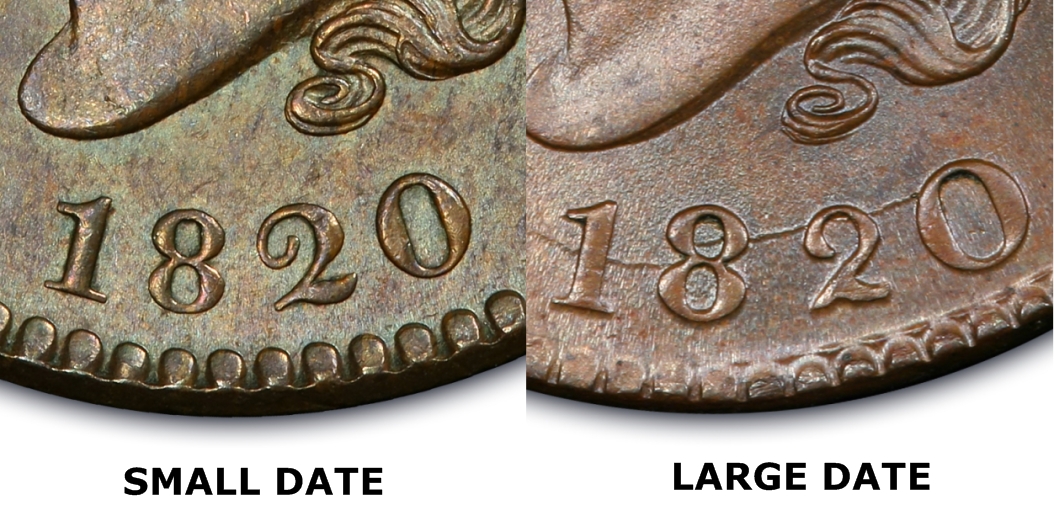
Use the portrait as a guide to scale
Place the date below Liberty's chin and lower hair curls in view. Keep those nearby details in your photo. In the reference, the Small Date's 0 is more compact. The Large Date's 0 is broader and taller. Compare the complete set of numerals too, rather than deciding from one worn edge.
A screenshot's border tells you little about the design. Two sellers may crop their pictures in quite different ways. Line up the same part of the portrait and date area before you compare them. Do not stretch one image to force a match.
PCGS catalogs Large Date and Small Date as separate entries in the Coronet cent series. Coronet refers to Liberty's headband. You may also see this design called a Matron Head cent. Both date forms show the same basic portrait and ONE CENT within the reverse wreath.
Keep 1820/19 on a separate line in your notes
The date-size choice is not the only question for this year. PCGS also catalogs an 1820/19 overdate. An overdate records a changed date on a die, the tool that strikes the design into a coin. It is not a second coin struck on top of the first.
Do not turn an apparent extra line near a digit into an overdate claim. A scratch, rough surface or shadow can distract from the actual numeral. Match the documented date detail and the other features needed for that variety. A date-size label alone cannot supply the overdate attribution.
Two separate observations: Which date family does the whole numeral set match? Is there enough clear evidence for a particular overdate or die pair? An answer to the first does not settle the second.
What a Newcomb number adds
A Newcomb number identifies a more exact pairing of front and back dies for this series. It goes beyond the broad Small Date or Large Date label. PCGS lists multiple die varieties under each family, so one closeup of the 0 is not a complete attribution.
Keep both faces in your record. A specialist may need the stars, letters, wreath and other small details to compare the dies. Our guide to die marriages explains that process. The CoinHub Variety Attribution Assistant can help organize the issue and feature you want to study. It suggests research directions; it does not prove a Newcomb number or authenticate a coin.
Save a useful result, including uncertainty
If the date is clear, record the family and attach the reference you used. If corrosion, wear or a holder hides the detail, write that down instead of filling in the missing shape. Take another straight-on photo under softer light. Do not clean or scrape the coin to uncover a number.
For example: “1820 Coronet cent; date compared with PCGS Small Date reference; full die pair not checked.” This leaves a useful trail without assigning a grade or a sale price. An exact die match, surface condition and genuine status still matter before you compare any values.
References checked October 18, 2026. Photographs courtesy of PCGS CoinFacts, used with permission. Complete reference coin and original labeled comparison resized; coin details unchanged. No current price or surviving-population estimate is claimed.