
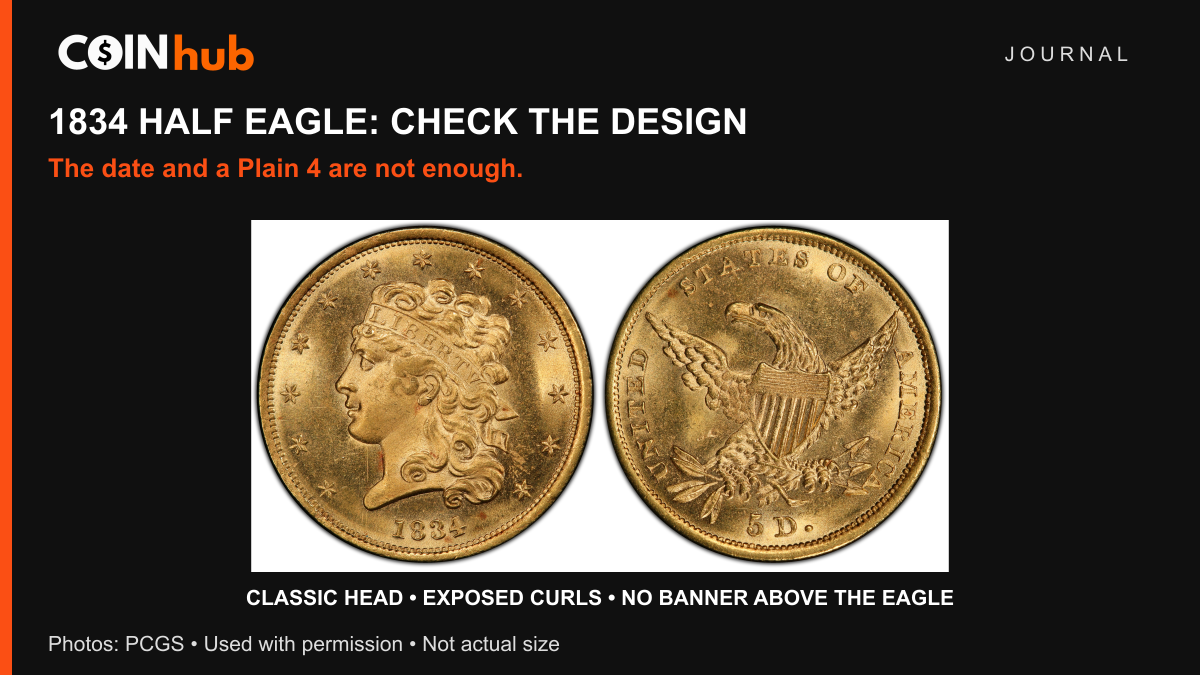
Two designs appear on the 1834 half eagle, the United States five-dollar gold coin. The Capped Bust version has a cap on Liberty's head and an E PLURIBUS UNUM banner above the eagle. The Classic Head version has exposed curls above a LIBERTY headband and no banner above the eagle. Check both sides before choosing a type.
Both portraits face left, and both dates can contain a Plain 4. Neither clue alone separates these designs. The Classic Head photograph shown here gives you a clear view of the curls and the open space above the bird.
First check the denomination: a half eagle is $5, not a half dollar. Look for 5 D. below the eagle. A Classic Head quarter eagle is a different, $2.50 gold coin, even when its portrait looks similar.
Find the cap or the exposed curls
Look at the top of Liberty's head on the obverse, or front. The older 1834 Capped Bust design shows a cloth cap above its LIBERTY band. You may also see this late design called Capped Head. The names can vary by reference, so match the actual coin rather than relying on a seller's short title.
PCGS places its 1834 Capped Bust, Plain 4 in the small-diameter Capped Bust type. The 1834 Classic Head, Plain 4 belongs to the new series. Those separate records are useful when a listing says only “1834 gold five.”
On the Classic Head coin, curls sit above the headband instead of the cloth cap. The portrait has a different outline, but do not make the decision from one soft patch of hair. Use an image that shows the entire head and the date, then turn to the reverse for a second clue.
Look above the eagle for the banner
The reverse is the coin's back. The older design carries the words E PLURIBUS UNUM on a ribbon above the eagle. The Classic Head design omits that ribbon. On the pictured Classic Head example, you can see open space between the eagle's head and the lettering around the rim.
For this 1834 comparison, “with motto” and “no motto” refer to E PLURIBUS UNUM. They do not refer to IN GOD WE TRUST. Write out the words in your notes if a seller's description is unclear. That small habit prevents a label used elsewhere in U.S. coinage from confusing the match.
Do not call a coin a Classic Head simply because a dim photo seems to lack a motto. A cropped image may cut off the relevant area. Glare can wash out detail, too. Ask for an evenly lit reverse photo that includes the whole rim and the space above the eagle.
The change went beyond Liberty's portrait
The PCGS Classic Head type history ties the new design to the Act of June 28, 1834. That law reduced the weight and changed the composition of U.S. gold coins. William Kneass designed the new half eagle.
The two PCGS specimen references list 8.75 grams and 23.80 millimeters for the older type, versus 8.36 grams and 22.50 millimeters for the Classic Head. These are reference specifications, not a promise that a worn coin will match an exact reading. A scale cannot replace the design check or prove a coin is genuine.
A Plain 4 does not settle the type
The shape of the final digit is a separate variety question. Both PCGS records linked above are called Plain 4. The Harry W. Bass Foundation's 1834 Classic Head entry explains the distinction: the Plain 4 has a straight end to the right-hand crossbar, while a Crosslet 4 adds a small upright serif there.
Start your notes with the denomination and design, then add the date variety when you can see it clearly. For example: “1834 $5; exposed curls; no E PLURIBUS UNUM banner; Classic Head; final digit needs a sharper photo.” This is more useful than assigning a full variety name from a blurry listing.
Identify the coin before comparing prices
An auction result for another 1834 half eagle may describe the other design, a different date variety or a much better-preserved coin. Keep those fields separate when you compare records. Our guide to price guides and auction results explains why two numbers may answer different questions.
Clear photos can help identify a design, but they cannot confirm authenticity or every surface problem. Do not clean or polish a coin to make its details stand out. If its type or authenticity remains uncertain, preserve that uncertainty and get an experienced specialist's assessment.