
Find out what the number measures
You find a guide figure, then a sold listing at a very different amount. It is tempting to choose the higher number when selling and the lower one when buying. A more useful approach is to work out why the two records differ. Sometimes the guide is broad; sometimes the auction coin has a problem, a special feature or a different attribution.
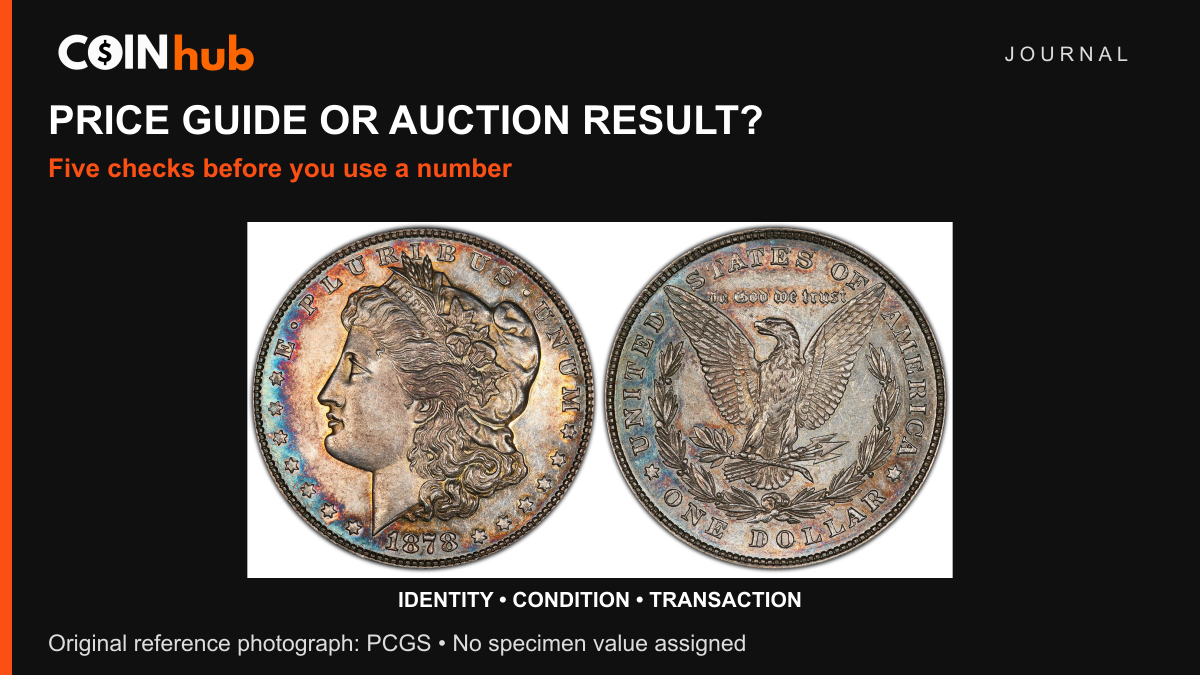
The Morgan dollar photograph above is a reminder to compare the actual coin. It is an identification reference, not a priced auction lot. Here are five checks to make before turning a number from a screen into a valuation or budget.
1. Identify the kind of price
Read the guide's explanation before its table. The PCGS Price Guide concerns PCGS-certified coins. PCGS explains in Is the Price Right? that these retail estimates are not offers to buy or sell a particular coin.
The NGC U.S. Price Guide describes average dealer retail prices for NGC-certified coins in standard holders, excluding sales tax. Its stated scope also matters for special labels and other holder premiums. Do not assume every guide uses the same basis.
A dealer's offer answers another question: what that buyer will pay under the proposed transaction. A seller's asking price is different again. Label each number in your notes before comparing it. There is no dependable rule that every coin should trade at the same percentage below a guide.
2. Match the exact coin category
Start with denomination, date, mintmark and recognized variety. Continue with strike format and any designation used by the reference. A common-date business strike is not a useful comparison for a Proof merely because the designs look alike.
Keep the source's full description with the price. An abbreviated search result can omit the feature that explains a strong sale. If a lot has an important pedigree, unusual variety or other documented distinction, decide whether your coin actually shares it. When that remains uncertain, place the result in a separate group instead of quietly counting it as equivalent.
A practical search order is exact identity first, then the closest defensible alternatives. If you cannot find a true match, say so. Expanding a search can provide context, but it does not transform a different coin into a direct comparable.
3. Compare condition beyond the grade number
Read the entire grading label and examine both sides. Details grading, color, surface quality, eye appeal and relevant designations can change the comparison. Two listings with the same numerical grade may still show noticeably different coins.
Keep problem coins separate from problem-free numerical grades unless you are specifically researching that problem. Our Details grade guide explains why visible detail alone does not settle a coin's market category. Likewise, an uncertified coin described by a seller as a certain grade has not automatically become equivalent to a certified example.
Save the photographs when the venue permits, or save the lot link and identifying number. A price without the coin's images loses much of its usefulness. If the photograph is too small to assess a stated defect, mark that limitation rather than filling it in with an optimistic assumption.
4. Put auction costs on the same basis
Check whether the displayed result includes the buyer's premium. Then distinguish that reported result from your total acquisition cost, which may also include shipping, insurance and applicable tax. Read the venue's current terms for the specific sale; an old lot does not establish today's fee schedule.
For a purely hypothetical example, a $200 hammer price with a 20% buyer's premium produces $240 before other charges. Comparing a $200 hammer with a $240 premium-inclusive result as though they were different market outcomes would be misleading. Those figures are arithmetic examples, not current fees or a value for the pictured Morgan dollar.
The seller's net proceeds are another amount. Do not infer them from what the buyer paid; selling charges and arrangements can differ. For the vocabulary behind these distinctions, see our guide to hammer price, buyer's premium and reserve.
5. Check the date and the depth of the evidence
Record when a guide was checked and when an auction took place. A recent guide entry and a much older transaction are different snapshots. NGC notes that periodic guide updates may not capture short-term changes and that thinly traded coins can vary substantially.
Use an archive such as PCGS Auction Prices to find more than one candidate, then open the actual records. Check whether the same coin appears repeatedly. A resale can reveal its history, but several listings for one specimen are not evidence of several different comparable coins.
Do not discard a result merely because it is inconvenient. Write down a concrete reason for excluding it: wrong variety, substantially different condition, unclear sale status or missing fee information. When the remaining evidence is sparse, a cautious range or an explicit unresolved question is more useful than a precise-looking average.
Build a small comparison worksheet
| Field | What to record | Why it helps |
|---|---|---|
| Reference and date | Guide name or auction, lot number, link and sale date | Makes the evidence retrievable |
| Identity | Date, mint, variety and strike format | Prevents unlike coins from being mixed |
| Condition | Grade, service, designations and visible problems | Keeps material differences visible |
| Price basis | Retail estimate, hammer or premium-inclusive result | Prevents fee mismatches |
| Comparison decision | Include, context only or exclude, with a reason | Makes your conclusion explainable |
You can keep this in a notebook or spreadsheet. Begin with a few carefully checked records rather than a large pile of unexplained numbers. If your goal is to sell, take that evidence to a dealer or auction specialist and ask how your particular coin differs. If your goal is to buy, set a total spending limit that accounts for the transaction's actual costs.
Guide methodologies checked September 23, 2026. This article explains comparison methods and assigns no current market value to an individual coin. Photograph courtesy of PCGS.