
Read the material claim as carefully as the denomination.
Quick answer: The 1837 Feuchtwanger cent is a private token made to show a plan for smaller change. Its German silver alloy contains copper, zinc and nickel. The word silver describes the alloy's appearance; it does not make this a silver bullion coin or an official U.S. Mint cent.
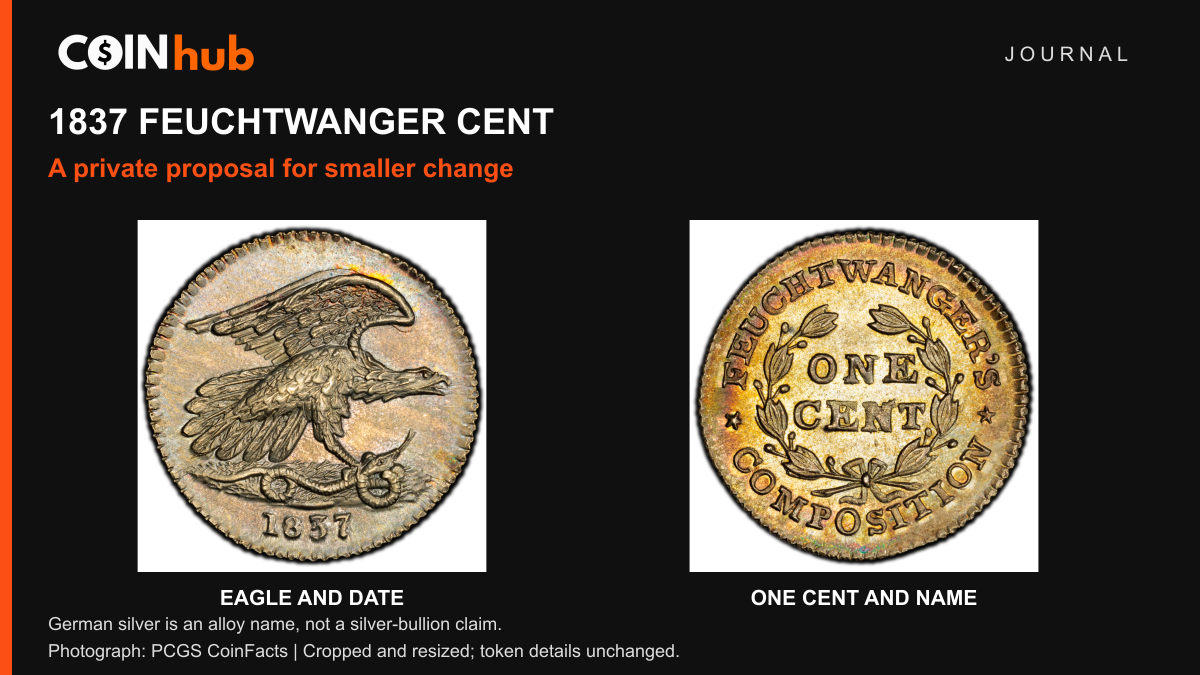
The two faces make a useful pair. One shows an eagle grappling a snake, with 1837 below. The other places ONE CENT inside a wreath and FEUCHTWANGER'S COMPOSITION around it. The name tells you whose token it is and what he hoped to sell.
What Feuchtwanger wanted to change
Lewis Feuchtwanger was a chemist and pharmacist working in New York City. He proposed his alloy as a substitute for the copper used in large cents. This was a plan from a private maker. The U.S. Mint did not issue the token.
NGC's specialist study describes the alloy as copper, zinc and nickel. It gives the token a diameter of about 18.5 millimeters, compared with 27.5 millimeters for the large cents of that period. The small size was part of the idea. ONE CENT was the stated value. It did not mean the pieces had the same metal or came from the same maker.
The proposal reached Congress, but it did not become the nation's cent. A Stack's Bowers catalog entry preserved by PCGS reproduces Feuchtwanger's offer to supply the material and records Mint Director Robert Maskell Patterson's rejection in 1838. A plan to use the new alloy was not the same as a choice to adopt it.
Three clues to read on the token
| Feature | What it tells you | What it does not establish |
|---|---|---|
| Eagle, snake and 1837 | A starting match to the one-cent design | Authenticity or an exact die pairing |
| ONE CENT inside the wreath | The stated denomination | Federal mint issue or precious-metal content |
| FEUCHTWANGER'S COMPOSITION | The maker's named material proposal | A modern alloy test or a silver weight |
Start with a clear photo of each face. In the reference photograph, the eagle and date are at left. The named composition and wreath are at right. Read the full outer words, rather than identifying the object from its bird alone.
The piece in the photo has warm color as well as gray areas. This can still fit the name German silver. Color in a photograph can vary with the surface and light. It cannot reveal the exact mix of metals in an unknown token.
Do not work out a silver melt value from its weight. Nor should you scratch, file or polish a token to test what lies beneath the surface. If you do not know what it is made of or whether it is real, leave it alone. Ask an expert who knows these tokens.
A token, a proposal and a collector's category
You may find these pieces described as Feuchtwanger cents, private patterns or Hard Times tokens. Each term gives some context. The name cent follows the stated value. A private pattern can show an idea for a new coin. Hard Times tokens form a collecting field associated with the shortage of change around the financial crisis of 1837.
Those labels do not tell you that a U.S. mint made it. For example, one field in a catalog can be less useful than its full text about a private New York issue. Read the words around the number, not just the number itself.
PCGS catalogs the one-cent type as HT-268. HT is a specialist reference label, not a denomination or a grade. The older Low-120 label may also appear in sale descriptions. Keep the reference name with its number so someone else can follow the identification.
Other American merchant pieces belong to different series. Our guide to Civil War store cards, patriotic tokens and sutler tokens explains a later group. Many tokens served trade and small change. They still belong to their own times and places.
Type identification comes before die attribution
A die is the tool that stamps one face of a coin or token. More than one die can carry a similar design. Specialists compare small features to work out which front and back dies were used together.
NGC's study illustrates differences in the date, snake, eagle and reverse lettering. Use that full diagnostic study if you want to go beyond the general type. A faint feather or a seller's label is a lead to check. It does not prove a die match.
Keep weak detail separate from wear and damage. A soft area in one photograph does not tell you why the feature is weak. Better lighting, both faces and a specialist comparison may resolve the question without touching the surface.
A useful first collection note
Begin with something modest and checkable: “1837-dated Feuchtwanger one-cent token; eagle and snake; named composition around wreath; die pairing not assigned.” Attach both photos and any holder or seller record. That note says what you can see. It leaves room for a more exact die match.
If a holder gives a grade or variety, copy it accurately and retain the certification number with your private records. Compare the actual token with the service's record. A number that matches is useful. Still, check the token itself as well as the typed number.
Before you compare prices, match the type, die pair and state of the surfaces. A problem-free piece and a cleaned or damaged one are not equal comparisons. Keep an asking price apart from a sold price. One high sale does not set the value of every token dated 1837.
This piece has a clear place in the history of change. Its small size, named alloy and face value show what its maker hoped to change. Read all three clues together. They help you avoid calling this private token a silver coin or a U.S. Mint cent.
Photograph: PCGS CoinFacts reference image, used with CoinHub's existing permission. Both faces come from one source photo. The panels are cropped and resized; token details are unchanged. Historical context was checked against NGC's specialist study and the cited auction catalog. No current price, exact alloy percentage or specimen-specific die attribution is asserted here.