
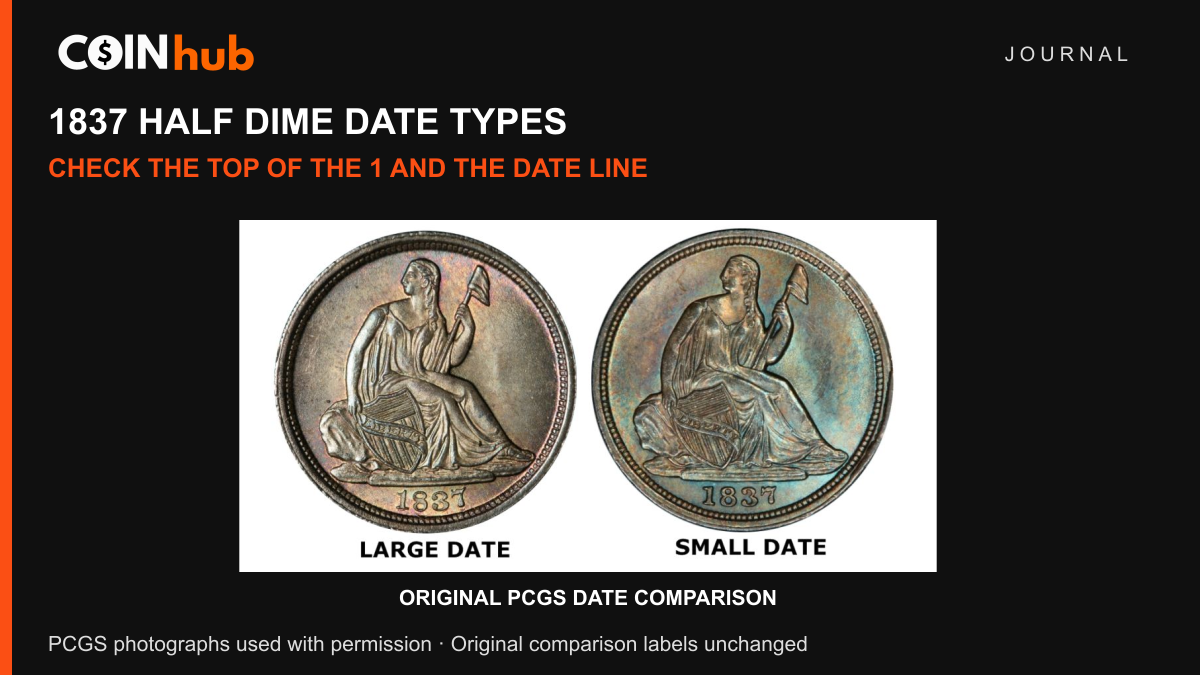
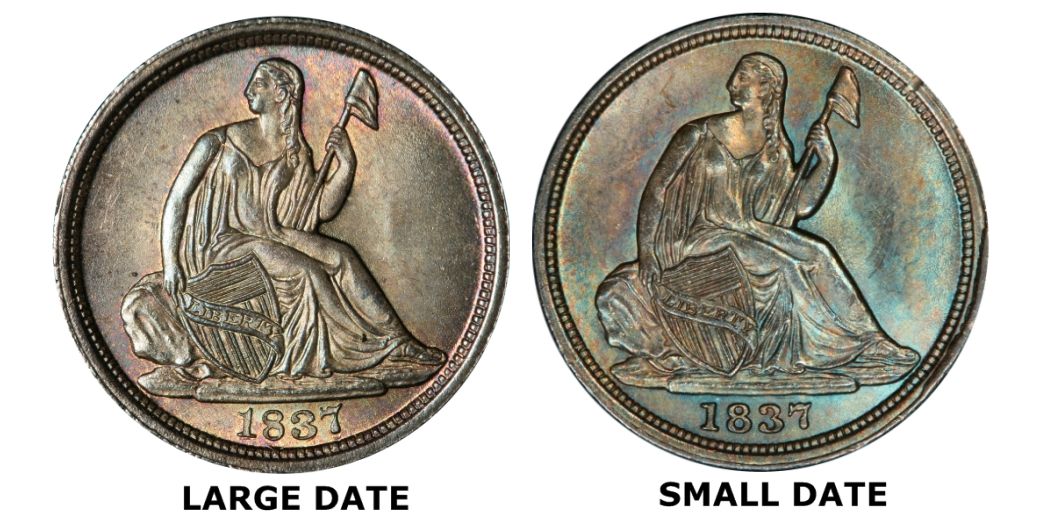
On an 1837 No Stars half dime, compare the top of the 1 and the way the date runs above the rim. The Large Date has a peaked 1 and a curved date. The Small Date has a flat-top 1 and a straighter date line. Those clues are more useful than comparing the size of two sellers' photographs.
First confirm that the reverse says HALF DIME. This is a five-cent silver coin. The similar 1837 No Stars dime says ONE DIME and has its own date diagnostics. A dime photograph is not the right reference for identifying the half-dime variety.
Compare the 1, then the whole date
| Check | Large Date | Small Date |
|---|---|---|
| Top of the 1 | Peaked or pointed | Flat top |
| Date arrangement | Curves with the rim | Forms a straighter line |
| Source catalog entry | PCGS 4311 | PCGS 4312 |
These features agree with the Quickfinder notes in the PCGS Large Date entry and Small Date entry. Compare both clues. A worn tip on the 1 can make a single-feature judgment unreliable.
Photograph the date straight on, keeping the base of Liberty's rock and the rim in view. That gives the date a fixed setting. Cropping away everything except four enlarged numerals can hide the curved or straight arrangement you need to compare.
Why the dime's 3 can mislead you
The half dime and dime changed to Christian Gobrecht's Seated Liberty design in 1837. Both have Large Date and Small Date descriptions. Those shared names do not mean every letter shape works the same way on both denominations.
In NGC's study of the coinage of 1837, David W. Lange explains that both half-dime date varieties have round-top 3s. The flat-top 3 used to help identify a Large Date dime therefore does not provide the same dividing line here.
Use the denomination and the actual half-dime references together. If the back reads ONE DIME, switch to the separate 1837 No Stars dime guide. Do not carry a half-dime attribution or catalog number across to that larger coin.
Keep the starless design in context
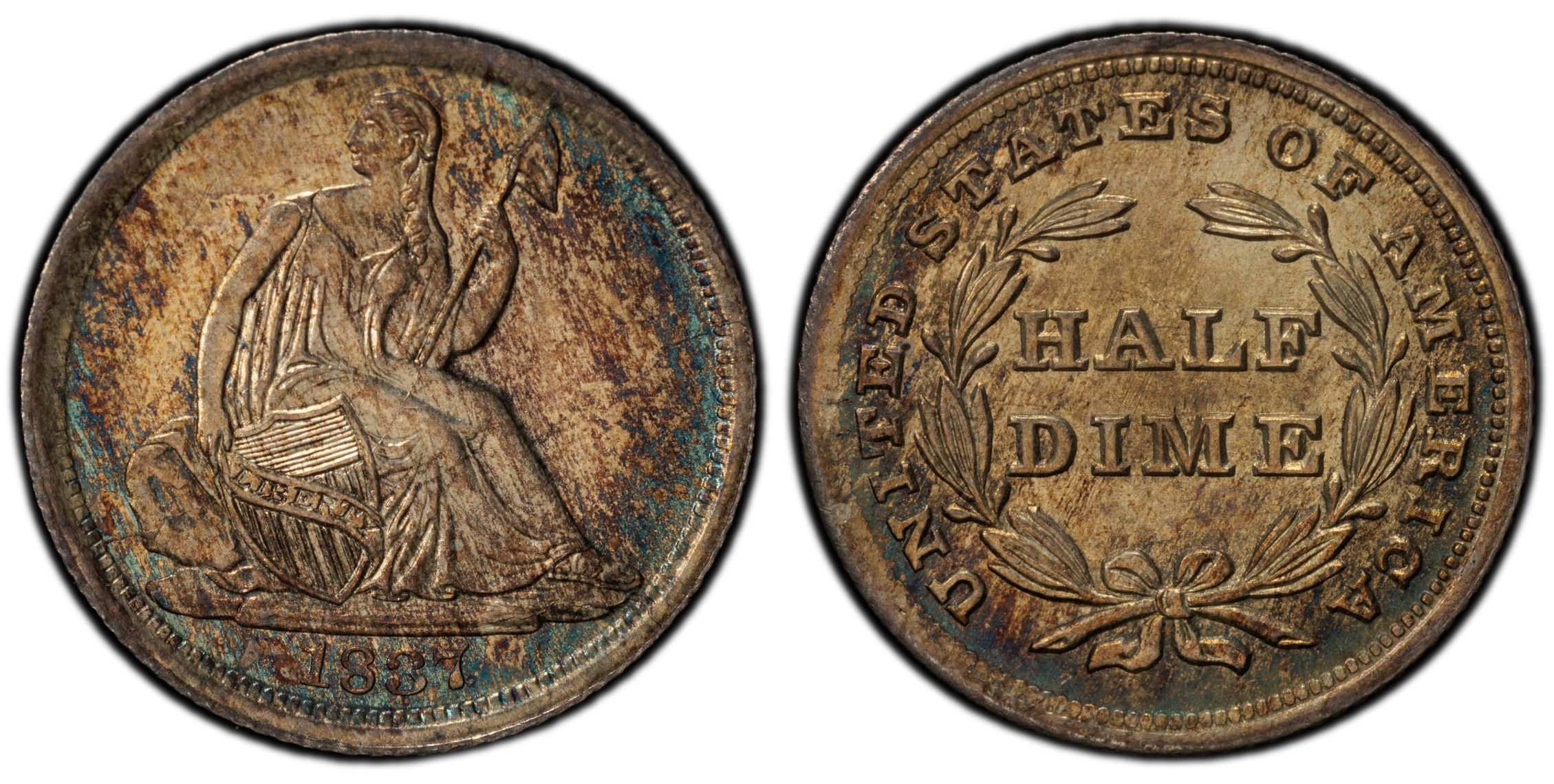
The obverse, or front, shows seated Liberty without a ring of stars. On this type, the open space is intentional. It does not show that stars were accidentally omitted from your coin. The reverse, or back, places HALF DIME inside a wreath.
A date style is also not a grade. A clear pointed 1 may help identify the variety while scratches, wear or cleaning still affect the individual coin. Neither date style alone proves a Proof, a coin made by a special manufacturing process. Leave that question to a separate examination.
Make the identification useful
- Save full front and back photographs, with the denomination readable.
- Keep one date detail that includes the rock and rim.
- Record the top of the 1 and the date's alignment separately.
- Leave an unclear feature undecided instead of turning a blurred image into a definite attribution.
When comparing sales, match the denomination and date style, then check condition and problem status. Large Date and Small Date name design details, not two fixed prices. An exceptional auction coin is not a general quote for any 1837 half dime.
For the wider series, use the Liberty Seated half-dime identification guide. This narrower comparison begins with HALF DIME, then asks two concrete questions: is the 1 peaked or flat, and does the date curve or run straight?