
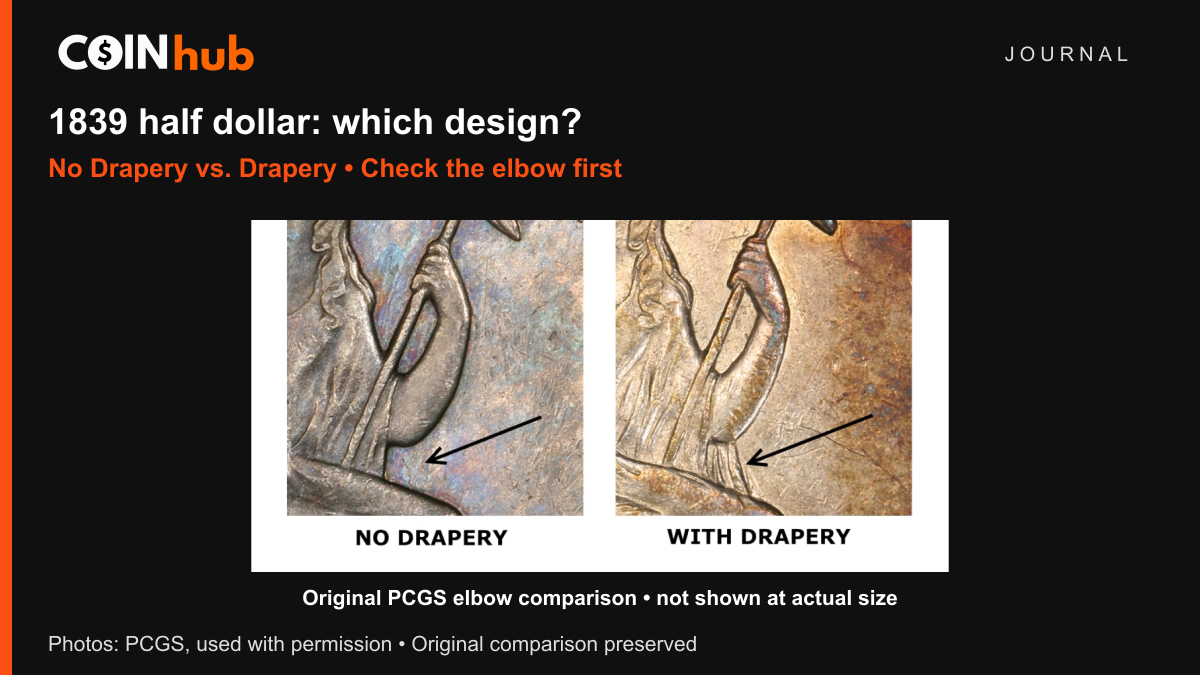
The 1839 Seated Liberty half dollar comes in two designs: No Drapery and Drapery. Look below Liberty's raised elbow, on your right as you face the coin. The Drapery version has an added fold of cloth there; the No Drapery version leaves that area open. A worn patch alone is not enough to identify the earlier design.
Both versions bear the same date. That makes this a useful lesson in reading the design before comparing prices. Start with the elbow, check the rest of the coin, and keep any uncertain result separate from a firm attribution.
Where to look on an 1839 half dollar
Use the front, or obverse, with Liberty seated and the date at the bottom. Her raised arm holds a pole. The small space below that elbow is the main comparison point in the PCGS photograph above. The original photo labels and arrows are preserved.
On the No Drapery design, the edge of the gown stops without the added hanging fold. On the revised design, cloth runs down from beneath the elbow toward the leg. PCGS's No Drapery reference explains this feature and lists the two designs as separate major types.
Keep left and right clear: references describe Liberty's left elbow. For you, looking at the front of the coin, that elbow is on the right. Compare the same small area in both photographs before judging your coin.
A second clue: the rock beside the stars
The elbow is not the only design difference. In the earlier No Drapery version, the rock beneath Liberty is larger. Its left edge sits closer to the lowest star on the left. The revised Drapery version has a smaller rock, with more space beside that star. CoinWeek's 1839 half-dollar study describes this as a useful supporting clue on worn coins.
Compare full front-side photographs for this check. An elbow close-up does not show the whole rock or its distance from the stars. Do not try to measure the gap in millimeters from images of different sizes. Look at the relationship between the rock, star and surrounding design.
| Feature | No Drapery | Drapery |
|---|---|---|
| Below the raised elbow | No added hanging fold | Added fold toward the leg |
| Rock on the viewer's left | Larger; closer to the lowest left star | Smaller; farther from that star |
| Major catalog reference | PCGS 6230; WB-101 | PCGS 6232; WB-102 |
Why a missing fold does not settle the question
Wear, flat lighting and marks can hide a small raised detail. First change the light and compare clear photographs. Leave the surface as it is: rubbing or scraping the elbow area will not reveal the coin's original design and can damage evidence.
There is also a difference between a design and a later change to a die. A die is the metal tool that strikes the coin. PCGS's Drapery entry notes that polishing could remove some or all of the drapery from later dies. A missing fold on another date is therefore not proof that the coin belongs to the original 1839 No Drapery type.
If the elbow seems open but the rock looks like the revised design, record both observations. Do not force a match. A specialist can assess the entire design and surface, especially when wear or possible alteration prevents a clear comparison.
What WB-101 and WB-102 mean
These are catalog labels used in the Wiley-Bugert reference: WB-101 identifies the No Drapery type and WB-102 the Drapery type. They are not grades. The No Drapery type also includes several known die marriages, meaning specific pairings of a front die and a back die.
You do not need to assign that more detailed pairing to make the first design comparison. Treat it as another task. A clear elbow photo may support the broad type while leaving the exact die pairing unresolved.
Make a useful record before checking value
- Photograph the complete front and back, then add a sharp elbow close-up.
- Write down the date, elbow feature and rock shape separately.
- Note any wear, marks or glare that limits the comparison.
- If the coin is certified, copy its full label and verify the certification with the grading service.
- Compare sales only after matching the type, condition and any surface problems.
For example, “1839, fold unclear, rock not yet compared” is an honest starting record. It is more useful than assigning No Drapery from one bright patch. The goal is a supported identification, not the highest possible price label.
Early half dollars had other changes too. Our 1836 lettered-edge versus reeded-edge guide covers a different transition. Keep that edge question separate from the elbow design on this 1839 coin.
Comparison photographs: PCGS, used with permission. Original details, arrows and labels preserved; complete comparison resized within the CoinHub layout. Reference coins are not CoinHub inventory.