
Read the denomination before you compare prices
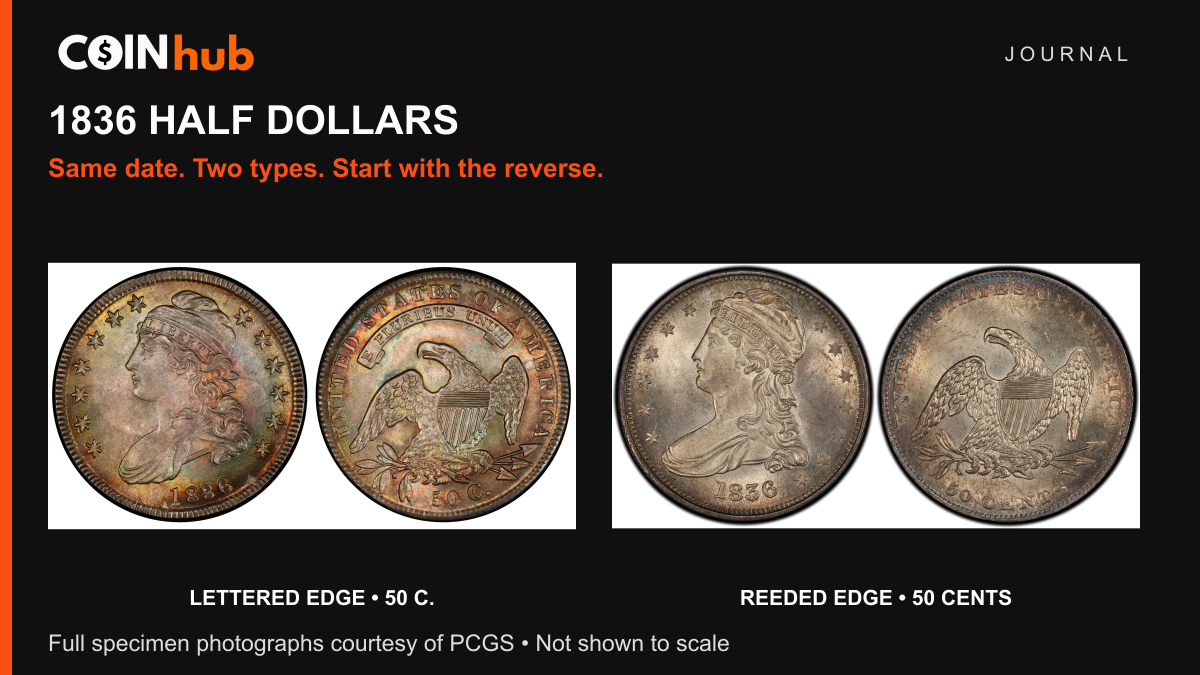
An 1836 half dollar can belong to either of two Capped Bust types. The older version has a lettered edge and 50 C. below the eagle. The newer version has a reeded edge and spells the denomination 50 CENTS. Both are legitimate issues; the difference is not, by itself, a mint error.
A seller's photograph may show only the front, where the shared date and broadly similar portrait make the coins easy to confuse. Ask for the reverse and an edge view before selecting a catalog entry. An identification based solely on the year can send you to the wrong reference and the wrong sale comparisons.
The practical comparison
| Observation | 1836 lettered edge | 1836 reeded edge |
|---|---|---|
| Below the eagle | 50 C. | 50 CENTS |
| Edge | Words giving the denomination: FIFTY CENTS OR HALF A DOLLAR | Closely spaced reeds |
| Nominal diameter | 32.50 mm | 30.00 mm |
| PCGS listed weight | 13.50 g | 13.48 g |
| Designer credited by PCGS | John Reich | Christian Gobrecht |
The measurements are reference specifications from the lettered-edge and reeded-edge CoinFacts entries. They are not an authentication test for an individual coin. Wear, damage and measurement technique matter; the listed weights are especially close together.
The genuine photographs above show both faces of reference specimens. They help with the reverse wording and design arrangement, but they do not show an edge close-up and are not printed at a shared scale. Do not measure the pictured circles to identify a coin.
Why the Mint changed the type
NGC's historical account by Jeff Garrett connects the redesign with the Philadelphia Mint's move from its hand-operated screw press to steam-powered coinage. Gobrecht adapted the existing Capped Bust design for the new issue. The change therefore belongs to a manufacturing transition, not merely to a different way of spelling fifty cents.
That context also explains why a date set and a type set may treat the year differently. A collector filling one space marked 1836 may select a lettered-edge example, while someone illustrating design changes will want to distinguish the two issues. Write the type alongside the year in an inventory so the purpose of the purchase remains clear.
Do not move 1837 specifications back a year
The reeded-edge design continued after 1836, but a description of the whole series can conceal a date-specific difference. Garrett dates the revised silver fineness and reduced weight to 1837. PCGS's two 1836 entries both list silver at 89.2%, rounded in their specification fields. Do not automatically label an 1836 reeded-edge half dollar 90% silver because a later example or a broad series summary uses that figure.
The same caution applies to reverse wording: the later HALF DOL. inscription is not the 1836 comparison shown here. Check the exact date and type before importing specifications from a neighboring catalog entry.
Why mintage figures deserve a source and a date
Current references do not present the reeded-edge production count uniformly. PCGS's regular-strike page lists 5,000. Garrett's 2022 discussion reports the traditional figure of roughly 1,200-plus and notes that some specialists believe more were produced. Those are different treatments of a historical estimate, not two numbers that should be added together.
For identification, you do not need to resolve that debate. For a researched collection description, name the reference and retain its qualification. Avoid turning an estimated original production count into a claim about the exact number surviving today.
Make a useful record of your coin
- Save full views. Include the complete front, reverse and any safely visible edge. Keep the original photographs as well as detail crops.
- Copy the wording. Record what is actually legible below the eagle. Use “unclear” when wear or glare prevents a reading.
- Separate type from condition. A correct type identification says nothing by itself about cleaning, repairs, grade or authenticity.
- Match the comparison. When investigating a sale, match type, grade and problem status instead of using any auction result headed 1836 half dollar.
Our coin-weighing guide explains how to record a meaningful measurement without treating it as a verdict. Once the broad type is secure, die-marriage attribution is a separate, more detailed question.
Questions collectors ask
Does a smooth-looking edge prove it is the lettered type?
No. A photograph may hide worn lettering, and damage can obscure either edge treatment. Compare the reverse and the rest of the coin. Unclear evidence should remain unresolved until a qualified examination supplies more information.
Can I identify it from weight alone?
No. The published nominal weights are too close to make that a sensible stand-alone distinction, and a match would not authenticate the coin. Start with the reverse wording and seek agreement among independent observations.
Sources and photographs: PCGS CoinFacts and NGC references checked September 27, 2026. Original PCGS specimen photographs used with permission; complete images unchanged within the CoinHub layout.