
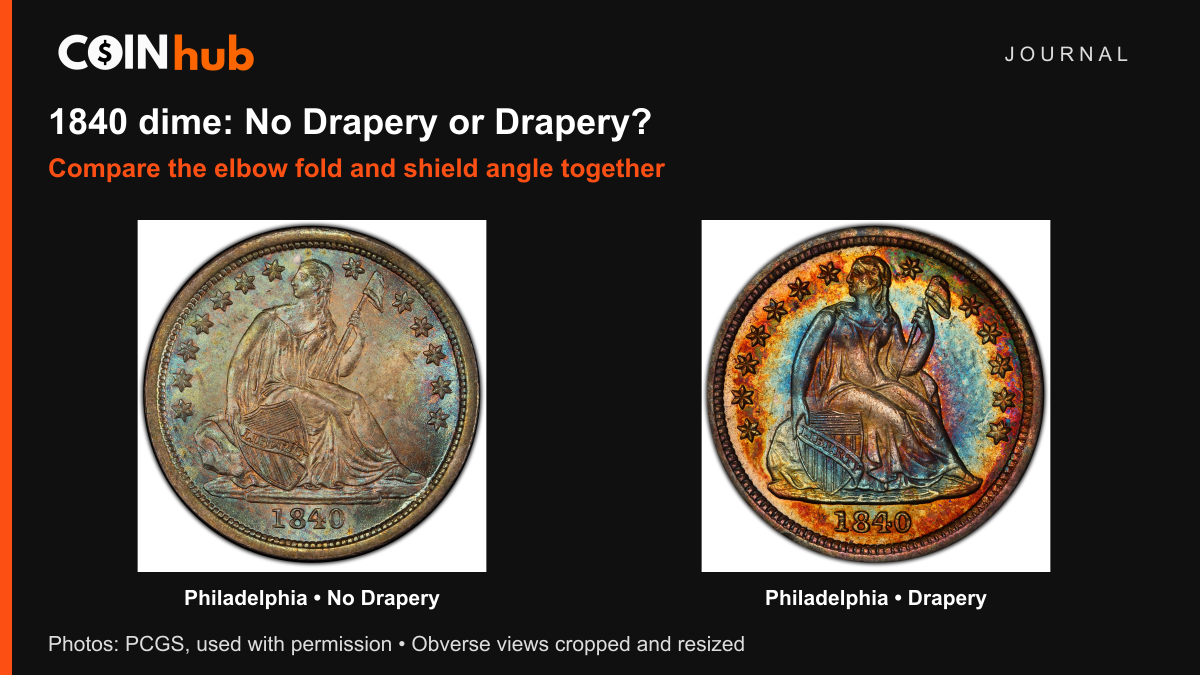
The 1840 Philadelphia Seated Liberty dime comes in No Drapery and Drapery designs. Check below Liberty's raised elbow, on your right as you face the coin, then look at the shield on your left. The revised design adds a fold of cloth and makes the shield upright. The earlier shield leans to the left.
Both coins have stars and the same date. A missing star is not the test, and a worn elbow alone is not enough. Use the two areas together before choosing a catalog entry.
Begin with the correct denomination
Turn the coin over and confirm that it says ONE DIME. A Seated Liberty half dime says HALF DIME and is a different five-cent coin. Search results often mix those two series, so a date and a seated portrait are an incomplete match.
The main photographs show two Philadelphia dimes: the No Drapery reference, PCGS 4573, and the Drapery reference, PCGS 4578. They are separate specimens. Their different colors and grades are not the design test.
Locate the fold below the elbow
The obverse is the coin's front. Liberty sits with a shield beside her and holds a pole in her raised hand. References call the relevant arm her left arm; for the viewer, it is on the right. Look just beneath its elbow.
On the Drapery design, a small added fold hangs down in that space. No Drapery lacks that added piece. The name does not mean that Liberty wears no gown: both designs show clothing. It refers to this particular addition.
Keep enough of the arm and leg in a close-up to show where you are looking. A tiny crop of a smooth patch loses the surrounding design. Compare the full photographs first, then use a closer view to study the fold.
Cross-check the shield angle
PCGS's narratives describe the earlier shield as tilted to the left and the revised shield as vertical. The rock on the viewer's left was also reshaped. This was a design revision, rather than one small piece of cloth added to an otherwise identical coin.
Hold the images upright before comparing the shield. A tilted seller photograph can make an upright shield appear slanted. Use the date and the round outline of the coin to check the image's position, then compare the shield within the design.
| Feature | No Drapery | Drapery |
|---|---|---|
| Below the raised elbow | No added hanging fold | Added fold of cloth |
| Shield | Leans to the viewer's left | Upright |
| PCGS reference | 4573 | 4578 |
Keep the mint and other variety questions separate
The two designs in this comparison are Philadelphia issues. Check the back for a mint mark before applying that pairing to another coin. PCGS lists the 1840-O New Orleans dime separately. Preserve its full description instead of dropping the O from your notes.
This elbow-and-shield question also differs from the 1837 No Stars dime and 1838 star-size varieties. A feature useful for one date need not identify another. Start with the denomination, date and mint, then choose the relevant comparison.
Make an honest identification record
Suppose the elbow fold is hard to see, but the shield appears upright. Record both observations. Do not turn the unreadable area into No Drapery merely because that label seems more desirable. Wear, glare and weak detail can hide a small feature.
- Photograph both complete sides, with ONE DIME and the date readable.
- Add an elbow detail that includes the arm and upper leg.
- Keep the shield visible in a straight-on front image.
- Copy any grading label exactly, including mint and design wording.
- Leave unclear details open until a better photograph or examination resolves them.
A design comparison does not authenticate a coin, assign a grade or establish a sale price. Keep the surface uncleaned and get a qualified assessment when those decisions matter. Match the complete issue and condition before using another coin's auction result as a comparison.
Original PCGS photographs used with permission. Front views are cropped from complete specimen photographs and resized. The coin details are unchanged. The references support the design comparison; inconsistent rarity ratios and old population statements are not used as current market evidence.