
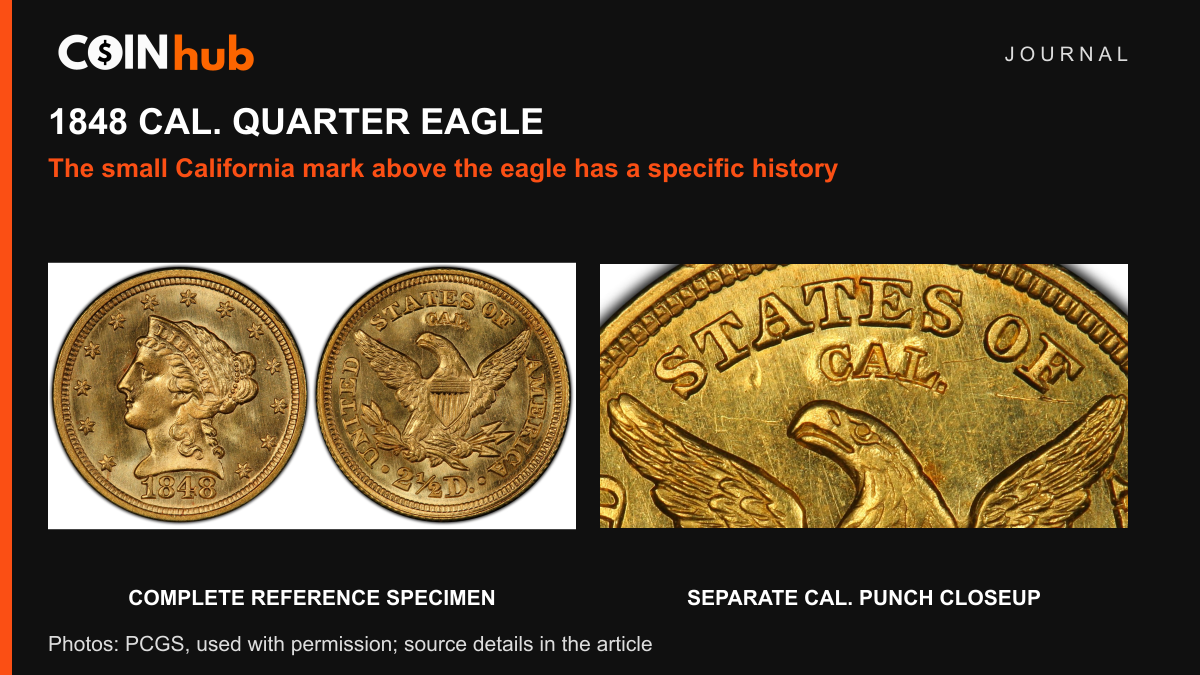
CAL. on an 1848 quarter eagle identifies a special issue made from California gold sent to the Philadelphia Mint. The letters were deliberately punched above the eagle on the reverse. A quarter eagle is a $2.50 gold coin; CAL. is not a face value, the Charlotte mintmark, or an accidental error.
The mark is small, but it tells a specific story. Start with the dated front, then turn to the eagle side. An ordinary 1848 quarter eagle and an 1848 CAL. quarter eagle are separate entries in coin catalogs.
Find the recessed mark above the eagle
The obverse is the coin's front, with Liberty and the date. The reverse is the back, with the eagle and the value 2½ D. The PCGS reference photos show CAL. in the space above the eagle's head.
The letters are incuse, meaning they sink into the surface rather than rise above it. In the closeup, look at the full group of letters and its period. NGC's Liberty Head quarter-eagle history notes the square period after CAL.
The full coin photo and the closeup are separate PCGS images. They show the design and punch clearly. The closeup is not presented as a crop of the exact coin beside it.
A mark is a starting clue: the correct-looking letters alone cannot prove that a coin is genuine. Someone can add a similar punch later. An expert needs to check the coin, its surfaces and the mark together.
Follow the California gold shipment
The Smithsonian's 1848 quarter-eagle record describes gold sent east by California military governor Richard B. Mason. The Secretary of War passed it to the Mint. Much went into medals for military officers; some was used for the marked quarter eagles.
The museum records 1,389 coins with the CAL punch. PCGS's account places the shipment's arrival at the Mint on December 15, 1848. The mark connected this issue to the source of the gold without replacing the standard Liberty Head design.
This history explains why collectors pay attention to three tiny letters. The mark records a particular use of California gold at a time when the gold rush was changing the country. It does not identify a mint operating in California.
CAL. is different from a C mintmark
Catalogs also list quarter eagles with a C for Charlotte. That is a mintmark: it identifies the facility that made the coin. CAL. on this Philadelphia issue records where the gold came from instead.
Write the full mark in an inventory note. “1848 $2.50; CAL. visible above eagle” is clearer than “1848 C gold.” Keep photos of both sides with that note so a later reader can check the date, denomination and actual lettering.
Two familiar “first” claims need context
You may see the CAL. quarter eagle called America's first commemorative coin. It does commemorate an event through its special mark. PCGS also distinguishes that historical description from a commemorative issue authorized by Congress, a tradition that began with the 1892 Columbian half dollar.
It is also unsafe to call it the first federal coin made from California gold without qualification. PCGS describes California gold delivered by Abel Stearns and coined at Philadelphia in 1842, before the famous 1848 rush.
Those qualifications do not diminish the CAL. issue's story. They clarify its role: this marked issue used a specific shipment, not a claim that no California gold had ever reached the Mint before.
Identify the complete coin before comparing prices
Ask for sharp photos with the full rim visible and a close view of the punch. Keep the seller's attribution and any certification number separate from your own observations. Do not clean or polish the mark to make it easier to see.
A sale or asking price for another example may involve a different grade, surface condition or history. Our guide to price guides and auction results explains those differences. This article assigns no price or authenticity judgment to an unseen coin.
Historical records and photos reviewed October 14, 2026. Photos: PCGS, used with permission; complete specimen image and separate source closeup resized without changing coin details. Reference specimens are not CoinHub inventory.