
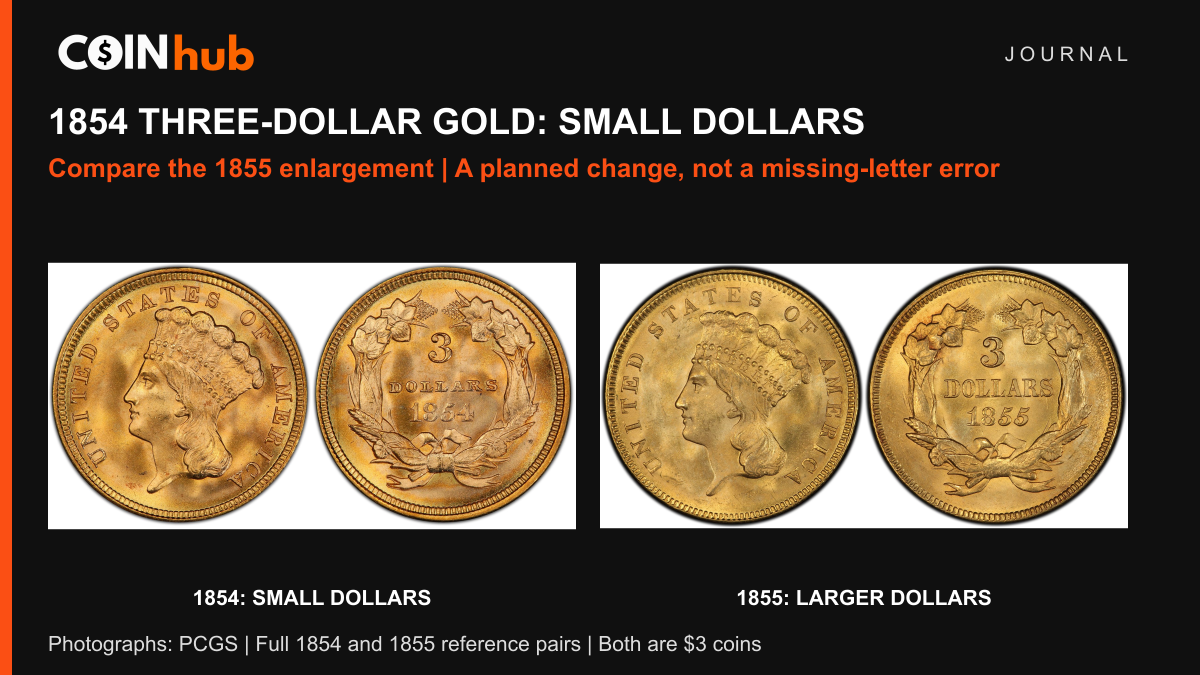
The 1854 three-dollar gold coin has small letters in DOLLARS on its reverse. The Mint enlarged that word in 1855 and kept the larger lettering for the rest of the series, through 1889. The small word is an intended first-year design, not a missing-letter error.
Start with the reverse: a large 3 sits above DOLLARS, with the date below. The coin is a three-dollar piece. It is not the one-dollar gold coin that also changed designs in 1854.
Compare the word inside the wreath
The PCGS 1854 reference shows the smaller word beneath the numeral. In the 1855 reference, the letters occupy more space across the wreath's center. Both still spell the same denomination.
Use the size of DOLLARS relative to the 3, date and wreath, not the size of a picture on your screen. A seller can enlarge a small photograph. Two images displayed at different scales can make the lettering change harder to judge.
| Feature | 1854 | 1855–1889 |
|---|---|---|
| Word below the 3 | Smaller DOLLARS | Larger DOLLARS |
| Face value | Three dollars | Three dollars |
| Meaning of the difference | First-year reverse style | Revised reverse style |
The two complete reference pairs above show an 1854 coin and an 1855 coin. The comparison concerns the word's design. It does not assign a grade, establish a price or imply that both dates are equally scarce.
What changed, and what stayed the same
James Barton Longacre designed the three-dollar gold type. Liberty faces left in a feathered headdress on the front. On the back, a wreath surrounds the numeral, denomination and date. The larger word did not create a new face value.
Stack's Bowers' 1854 reference identifies the small lettering as that year's feature and notes the later enlargement. The visible change is a useful way to sort the first year from the later reverse style.
A small word that is fully formed is not the same as lost detail. Wear can blur the word, and a filled die can weaken a letter. Neither process explains the planned small DOLLARS layout of a normal 1854 coin.
Keep the three-dollar coin apart from gold dollars
Search results for “1854 gold” can mix several denominations. The 1854 Type 1 and Type 2 gold dollars are one-dollar coins. Their design comparison is a different question from the lettering on a three-dollar reverse.
Read the actual denomination before using a title or price guide. A three-dollar piece says 3 DOLLARS inside its wreath. A photograph that shows only the portrait can leave this basic identity unclear.
A crop can also hide the date, rim or mintmark area. Ask for both full faces and the edge before making a record. Leave a sealed certified holder intact and save its label with the images.
Date and mint still matter
The 1854 issue includes coins from Philadelphia, Dahlonega and New Orleans. The branch-mint letters D and O distinguish the latter two. The small DOLLARS style alone does not tell you which mint made the coin.
Record the date and any mintmark exactly as seen. Do not use a Philadelphia example's guide entry for a D or O coin just because the lettering matches. A missing or hidden mark in a photograph needs a better image, not an assumed attribution.
Check a certified coin's number with the named grading service and compare the pictured object with the record. Copying a valid number onto another holder does not authenticate that holder or coin. An uncertain early-gold piece warrants specialist examination.
Use the lettering as one part of the record
A useful note reads “1854, 3 DOLLARS reverse, small lettering,” followed by the mintmark, if present, and clear images. Keep that observation separate from a claim about grade or originality. Avoid cleaning or polishing the coin to sharpen the word.
Only compare sale records after the date, mint and condition are established. The price for one scarce mint or high-grade example cannot be transferred to every coin with small lettering. This guide gives a design comparison, not a current appraisal.
References: PCGS CoinFacts entries 7969 and 7972 and Stack's Bowers' 1854 gold three-dollar resource, checked October 15, 2026. Historical mintage figures that differ between source sections are not repeated here.
Photographs: PCGS, full 1854 and 1855 reference pairs, reused under CoinHub's saved permission. Original photographs resized in full with labels and CoinHub branding added. No coin lettering or other detail altered; no source endorsement implied.