
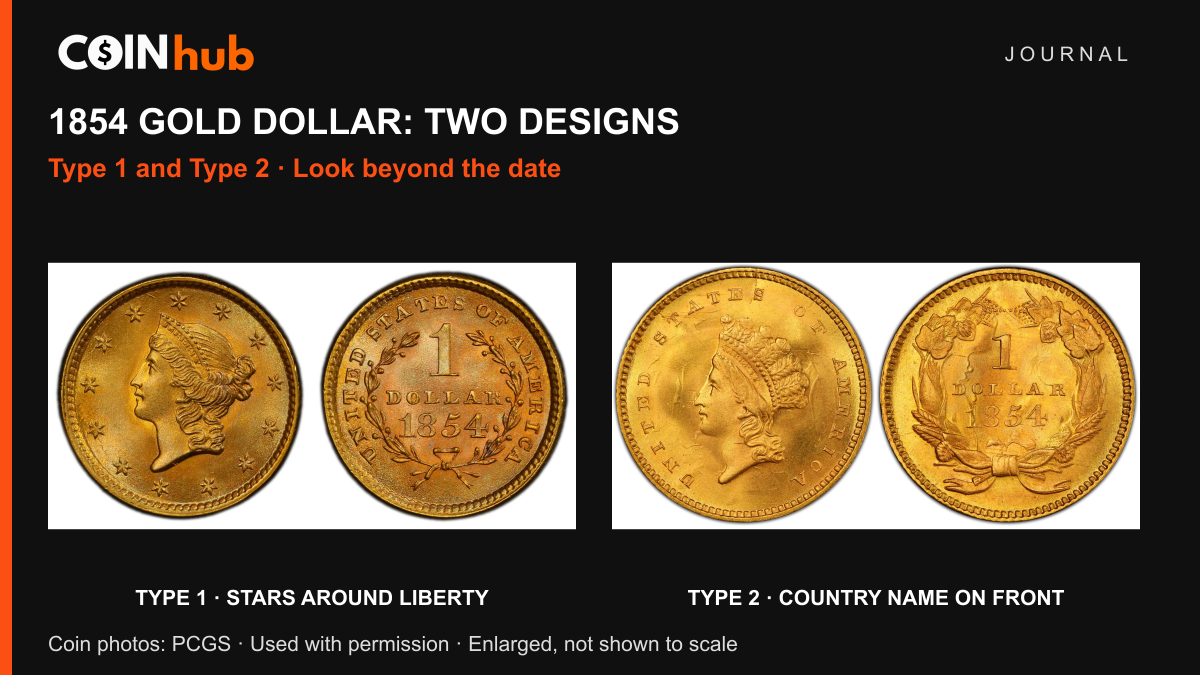
An 1854 gold dollar can have either of two regular designs. Type 1 shows Liberty wearing a small coronet, with stars around her head. Type 2 shows Liberty in a feathered headdress, with UNITED STATES OF AMERICA around the portrait. Check that portrait and lettering before using the date to look up the coin.
The change is part of the design history of the gold dollar. A Type 2 coin is not a mint error simply because it looks different from a Type 1 of the same year. Both designs belong in an 1854 comparison, and a listing that gives only the date leaves out a key detail.
The quickest check: Find the words UNITED STATES OF AMERICA. On Type 1, they surround the wreath on the back. On Type 2, they surround Liberty on the front. Use the portrait as a second check.
Why does 1854 have two gold dollar designs?
The U.S. Mint's dollar history places the first gold dollars in 1849, during the California Gold Rush. The original Liberty design continued into 1854. That year, the Mint introduced the Small Head Indian Princess design, now called Type 2. James B. Longacre designed both.
Those type names describe changes in the design, not different denominations. Each coin still says 1 DOLLAR on the back. The Mint later introduced the Large Head version, called Type 3, in 1856. That later change can make a search for an “Indian Head gold dollar” too broad when you need an exact match for 1854.
Read the portrait, then turn the coin over
The two genuine PCGS examples in the comparison image show the details to look for. Each photograph includes the front and back of one coin. The images are enlarged for reading; their displayed size is not a measurement of the coins.
Type 1: a coronet and a ring of stars
On the 1854 Type 1 example, Liberty faces left. A narrow coronet, or small crown, carries LIBERTY. Stars fill the space around the portrait. Turn it over and look beyond the thin wreath: the country's name runs around the outer edge of that side.
The date sits below 1 DOLLAR inside the wreath. This gives you three separate matches to make: the coronet, the stars and the country name on the back. A clear match across both sides is more useful than a guess from the gold color or a seller's short title.
Type 2: a feathered headdress and a fuller wreath
The 1854 Type 2 example also has a left-facing portrait, but the headdress is much taller. UNITED STATES OF AMERICA now surrounds Liberty. On the back, a fuller wreath frames 1 DOLLAR and the date, without the separate outer ring of country lettering seen on Type 1.
Start with those large design features if a small photograph makes the date hard to read. Then ask for a sharper date image. Matching a design does not settle a missing digit, and it does not prove the coin is genuine.
Do not confuse a weak detail with a different type
A coin's design and its condition answer different questions. The design tells you which type you have. Condition concerns what happened during striking and afterward, including wear, marks or damage.
NGC's guide to grading gold dollars notes that the date on Type 2 pieces is often weak. That matters when reading an online photo: an unclear digit is not, by itself, evidence of a rare error. Our guide to weak strike versus wear explains why missing detail needs a closer look.
Do not clean or polish the coin to bring up its features. Better lighting and clear photographs of both sides are a safer starting point. For a valuable coin with uncertain authenticity or condition, have an experienced dealer or a grading service examine it.
Make a useful identification note before comparing prices
Write down the date, type and any mintmark you can actually read. Add what is uncertain, such as “date partly unclear in photo.” Keep those observations separate from a grade or a value you have not established.
For example, a listing titled “1854 gold dollar” might show stars around Liberty. You would compare its photographs with Type 1 references first. If another listing shows the country's name around a feathered portrait, start with Type 2 references instead. Neither observation establishes a bargain, a grade or an error premium.
Also keep these small gold dollars separate from the later incuse Indian Head quarter eagles and half eagles. Those are different denominations and designs. The words “Indian Head gold” alone do not identify the coin.
Sources checked October 2, 2026: U.S. Mint dollar history, the two linked PCGS CoinFacts entries and NGC's gold-dollar grading guide. Coin photographs courtesy of PCGS; used with CoinHub's documented permission. This comparison explains visible design features, not authentication or a current price estimate.