
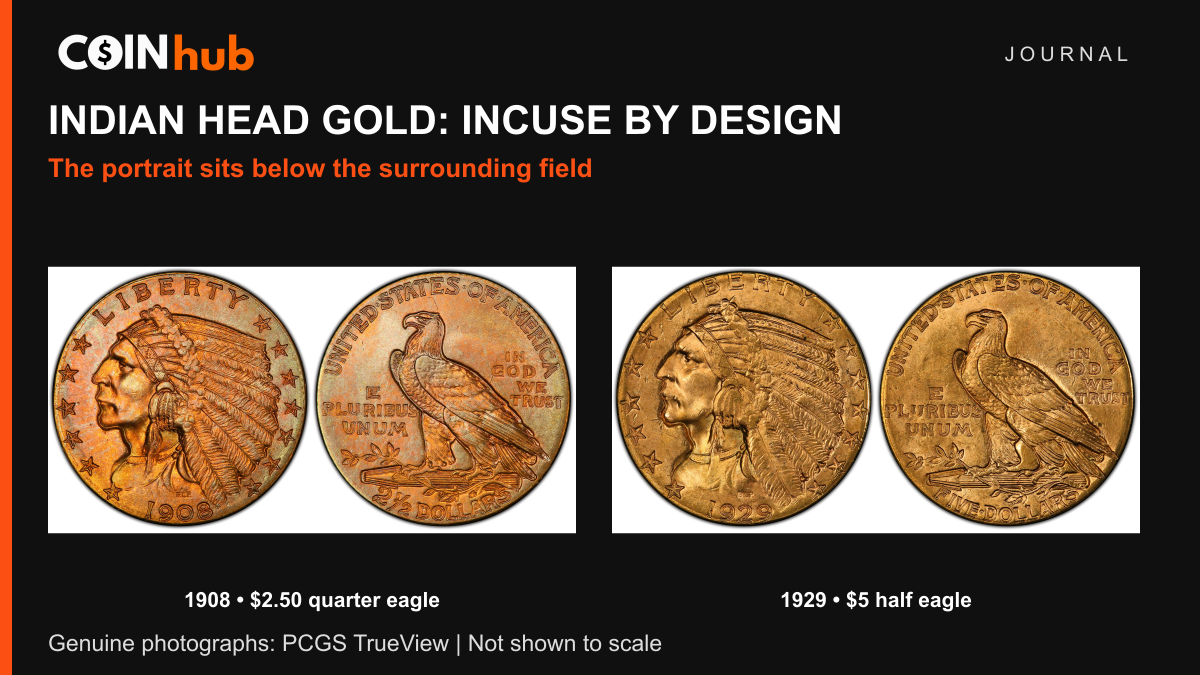
Why recessed details are normal on Pratt’s quarter and half eagles—and what collectors should examine next.
An Indian Head gold coin can look backwards to someone used to raised portraits. The surrounding surface sits above much of the design, while the portrait, eagle and lettering appear sunk into it. On the $2.50 quarter eagle and $5 half eagle, that is a normal feature of the type.
Start with the denomination, not the nickname
“Indian Head gold” is too broad a description for a careful comparison. Read the reverse denomination first. The quarter eagle is the $2.50 coin; the half eagle is the $5 coin. The PCGS explanation of incuse coinage identifies both as Pratt designs. Their similar appearance makes a denomination check especially useful when comparing online pictures.
The photographs above provide two clearly labeled examples: a 1908 quarter eagle and a 1929 half eagle. They are resized illustrations, not a measurement chart. Do not estimate a coin’s diameter by comparing the size of the two images in this article.
For a research note, use a complete description: denomination, date and any visible mintmark. That is much more useful than “old Indian gold coin.” If a seller’s title and the visible denomination disagree, resolve that mismatch before using the listing as a reference.
How to understand the recessed design
Think of the field as the broad background surface around the design. On these coins the design is set down into that surface instead of projecting above it in the usual way. This relationship is intentional and appears across the normal design. It is not an isolated dent that happened to land on the portrait.
Photographs can make this difficult to read. Before interpreting a dark outline as a groove, compare both sides with a clearly identified genuine reference. Look at the whole arrangement of portrait, lettering and eagle rather than one dramatic shadow. If you can inspect a coin in hand, view it from more than one lighting angle without touching the faces.
Why the fields matter when looking for wear
NGC’s quarter eagle grading guide explains that the type lacks a raised border. The exposed fields can show wear even when it is less evident on the design. Marks also require attention across the whole coin, rather than only at the familiar high points of a conventional raised portrait.
That is the grading trap: a sharp-looking recessed portrait does not automatically mean the coin is uncirculated. NGC also notes that the Denver mintmark is raised and can be rubbed or indistinct. Avoid the absolute claim that every detail on the coin is recessed.
For the quarter eagle specifically, NGC lists production in 1908–1915 and again in 1925–1929. Those dates describe the $2.50 series; do not copy them into a description of every Indian Head gold denomination.
A useful first observation is descriptive: “The fields show these marks; the portrait shows this detail.” A numerical grade is a separate judgment. Our weak strike versus wear guide explains why missing detail and wear should not be treated as interchangeable conclusions.
Normal design, damage or a strike error?
| What you notice | What to investigate | What it does not prove |
|---|---|---|
| The familiar portrait and eagle are recessed | Compare the complete design with the correct denomination’s genuine reference | An error premium or authenticity |
| A single unfamiliar depression interrupts the design | Record its shape and position; compare both faces and the edge | That every sunken mark came from the Mint |
| A second, reversed-looking impression appears | Compare the image orientation and surrounding strike evidence with a specialist reference | A brockage diagnosis from the word “incuse” alone |
| The portrait looks sharp but the fields look rubbed | Examine the entire surface and seek a grading opinion if needed | Mint State condition |
The word describes a surface relationship; it does not name the cause of every depression. Our brockage identification guide deals with the separate error question. Use that diagnostic process only when there is actual evidence of an abnormal impression, rather than because a normal Pratt design looks unfamiliar.
A design check is only the beginning of authentication
NGC’s 2021 examination of a counterfeit 1908 quarter eagle offers a useful example. That particular fake did not even reproduce the incuse design. NGC also found incorrect details and measured a weight of 3.18 grams, compared with the genuine quarter eagle’s 4.18-gram standard.
The lesson is limited but useful: an obviously wrong design can reveal a problem. The reverse conclusion does not follow. A piece with a recessed design is not automatically genuine, and passing one visual check does not settle the rest of the examination.
If the coin is in a grading-service holder, compare the certification record with the coin and label in front of you. If uncertainty remains, keep your description provisional and obtain an expert opinion. Do not polish the surfaces or try to make a weak feature easier to see before that review.
A practical record to make before asking for help
- Identity: record the visible date, denomination and mintmark without guessing an indistinct letter.
- Whole-coin views: photograph both sides, then add the edge and any area that prompted your question.
- Observation: describe where the surface looks recessed, raised, rubbed or interrupted.
- Comparison: save the exact reference you used, including which denomination it illustrates.
- Question: separate “Is this the normal design?” from “Is it genuine?” and “What grade is it?”
This gives a specialist something concrete to work with. It also prevents a striking photograph from answering a question it cannot settle. Incuse Indian Head gold is distinctive because of its intended design; understanding that design is the first step toward examining the individual coin carefully.
Sources checked September 22, 2026: PCGS on incuse design; NGC on quarter eagle grading and its documented 1908 counterfeit case. Historical grading fees and dated market-value comments in source material are not presented as current guidance. The PCGS TrueView photographs show genuine reference examples and do not authenticate another coin.