
Two clues to read together: mirrored and incuse
The distinction between raised and sunken detail is essential. “Backward lettering” describes orientation; “incuse” describes depth. Record both before deciding what happened. A bright patch, an indistinct portrait or doubled-looking letters without that context can lead the investigation in the wrong direction.
How one coin becomes a striking surface
Normally a struck coin leaves the press before the next planchet is struck. If it remains between a die and the next blank, its raised design can impress a reversed, recessed version into the new coin. NGC’s brockage reference explains the process and shows a rupee example with a reversed portrait.
The coin receiving that impression is the brockage. For the related coin that remains attached to a die and can become cup-shaped, see our capped die guide. Keep those objects separate when describing a collection or asking for an opinion.
A real partial brockage example
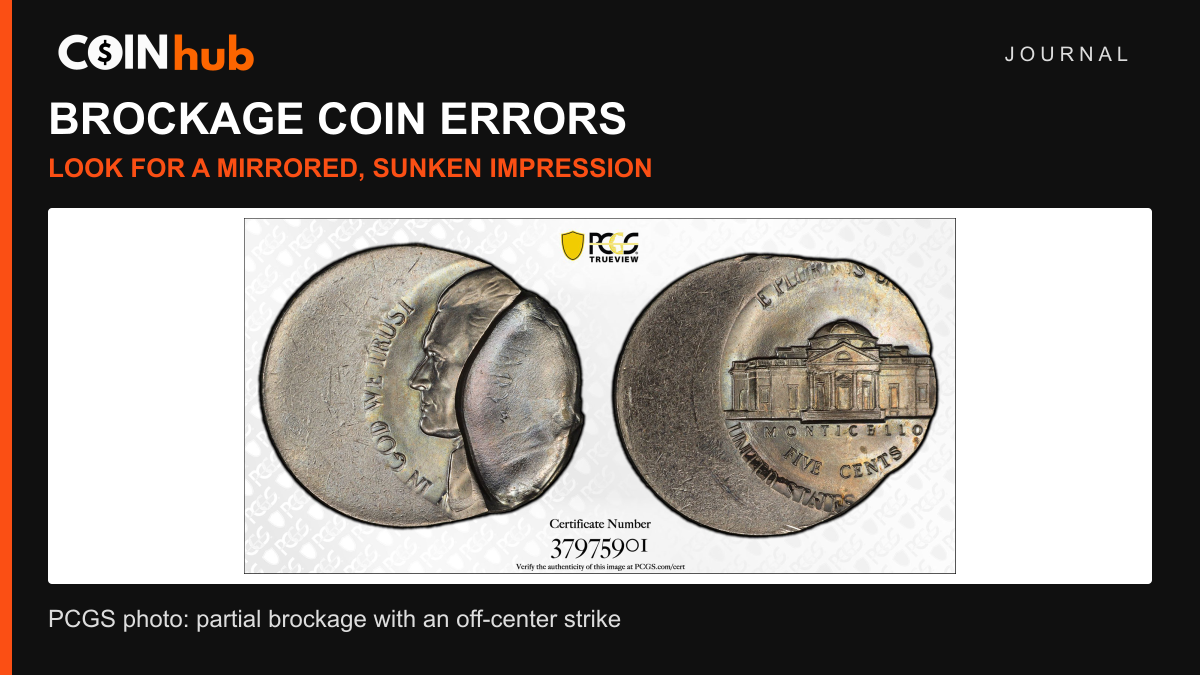
The PCGS photograph above shows a Jefferson nickel identified as a 198X-P, with 30% brockage on a 40% off-center strike, graded MS66. The incomplete date is preserved as the source describes it; this article does not guess the missing digit.
On the left-hand view, examine the recessed partial impression near the right side of the coin. Then compare the complete right-hand view. The surrounding unstruck area and displaced normal design are part of this particular coin’s combined error. It should not be treated as the appearance of every brockage.
PCGS’s source article supplies the original enlarged image and attribution. The two percentages describe different features. Do not add them together, or estimate the percentage on another coin by measuring the width of a cropped photograph.
Build an evidence set before naming the error
| Photograph or note | What it helps establish | What it cannot prove alone |
|---|---|---|
| Complete obverse and reverse | Which design is present and where the unusual impression lies | That the impression formed at the Mint |
| Close-up under changing light | Whether the suspect detail appears raised or recessed | The sequence of strikes from one shadow |
| Edge views around the coin | Shape, disturbances and context missing from face-on photos | An exact attribution without examining both faces |
| Clear source or holder record | Who supplied a description and which specimen it concerns | That an unrelated coin has the same error |
Keep the original images and label them by side. If you rotate a photo for comparison, note that rotation. Do not mirror the file: doing so changes one of the very features you are trying to investigate. Avoid artificial sharpening that invents edges around indistinct letters.
Why damage still needs to be considered
A manufacturing explanation must account for the whole coin. PCGS distinguishes mint errors from later damage and alteration. Reversed detail is therefore a useful observation, not permission to skip authentication. When asking for help, include any visible rim or edge disturbance instead of cropping it away.
Use a neutral description such as “recessed reversed lettering on this part of the obverse; both faces attached.” That gives an examiner evidence without forcing a conclusion. Do not strike, squeeze, scrape or clean another coin to create a comparison.
What to compare before discussing value
Identify the denomination, the actual error combination, its extent and the coin’s condition. Compare documented completed sales of reasonably similar pieces, keeping fees and sale dates visible. A full-face example from another country is not automatically a price guide for a partial U.S. nickel.
For the separate positioning error pictured here, see off-center strikes. When the claimed premium matters, obtain an expert error attribution before relying on a seller’s title.
Must a brockage cover the entire face?
No. The PCGS example illustrates a partial brockage. Record the actual affected area without assuming that incomplete coverage rules the error out.
Is every mirrored mark a brockage?
No. The proposed minting process must explain the physical evidence. Keep “possible brockage” provisional until the coin has been examined appropriately.
Sources and Google/Bing search results checked September 15, 2026. No current market price, rarity count or attribution of a reader’s coin is asserted.