
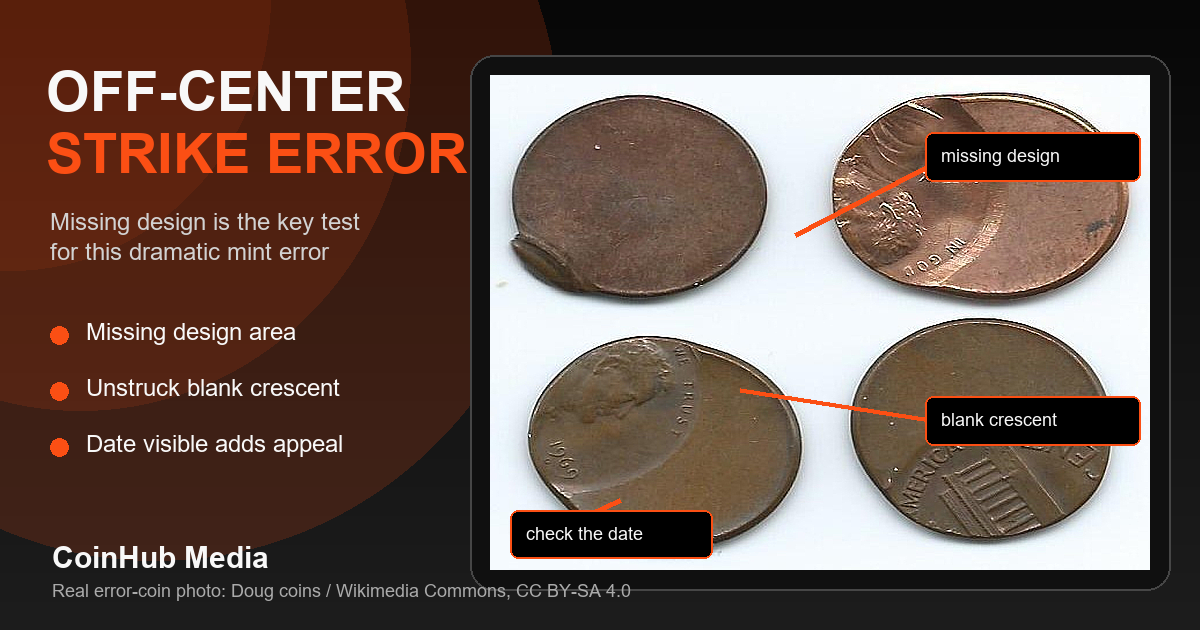
How To Check an Off-Center Coin
An off-center strike error happens when a coin planchet is not properly centered between the dies during striking, leaving part of the design missing and part of the blank planchet visible. The key test is simple: a true off-center strike must be missing part of the design.
A coin is off-center when the strike lands away from the center of the blank and cuts off part of the design. If the full design is present but shifted, widened, or poorly centered, it may be a misaligned die, broadstrike, or another issue instead.
Collectors usually prefer off-center coins with a clear date, strong eye appeal, and a dramatic percentage off center. Tiny shifts and damaged coins often bring little or no premium.
What Is an Off-Center Strike Error?
PCGS explains that an off-center error occurs when the planchet is not properly positioned between the dies and the coin is struck with part of the design missing. NGC describes the same basic problem: the planchet is not fully restricted by the collar and part of it falls outside the die area during the strike.
That missing-design requirement matters. A coin can look odd, wide, or shifted without being a true off-center strike. For collectors, the practical question is whether the coin was actually struck partly outside the die area or whether it is a different mint error or post-mint damage.
Start with these diagnostics:
- Look for missing design: part of the date, motto, rim, portrait, or reverse should be cut off by the edge of the struck area.
- Find the blank crescent: true off-center strikes often show an unstruck blank area on one side of the coin.
- Check both sides: both obverse and reverse should reflect the same off-center strike direction, not just one shifted side.
- Estimate the percentage: collectors often describe examples as 5%, 10%, 25%, 50%, or more off center.
- Protect the date: a visible date and mint mark can make the coin easier to identify and often more collectible.
CoinHub tip: A centered coin with a slightly uneven rim is usually not a major off-center error. Look for missing design and a clear unstruck area before trusting a big online asking price.
Off-Center Strike vs Broadstrike, Misaligned Die, and Damage
| What You See | More Like Off-Center Strike | More Like Something Else |
|---|---|---|
| Part of the design is missing | Yes, the design is cut off because the strike landed away from center | A full design that is just wider may point to broadstrike |
| Only one side looks shifted | Less likely if the reverse is normal | Possible misaligned die, especially when one side is centered and the other is not |
| Coin is larger than normal | Can happen with some related strike errors, but missing design still matters | Broadstrike if full design remains and collar was not restraining the coin |
| Edge looks crushed or scraped | Not enough by itself | Dryer coin, spooned rim, vise damage, or other post-mint damage |
| Value potential | Better when dramatic, high-grade, identifiable, and dated | Minor shifts, damage, and no-date examples usually need caution |
What Percentage Off Center Is Valuable?
There is no single cutoff, but eye appeal matters. A 5% off-center strike may be interesting if sharp and uncirculated, but it is usually less dramatic than a 25% or 50% example. Many collectors like coins where the date is still visible because the coin can be identified without guesswork.
No-date off-center coins can still be collectible, especially when dramatic or certified, but they usually need stronger visual impact. A small off-center shift on a heavily worn common coin may not justify grading fees.
Common Coins to Check
Off-center strikes can appear on cents, nickels, dimes, quarters, halves, dollars, and foreign coins. Cents are common enough that collectors see many examples, while dramatic off-center errors on larger denominations can draw more attention. Modern coins with strong quality control may be harder to find in circulation, but they still appear in collections, rolls, and error-coin inventories.
When checking pocket change, do not confuse an off-center strike with normal rim variation. Many coins have slightly uneven rims from wear, strike pressure, or minor alignment issues. The off-center premium comes from missing design, not from a rim that simply looks a little thick on one side.
How To Photograph One for an Opinion
- Take a straight-on photo of both sides.
- Include the full coin edge in the frame so the unstruck area is visible.
- Photograph the date and mint mark if they are present.
- Place it beside a normal coin of the same denomination for size comparison.
- Do not clean, bend, flatten, or try to improve the coin.
For related diagnostics, compare CoinHub's clipped planchet error guide, grease-filled die guide, penny error list, quarter error list, and error or damage checker.
Off-Center Strike Error FAQ
Is an off-center strike a real mint error?
Yes, when the coin was struck while the planchet was not properly centered between the dies and part of the design is missing.
Is a coin with an uneven rim off center?
Not automatically. A true off-center strike should have missing design and usually shows an unstruck blank area.
Is off-center the same as broadstrike?
No. A broadstrike is struck outside the collar but normally retains the full design. An off-center strike is missing part of the design.
Should I get an off-center coin graded?
Consider grading when the coin is dramatic, higher grade, dated, valuable, or hard to authenticate. Minor examples may be worth less than the certification cost.
Bottom Line
A real off-center strike error should show missing design, an unstruck area, and matching evidence on both sides. The best examples are easy to see, clearly dated, and dramatic enough that collectors understand the error without guessing.