
Start with the alloy, then examine the design
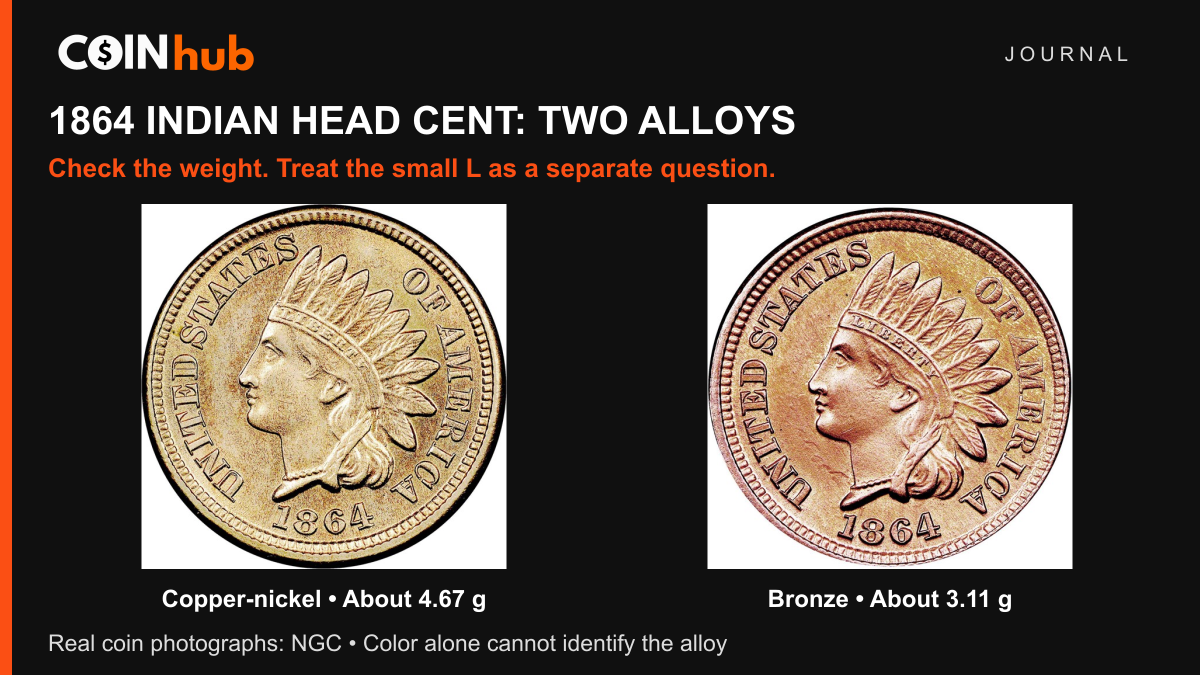
An 1864 Indian Head cent can be copper-nickel or bronze. The date alone does not settle the question, and neither does the absence of the small L on the ribbon. The practical starting point is a reliable weight measurement of a raw coin, followed by a design check and an honest assessment of the coin's condition.
Quick answer: The copper-nickel type has a nominal weight of about 4.67 grams; the bronze type is about 3.11 grams. Both have a nominal diameter of 19 millimeters. An L, when correctly identified, belongs to a bronze design subtype. A missing L does not prove copper-nickel.
Why are there two metals in one year?
The cent changed during the Civil War. NGC's Civil War coin history describes the April 22, 1864 legislation that introduced the lighter bronze cent. Collectors therefore encounter both the earlier copper-nickel issue and bronze cents dated 1864. This is a regular transition in the series; finding either normal alloy does not by itself establish a wrong-planchet error.
Keeping that history in mind prevents a common catalog mistake: placing every coin of one date into the same type. An album, inventory or sales listing needs more information than “1864 Indian Head penny.” Record the alloy as its own field, and leave it unconfirmed until the evidence supports it.
1864 copper-nickel vs. bronze at a glance
| Check | Copper-nickel | Bronze |
|---|---|---|
| Nominal weight | 72 grains, about 4.67 g | 48 grains, about 3.11 g |
| Composition | 88% copper, 12% nickel | 95% copper; remaining 5% tin and zinc |
| Nominal diameter | 19 mm | 19 mm |
| Does an absent L identify it? | No | No; bronze cents also exist without L |
The table summarizes NGC's study of the three 1864 cent varieties. Published decimal weights can differ slightly through rounding: PCGS CoinFacts lists 4.70 grams for copper-nickel. That is not a third alloy or a separate variety. The substantial difference between the two standards is the useful comparison.
Take a weight you can actually trust
Use a stable scale on a level surface, confirm that it reads grams and check it with an appropriate calibration weight. Remove unrelated packaging from the measurement. A coin weighed in a flip, capsule or slab cannot be compared directly with a bare-coin standard. Do not break a certified holder simply to perform this check; read the attribution and verify the certification instead.
For a raw example, handle it by the edge over a soft, clean surface. Record the reading, lift the coin and repeat. If the display jumps, drifts or never settles, fix the measurement problem before drawing a conclusion. CoinHub's guide to weighing coins explains why a useful screening measurement still falls short of authentication.
The figures above are nominal standards, not a promise that every circulated piece will read exactly those numbers. Wear, corrosion, deposits, damage and scale error can complicate an individual result. A surprising reading is a reason to investigate. It is not enough evidence to label the coin an error, counterfeit or rare composition.
What does the L mean?
NGC describes an initial bronze design without the L and a later bronze subtype with Longacre's small initial on the ribbon. The later design also has a more pointed bust tip. These are design features to compare after identifying the general type, not a shortcut that makes every no-L coin copper-nickel.
Examine the ribbon with magnification and diffuse light. On a worn or damaged coin, a tiny feature may be too weak to call confidently. Write “L attribution unresolved” rather than treating “I cannot see it” as proof that it was never present. A good comparison image should show the same area at sufficient detail; a dark listing thumbnail is poor evidence.
Why the photographs are not a color test
The two real NGC photographs above help illustrate the types, but your coin does not need to match their exact shades. Surface changes, lighting, camera processing and previous treatment can alter the appearance. Avoid cleaning, scratching or applying chemicals to expose a supposedly diagnostic color. Such a test can permanently damage the object you are trying to identify.
Make a short record instead: date, bare-coin weight, scale check, clear photographs of both sides, any visible damage, and what you can actually see on the ribbon. Separate each observation from your tentative conclusion. If those observations disagree, have the coin examined before buying, selling or describing it as an unusual issue.
Identify the type before estimating value
Alloy identification is only the first part of a value assessment. Condition, originality, damage and a defensible subtype attribution still matter. Do not transfer the price of a high-grade photographed example to a worn coin merely because the date and metal match.
Once the type is established, use the broader Indian Head penny value guide for series context. Keep this narrower rule with your notes: weight helps separate the alloys; design details address the subtype; neither step alone authenticates the coin or sets its price.
Sources checked September 19, 2026. Specifications describe normal issues, not a diagnostic tolerance for an individual coin. Photographs courtesy of NGC.