
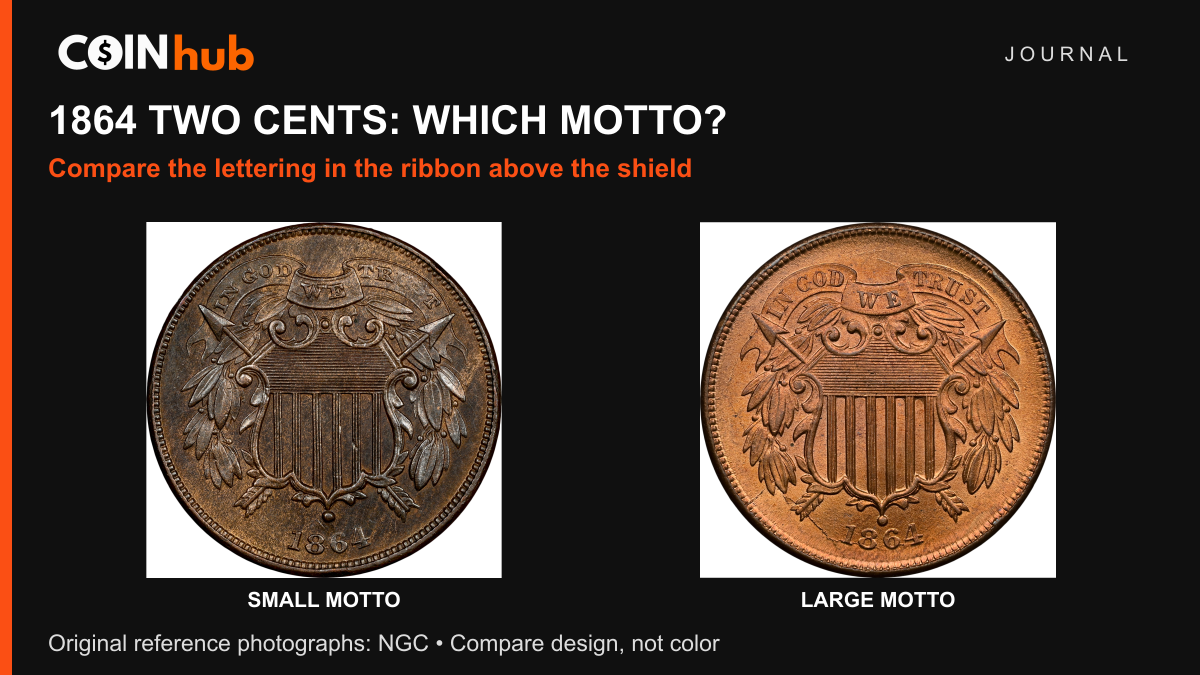
Start with the ribbon, not a price listing
A two-cent piece is an unusual enough find to encourage a fast search for its value. For an 1864 example, pause at attribution first. A description written on an old envelope or copied into a sales listing can be wrong, and the most expensive search result may concern a different variety or condition.
Put the coin in the correct orientation
Find the side with the shield, crossed arrows and date. That is the obverse. The motto curves through the ribbon above the shield. The reverse, with the large numeral 2, confirms the denomination but is not the starting point for this comparison.
Read the date on the coin itself. This guide concerns the two motto styles of 1864. The broader two-cent piece history and value guide covers the series, including other dates that deserve separate attention.
Compare letter proportions at a similar viewing size
The complete obverses above are NGC's identified reference examples. In the Small Motto image, the lettering is shorter and more compact. In the Large Motto image, the letters are taller and more elongated. Look across GOD and TRUST rather than relying on a single worn stroke.
The NGC Small Motto description identifies letter height as the most conspicuous difference. Open the reference photographs at a useful size and compare the whole ribbon. The differently colored surfaces in these two examples are incidental; brown or reddish color is not the motto diagnostic.
| What you compare | Useful evidence | Common trap |
|---|---|---|
| Motto lettering | Height, proportions and arrangement across the ribbon | Calling faint lettering Small Motto |
| Complete obverse | Date, orientation and surrounding design | Using a tiny crop with no context |
| Surface color | A separate observation about the specimen | Treating copper color as variety proof |
| Holder or listing | An attribution to verify against the actual coin | Assuming any typed description is correct |
Why both varieties belong in an 1864 comparison
PCGS explains that the Large Motto superseded the Small Motto and continued through the later years of the type. Large Motto is the more common 1864 version. That historical sequence explains the names; it does not authenticate an individual specimen.
NGC also distinguishes the Small Motto circulation issue from references that describe it only as a prototype or pattern. Keep a normal motto attribution separate from claims about proof manufacture, doubled dies or repunched dates. Those are additional questions requiring their own evidence.
What to do when wear obscures the answer
Do not use weak lettering as a shortcut. If the strokes or ribbon are too worn, corroded or poorly lit to compare, the appropriate record is “motto variety uncertain.” An honest unresolved attribution is more useful than a confident guess that gets copied into future collection records.
Take a square-on photograph of the full obverse and a second close view that includes the entire motto ribbon. Keep the unedited originals, then photograph the reverse and edge. Try soft light from another direction if glare hides detail. Our coin photography guide explains how to improve visibility without cleaning.
Send those images to a knowledgeable dealer or attribution specialist with the date and your question. Avoid polishing, scraping or tracing the letters to make them more obvious. A photograph can help identify the variety, but uncertain authenticity or altered surfaces may require examination in hand.
Leave the price comparison until afterward
Once the identification is supported, compare the same variety and comparable condition. A scarce-variety label is not a grade, and a high asking price is not a completed sale. Keep the reference used and any remaining uncertainty with the collection entry so the reasoning survives beyond today's search.
Sources and original reference images checked September 22, 2026. This is a variety-identification guide, not an appraisal. Images are enlarged independently and should not be used to measure diameter.